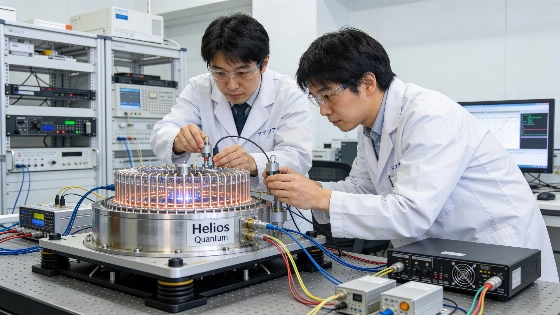
Mitsui & Co. and Mitsubishi Electric have published experimental benchmarks of the Quantum Fourier Transform on Quantinuum's 98-qubit Helios trapped-ion processor, testing both approximate and error-corrected logical circuits
Japanese industrial groups Mitsui & Co. and Mitsubishi Electric have released new experimental benchmarks evaluating the Quantum Fourier Transform (QFT) on Quantinuum's Helios trapped-ion quantum processor. Their technical report details the execution of both approximate QFT circuits using physical qubits and logical QFT circuits protected by quantum error correction, providing a direct look at the current capabilities and limitations of large-scale trapped-ion hardware.
Physical Qubit QFT Scaling
The team implemented approximate QFT circuits on up to all 98 physical qubits available in the Helios processor. By truncating small-angle phase rotations (with a threshold parameter degs=5), they maintained a measurable probability of preparing the intended quantum state, reporting a target-state probability of 0.143 at the full 98-qubit scale. To address errors from environmental noise and hardware imperfections, the researchers applied leakage-detection post-selection, discarding runs where errors were detected. This approach improved the reliability of the measured output but reduced the number of accepted experimental shots, highlighting the trade-off between error mitigation and data yield in current hardware.
Logical Qubits and Error Correction
To explore error correction, the experimenters encoded logical qubits using the 7-qubit Steane code ([[7,1,3]]), constructing up to 12 logical qubits across 84 physical qubits. They compared two strategies: error-detection post-selection and active error correction. Error detection produced higher logical target-state probabilities-0.934 for 4 logical qubits and 0.774 for 8 logical qubits-but at the cost of sharply reduced acceptance rates, with only 31% of shots accepted at 8 logical qubits and 8% at 12 logical qubits. This demonstrates that while error detection can improve logical fidelity, it does so by discarding a significant fraction of experimental data, limiting throughput and scalability.
Logical Gate Implementation and Overheads
In a focused test of logical gate construction, the team compared two approaches for implementing the T-gate-a key non-Clifford operation-within a two-logical-qubit QFT circuit. They contrasted direct analog rotations, which are not fault tolerant, with a code-switching state-injection method that uses 30 physical qubits distributed across quantum Reed-Muller and Steane code blocks. Under current noise conditions, direct analog rotation yielded higher output fidelity, while the fault-tolerant approach introduced substantial overhead and reduced performance. This result underscores the significant resource and fidelity costs associated with full fault-tolerant gate construction on present-day hardware.
Software and Cross-Layer Design
The research team developed custom quantum error correction software using Quantinuum's Guppy(R) hybrid programming language and pytket(R) compilation tools. Their benchmarks evaluated the interplay between physical gate noise, code overhead, and post-selection acceptance rates, providing insight into the engineering trade-offs that define near-term quantum computing. These findings complement recent efforts to integrate the Helios processor into cloud infrastructure, as seen in the deployment partnership with Oracle described in this related report.
Physical and logical qubits play distinct roles in quantum computing. A physical qubit is a single controllable quantum system, such as an ion or superconducting circuit, that can be directly manipulated and measured. Logical qubits, by contrast, encode information across multiple physical qubits using quantum error-correcting codes. This encoding allows detection or correction of errors arising from noise and imperfections, but it requires significant hardware overhead and complex control. The transition from physical to logical qubits is essential for building scalable, fault-tolerant quantum computers, but current experiments show that error correction introduces substantial resource and fidelity costs. Understanding these trade-offs is central to evaluating the practical progress of quantum hardware toward useful computation.