Quantinuum and Oracle have announced a partnership to deploy the 98-qubit Helios trapped-ion quantum processor inside a U.S.-based Oracle Cloud Infrastructure AI data center, enabling managed hybrid quantum-AI workloads for enterprise and research users
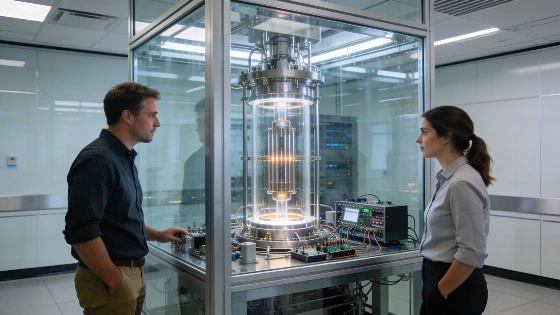
Quantinuum and Oracle have announced a multi-year partnership to deploy Quantinuum's Helios quantum processor within a U.S.-based Oracle Cloud Infrastructure (OCI) AI data center. The integration will make the 98-qubit trapped-ion system available as a managed quantum service, directly connected to OCI's high-performance computing and NVIDIA GPU clusters. This arrangement is intended to support hybrid quantum-classical workflows for enterprise, research, and academic users, with a focus on applications in drug discovery, materials science, financial modeling, and large-scale optimization.
Trapped-Ion Hardware and Performance
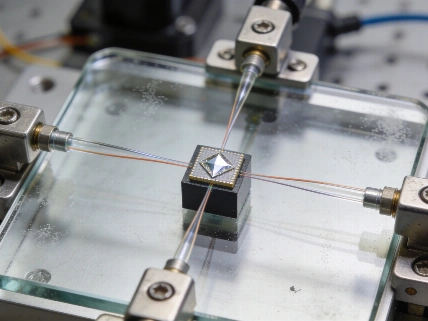
The Helios processor is Quantinuum's third-generation trapped-ion quantum system, employing a Quantum Charge-Coupled Device (QCCD) architecture. The device uses barium-137 (137Ba+) hyperfine qubits, which offer all-to-all connectivity between qubits-a feature that can simplify circuit design and reduce the number of required operations for certain algorithms. According to Quantinuum, the system achieves an average two-qubit gate fidelity of 99.921%, and has demonstrated circuits involving up to 48 logical qubits in experimental settings. These figures are developer-reported and have not yet been independently benchmarked in the context of the new cloud deployment.
Energy Efficiency and Cloud Integration
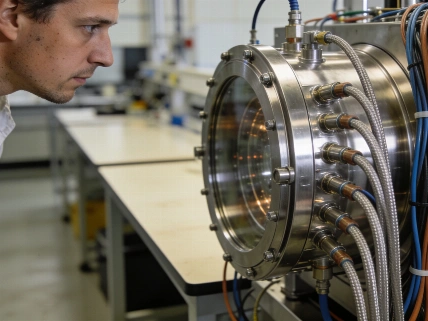
One notable engineering aspect of the Helios system is its relatively low power consumption. Quantinuum estimates the processor's power draw at approximately 60 kilowatts, excluding external HVAC requirements. This is less than one percent of the energy consumed by leading supercomputers, though the comparison does not account for the total system overhead or the energy required for error correction at scale. By co-locating the quantum processor within the OCI data center, the service is designed to allow users to orchestrate hybrid quantum-classical workflows without the need for specialized on-premises hardware or local facility management. The integration leverages OCI's compute, storage, networking, and security frameworks, aiming to streamline access for developers and researchers.
Service Preview and Technical Limitations
Oracle plans to offer a preview of the managed quantum service in the coming months, combining Quantinuum's development environment with open-source hybrid programming frameworks. The deployment represents Quantinuum's first on-premises integration within a major hyperscale public cloud provider's AI data center. However, the announcement does not specify the range of quantum algorithms or workloads that will be supported at launch, nor does it address the practical limits imposed by noise, calibration drift, or error rates in large-scale circuits. The system's logical-qubit demonstrations remain at the proof-of-principle stage, and the transition from laboratory benchmarks to reliable, reproducible cloud operation will require further engineering validation.
Context in Quantum Cloud Services
The integration of trapped-ion quantum hardware into public cloud infrastructure reflects a broader trend toward hybrid quantum-classical computing environments. While superconducting and photonic quantum processors have previously been made available through cloud platforms, the direct deployment of a trapped-ion system within a hyperscale data center is less common. For comparison, recent developments in quantum hardware security, such as the ISO/IEC 23837 evaluation of entanglement-based QKD devices, have highlighted the importance of independent benchmarking and side-channel analysis in quantum technology deployments. Readers interested in the technical challenges of quantum hardware certification may find further context in the report on hardware security evaluation of entanglement-based QKD systems.
Understanding the distinction between physical and logical qubits is essential for interpreting quantum processor specifications. A physical qubit is a single controllable quantum system, such as a trapped ion or superconducting circuit, that can be manipulated and measured. Logical qubits, by contrast, encode information across multiple physical qubits using error-correcting codes to detect and correct errors. The number of logical qubits that can be reliably operated depends on the underlying physical error rates, the code used, and the stability of the hardware. High gate fidelity and all-to-all connectivity can reduce the overhead required for error correction, but achieving practical fault tolerance remains a major engineering challenge. As quantum processors move from laboratory demonstration to cloud deployment, the reproducibility of logical-qubit performance and the management of noise and drift will be critical for delivering reliable quantum computation at scale.