

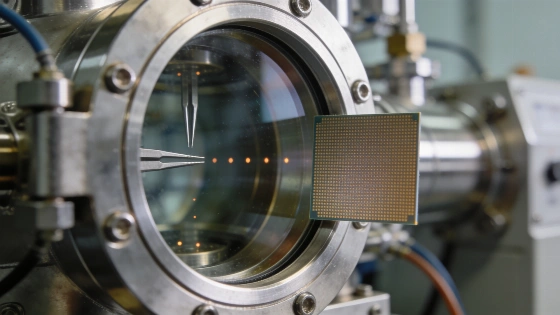
A metasurface-assisted array held an average of 11,022 atoms, while a separate Chinese team reported two-qubit gate fidelity of 99.84%. An arXiv review says turning such hardware results into sustained logical computation remains the harder test
An optical grid with 18,225 sites held an average of 11,022 neutral atoms in a Tsinghua University experiment, using a flat metasurface mounted outside the vacuum chamber. The result sits alongside high gate-fidelity and fast-rearrangement demonstrations in a broad review of neutral-atom research. The review's harder question is whether those physical capabilities can support repeated quantum error correction and useful logical operations.
Array scale and control
The arXiv review, arXiv:2608.05010, surveys work from 2000 through mid-2026, including research by QuEra, Atom Computing and Pasqal. It gives particular attention to China's academic groups and newer hardware companies. Its findings are a review of reported results, rather than an independent test of the systems it describes.
At the University of Science and Technology of China (USTC), Pan Jianwei's group used a high-speed spatial light modulator controlled by an artificial-intelligence method to rearrange atoms in constant time as array size increased. In August 2025, the team assembled defect-free two- and three-dimensional arrays of 2,024 atoms in 60 milliseconds. The reported fidelities were 99.84% for two-qubit gates, 99.97% for single-qubit gates and 99.92% for readout. These are distinct physical-layer benchmarks: they describe individual operations and measurements, not the combined error rate of a long computation or repeated correction cycles. In 2026, the group also demonstrated non-destructive auxiliary readouts during a circuit and feedback control.
The Tsinghua setup addressed limits in conventional microscope objectives by placing a 2-centimeter metasurface chip outside the chamber. The group paired the array with its "Zhui Feng" graph neural network rearrangement algorithm and reported sorting times below 20 milliseconds for 10,000-atom-scale arrays. The reported average occupancy of 11,022 atoms across 18,225 sites and the sorting-time result describe array preparation and control; neither alone measures the total error of a computation involving repeated gates, measurements, decoding and correction.
Neutral-atom processors use optical tweezers to arrange and move atoms, allowing their geometry and interactions to be reconfigured rather than relying solely on fixed physical connections. Engineering work on fault-tolerant architectures also describes dynamically controlled optical channels, including spatial light modulators and acousto-optic deflectors, as routes to nonlocal operations. Proposed photonic links could connect separate arrays, extending that flexibility across processors.
From labs to systems
Other university efforts pursue different hardware problems. Fudan University has developed atom-transport approaches for quantum annealing, reporting loss rates below 1% and hardware at the 1,000-atom scale. In Wuhan, the New idea Academy for Precision Measurement Science and Technology (APM, CAS) has worked on entangling gates between 87Rb and 85Rb atoms, as well as a compact fiber-array design for addressing individual atoms.
The review describes Zhongke Kuyuan's Hanyuan 1 platforms as delivered experimental systems in early 2025. It says the company launched Hanyuan 2 in 2026, with more than 500 optical tweezers in a dual-cavity, dual-basic design. Reported specifications include coherence time above 300 milliseconds, single-qubit fidelity above 99.9% and two-qubit fidelity above 99%. The company says the room-temperature system fits standard server racks, draws under 7 kilowatts and uses components with an 80% or higher domestic localization rate. These are reported product specifications; they do not establish sustained performance across workloads or independent verification.
Other ventures are pursuing distinct routes. Taiyi Liangsheng, founded in early 2026, is developing ytterbium-171 platforms based on nuclear-spin clock states and telecom-band optical interconnects; the review reports more than ¥400 million in Angel and Pre-A financing. Liangyi Wanxiang has reported a platform with more than 500 atoms and two-qubit gate fidelities above 99.5%, while targeting a 1,000-qubit fault-tolerant platform by 2027. That target remains a plan. Zhongqi Wuliang and Xuanxiang Technology have also validated a million-tweezer metasurface optical chip, information from the review; a chip-scale array does not establish that each trap can be controlled and read out at useful fidelity.
The logical-qubit hurdle
The survey's strategic assessment separates physical performance from error-corrected computation. It says Chinese teams have closed much of the gap in array scale, rearrangement speed and raw gate metrics, while leading U.S. programs have moved further in system-level error correction. The review cites transversal logical gates across 48 logical qubits from QuEra and Harvard, multi-round syndrome extraction on toric codes by Atom Computing, and precompiled logical Shor's algorithm implementations by Infleqtion. It places Chinese work at an earlier stage, advancing from mid-circuit measurement primitives toward active multi-round correction cycles.
The field's published benchmarks also include logical-processor work with reconfigurable atom arrays. In 2024, David Bluvstein and collaborators published Logical quantum processor based on reconfigurable atom arrays in Nature, volume 626, pages 58-65. That year, Qian Xu and collaborators published Constant-overhead fault-tolerant quantum computation with reconfigurable atom arrays in Nature Physics, volume 20, pages 1084-1090. The Nature paper is part of a shift in evaluation toward logical operations, repeated correction, connectivity and resource overhead, alongside the physical-qubit count.
That distinction matters because high physical fidelity does not automatically produce a reliable logical qubit. Error correction requires repeated measurements that reveal error syndromes without directly measuring the encoded information, plus a decoder that can identify likely errors in time to guide correction. A surface-code decoding analysis illustrates how decoder choices can affect the protection a code provides. The review identifies continuous, fault-tolerant logical computation as the basic remaining objective for China's roadmap.
Physical qubits are individual atoms used to store and manipulate quantum states; a logical qubit encodes information across multiple physical qubits so errors can be detected and corrected. A gate-fidelity figure describes the quality of an operation under a particular measurement and benchmark, not the accuracy of an entire algorithm. Demonstrating a logical qubit so requires evidence that error correction improves performance across repeated cycles, with the overhead and control demands included.







