Qilimanjaro Quantum Tech has released QiliSDK v0.3.0, introducing GPU-accelerated analog quantum simulation, a new stabilizer state simulator, and expanded classical optimization tools for hybrid quantum-classical workflows
GPU acceleration has arrived for analog quantum simulation in the latest release of QiliSDK, the open-source framework from Barcelona-based Qilimanjaro Quantum Tech. With version 0.3.0, the company is pushing its hybrid digital-analog control stack further into territory where classical simulation and quantum hardware must be tightly integrated to model complex quantum systems and optimization problems.
Hybrid simulation and control
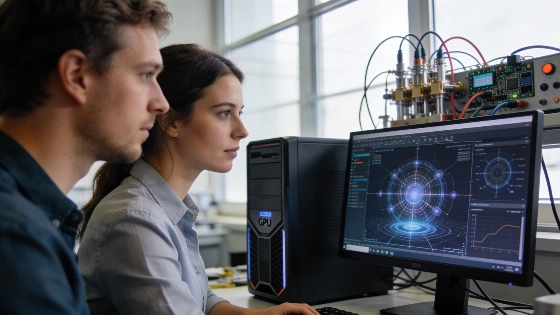
QiliSDK v0.3.0 is designed to bridge digital circuit-based algorithms, analog time evolution, and hybrid variational workflows within a single Python interface. The update introduces GPU-accelerated variational annealing, allowing users to run larger or more complex analog schedules on classical hardware before targeting quantum processors. The new release also brings full compatibility with Python 3.14, an upgraded tensor network engine (QTensor), and a dedicated module for classical solvers, including a high-performance simulated annealing algorithm.
For analog schedule modeling, QiliSDK now supports time-dependent noise profiles and a unified Expression class that merges symbolic terms and variables. Operator drawing tools have been simplified, making it easier to construct and visualize Hamiltonians and control sequences. These features are intended to streamline the workflow for researchers developing and benchmarking hybrid quantum-classical algorithms.
QiliSim engine and technical benchmarks
Under the hood, the QiliSim C++ backend has been enhanced with a stabilizer state simulator, enabling efficient verification of Clifford circuits-a class of quantum circuits that can be simulated classically but are essential for error correction and benchmarking. GPU acceleration is now available for complex variational schedules, and the engine supports multi-GPU and CUDA-Q backend interoperability. The release also includes an expanded unit and integration test suite for the C++ core, aiming to improve reliability and reproducibility.
QiliSDK operates as a backend-agnostic control layer, capable of targeting CPU simulators, GPU clusters, and Qilimanjaro's own cloud-accessible analog quantum processing units (QPUs). The open-source package is distributed under the Apache-2.0 license and can be installed via PyPI or GitHub. According to the developer, the new simulated annealing solver and QTensor engine optimizations are intended to improve performance for hybrid workflows, but independent benchmarking against leading classical and quantum simulation tools remains limited.
Classical and quantum integration
Hybrid quantum-classical workflows depend on the ability to model noise, optimize control schedules, and verify results across both classical and quantum backends. QiliSDK's new time-dependent noise modeling and unified symbolic expression architecture are designed to make it easier to prototype algorithms that combine analog quantum evolution with classical optimization. The stabilizer simulator module targets verification tasks that are critical for error correction research, while GPU acceleration aims to reduce the computational bottleneck in variational algorithms.
While Qilimanjaro Quantum Tech positions its platform as a flexible toolkit for hybrid quantum computing, the practical impact will depend on how well these features perform in real research settings. Previous efforts to integrate quantum processors with classical high-performance computing infrastructure, such as those reported earlier for trapped-ion systems, have shown that seamless software and hardware integration is a persistent engineering challenge.
Open-source access and reproducibility
QiliSDK v0.3.0 is available as an open-source package, with documentation and release notes accessible through the project's GitHub repository. The framework's backend-agnostic design allows researchers to test algorithms on local simulators, GPU clusters, or Qilimanjaro's cloud QPUs without rewriting code for each target. However, as with most quantum software platforms, the gap between simulated performance and hardware execution remains significant, especially for analog quantum devices where calibration, noise, and device variability can dominate outcomes.
For users interested in the technical details, the release notes specify support for Python 3.14, multi-GPU execution, and a new classical simulated annealing solver. The stabilizer simulator is intended for Clifford circuit verification, but the documentation does not provide independent performance benchmarks or comparisons with established simulation libraries. As the field moves toward more complex hybrid algorithms, transparent reporting of benchmark conditions and reproducibility will be essential for evaluating practical utility.
Analog quantum simulation aims to model the time evolution of quantum systems by directly controlling the Hamiltonian governing the device, rather than decomposing the computation into discrete gate operations. This approach can be more efficient for certain classes of problems, such as quantum chemistry or optimization, but it also introduces new challenges in calibration, noise modeling, and verification. Hybrid workflows combine quantum and classical resources, often using classical optimization to tune quantum control parameters. The effectiveness of these methods depends on the accuracy of the simulation, the fidelity of the hardware, and the ability to benchmark results against classical algorithms. As quantum software platforms evolve, the distinction between simulation and experiment will remain central to claims of quantum advantage and practical utility.