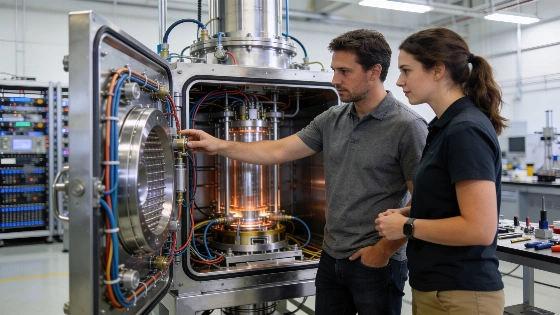
Zero Point Cryogenics and Ability Engineering Technology are establishing new operations at the Illinois Quantum and Microelectronics Park, aiming to localize cryogenic and precision engineering supply chains for quantum hardware development in the Midwest
The Illinois Quantum and Microelectronics Park (IQMP) in Chicago has secured its first two physical supply-chain tenants, marking a concrete step toward building a regional quantum hardware ecosystem. Edmonton-based Zero Point Cryogenics, a manufacturer of dilution refrigerators, and Illinois-based Ability Engineering Technology, a precision engineering firm, will both establish operational presences at the IQMP FaQtory. This facility is designed to co-locate component suppliers, fabricators, and hardware developers alongside anchor quantum computing companies, with the goal of reducing hardware iteration times and dependence on overseas components.
Zero Point Cryogenics: U.S. Expansion
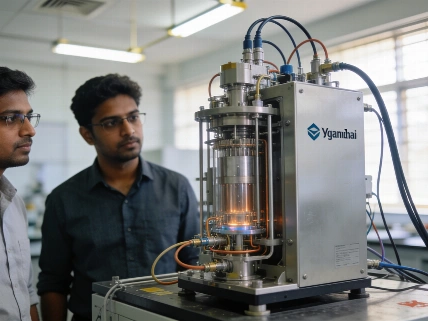
Zero Point Cryogenics (ZPC), founded in 2017 as a spinout from low-temperature physics research at the University of Alberta, specializes in custom "cryogen-free" dilution refrigerators. These systems are essential for operating superconducting and spin-qubit quantum processors, maintaining device temperatures near absolute zero to suppress thermal noise and decoherence. ZPC's new Chicago facility, supported by the Manufacturing Illinois Chips for Real Opportunity (MICRO) Act, will serve as its first U.S. hub for research and development, sales, installation, and field service. The company reports that the site will create more than 20 specialized engineering jobs in Illinois and provide direct technical support to quantum hardware developers and research laboratories across North America. While primary manufacturing remains in Alberta, the Chicago location will function as ZPC's main U.S. service center, enabling faster maintenance and integration for quantum computing projects.
Ability Engineering Technology: Modernization and Co-Location
Ability Engineering Technology (AET), headquartered in South Holland, Illinois since 1947, is expanding its advanced manufacturing operations through a two-site investment. Supported by the state's Economic Development for a Growing Economy (EDGE) program, AET will open a new R&D satellite office at the IQMP FaQtory focused on rapid prototyping, small-scale fabrication, equipment modification, and workforce training. In parallel, the company is upgrading its existing 35,000-square-foot South Holland plant with new handling cranes, workflow machinery, and structural improvements. Under the EDGE agreement, AET has committed to investing at least $1.8 million, creating five new full-time positions, and retaining 23 existing manufacturing jobs. The co-location of AET's engineering capabilities with quantum hardware developers is intended to accelerate the development and modification of cryogenic and vacuum components required for quantum processors.
Infrastructure and Policy Context
The dual tenant announcements were made by Illinois Governor JB Pritzker during the Global Quantum Forum in Chicago. The IQMP FaQtory is supported by $500 million in state funding for the park and $200 million for the Chicago Quantum Exchange, alongside federal investment from the U.S. Economic Development Administration's Tech Hubs initiative. By attracting both a dilution refrigerator supplier and a precision vacuum engineering firm, the park aims to establish a localized supply chain for quantum hardware manufacturing in the Midwest. This approach is designed to reduce lead times, improve hardware iteration cycles, and decrease reliance on international suppliers for critical components. The presence of anchor quantum computing firms-including IBM, PsiQuantum, Infleqtion, Pasqal, Diraq, and Quantum Machines-at the IQMP FaQtory is expected to facilitate direct collaboration between hardware developers and their supply-chain partners.
Recent developments in the quantum hardware sector have highlighted the importance of robust supply chains and independent verification of component performance. For example, PsiQuantum's photonic quantum hardware has recently come under expanded DARPA scrutiny to ensure reliability and transparency in manufacturing and cryogenic infrastructure. The addition of ZPC and AET to the IQMP FaQtory reflects a broader trend toward regionalizing quantum supply chains and integrating engineering support directly with quantum device development.
According to figures released by the state and participating companies, the combined investments from ZPC and AET are expected to create at least 25 new specialized jobs in Illinois, with ZPC's Chicago hub focused on U.S. research, sales, and field service, and AET's expansion supporting both rapid prototyping at IQMP and modernization of its South Holland manufacturing plant. These investments are supported by state tax incentives and are intended to anchor a sustainable quantum hardware supply chain in the region.
Cryogenic systems are a foundational requirement for most current quantum computing platforms, particularly those based on superconducting and semiconductor spin qubits. Dilution refrigerators enable device operation at millikelvin temperatures, where thermal noise is minimized and quantum coherence can be preserved for longer durations. The integration of cryogenic engineering and precision vacuum fabrication directly alongside quantum hardware developers is intended to streamline the design, testing, and maintenance of quantum processors, but significant engineering challenges remain in scaling these systems for larger, more complex quantum computers. The effectiveness of this localized supply-chain model will depend on continued investment, technical collaboration, and the ability to adapt to evolving quantum hardware requirements.