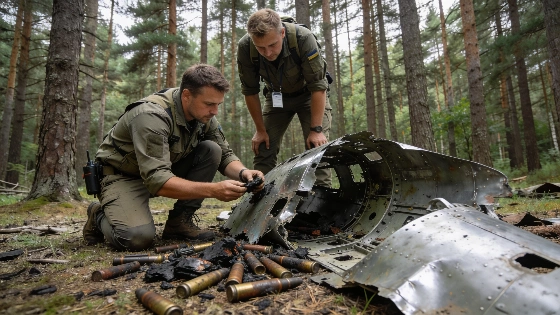
Archaeologists are investigating a debris field in woodland near Świnoujście, Poland, where aircraft fragments and ammunition suggest a possible Allied wartime crash. The site's context and material evidence are now under formal examination
A recent discovery in the forests near Świnoujście, a city on Poland's Baltic coast, has prompted a new archaeological investigation into what may be the remains of a World War II Allied aircraft. The find was made by a local resident who noticed disturbed ground and scattered metallic debris in woodland close to Fort Gerhard and the historic Underground City complex. Among the surface finds were fragments of aluminum aircraft structure and burnt ammunition, which were subsequently brought to the attention of the Museum of Coastal Defence at Fort Gerhard.
Material Evidence and Site Context
Upon inspection, museum specialists identified the debris as likely originating from an aircraft, based on the construction of the aluminum panels, distinctive riveting, and the presence of structural components. The site itself revealed a broad scatter of aircraft fragments, disturbed soil, and ammunition, suggesting a significant crash event rather than isolated dumping or postwar activity. Notably, the ammunition recovered was identified as .303 British caliber, a type widely used in Royal Air Force (RAF) Browning machine guns during the Second World War. This detail, combined with the aircraft materials, supports the hypothesis that the wreckage may be from an Allied plane, possibly operated by the RAF or another Allied air force.
Further investigation yielded a section of seamless copper tubing marked with the code "T7." According to RAF technical documentation, this marking was used on copper tubing fitted to oil, fuel, and gas systems in British military aircraft. Researchers also noted the recovery of a numbered tube that some believe could be associated with a Rolls-Royce Merlin engine, a powerplant used in several Allied aircraft types, including the Avro Lancaster heavy bomber and the de Havilland Mosquito. However, the identification remains provisional, and archaeologists emphasize that the evidence does not yet allow for a definitive attribution to a specific aircraft model.
Preservation, Investigation, and Ethical Considerations
The site's archaeological context is of particular importance. The debris field is located in an area that, during the final years of World War II, lay beneath major Allied flight routes targeting strategic locations such as Szczecin, Police, and other industrial centers along the southern Baltic. The region was heavily defended by German anti-aircraft batteries, and several Allied aircraft are known to have been lost in the area. The possibility that human remains may still be present at the site has led authorities to caution against unauthorized excavation. The Provincial Conservator of Monuments, the Międzyzdroje Forest District, and organizations responsible for military graves have been notified, and formal archaeological and forensic investigations are now underway to secure and document the site appropriately.
Preliminary analysis has focused on the distribution and condition of the material evidence. The aluminum fragments show signs of burning and mechanical deformation consistent with a high-energy impact and subsequent fire. The ammunition, while corroded, retains diagnostic features that allow for confident identification. The seamless copper tubing and its technical markings provide further support for a British military origin. However, the absence of serial numbers or personal effects means that the aircraft and its crew have not yet been conclusively identified. The site's disturbed context, likely the result of both the original crash and subsequent environmental processes, complicates efforts to reconstruct the precise sequence of events.
Historical and Comparative Context
The discovery adds to a growing body of evidence documenting the intensity of aerial operations over the southern Baltic in the closing months of World War II. Świnoujście's strategic location made it a focal point for Allied bombing campaigns, with RAF Avro Lancaster and de Havilland Mosquito aircraft, as well as American and Soviet planes, operating in the region. The loss of multiple Allied aircraft in this area is well documented, but many crash sites remain unlocated or uninvestigated. The current find may help clarify the fate of one such missing aircraft and, if human remains are present, could contribute to the identification and commemoration of lost crew members.
Archaeological investigations of wartime crash sites require careful attention to both material evidence and ethical responsibilities. The potential presence of human remains means that the site must be treated as both an archaeological and a war grave context. Unauthorized disturbance not only risks the loss of critical evidence but may also violate the dignity of those who died. The formal involvement of heritage authorities and military grave organizations is intended to ensure that any recovery is conducted according to best practice and legal requirements.
Comparative research into other wartime burial and crash sites, such as the recent analysis of early Roman connections at an Iron Age cemetery in England, highlights the importance of integrating archaeological, forensic, and historical methods to reconstruct past events. For example, the study of cremation burials and imported artifacts at a site in eastern England (see this related research) demonstrates how multidisciplinary approaches can yield new insights into both individual fates and broader historical processes.
Limits of Interpretation and Ongoing Research
At present, the identification of the Świnoujście crash site remains provisional. While the material evidence strongly suggests an Allied aircraft, and several features are consistent with British military aviation, the absence of definitive serial numbers or personal items means that the specific aircraft and crew cannot yet be named. Further excavation and forensic analysis may recover additional evidence, including possible human remains, that could allow for more precise identification. Until such work is completed, the site remains an important but as yet unresolved chapter in the region's wartime history.
The ongoing investigation will focus on systematic recovery, documentation, and analysis of all material evidence. This includes mapping the distribution of debris, assessing the preservation of metallic and organic materials, and applying forensic methods to any human remains that may be present. The results will contribute not only to the historical record of World War II aerial operations but also to the ethical management of wartime heritage sites.
Understanding the archaeological context of aircraft crash sites requires careful integration of material evidence, historical records, and forensic analysis. Unlike many other archaeological sites, crash sites often involve high-energy impacts, burning, and subsequent disturbance by both natural and human agents. The identification of aircraft type and crew relies on diagnostic features such as ammunition, technical markings, and, when present, serial numbers or personal effects. However, preservation is often poor, and the context may be heavily disturbed. Ethical considerations are paramount, especially when human remains are involved, requiring collaboration between archaeologists, heritage authorities, and organizations responsible for war graves.