A pair of unusually well-preserved Polish military field telephones has been recovered near Sochaczew, where the Battle of the Bzura turned retreat routes into a fragmented wartime landscape
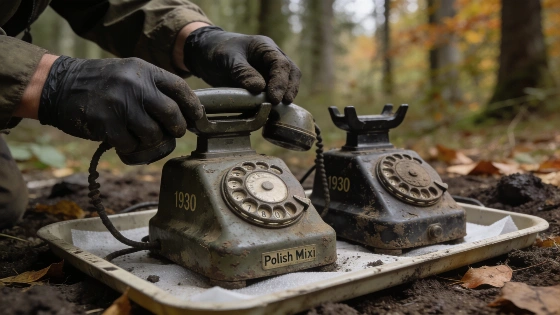
Two Polish military field telephones found in woodland near Sochaczew offer a rare material trace of how army units tried to maintain communications during the German invasion of Poland in 1939.
Members of the Sochaczew Group of History Explorers and the Historical and Exploration Association "VIS" recovered the equipment during a weekend search for wartime relics. Łukasz, a member of the "VIS" Association, found the telephones alongside rifle cartridge cases, a backpack buckle, a military identity tag and coins.
The sets are believed to be Polish AP-27 field telephones. Their survival is notable: both appear to have remained in surprisingly good condition after more than eight decades underground. The explorers secured and protected the artefacts after recovery, but the available account does not report conservation testing, laboratory analysis or a formal technical examination. No independent official confirmation identifying the objects specifically as AP-27 sets has been located in the reviewed material.
The telephones were not recovered from a documented command post or an intact military installation. Their archaeological value therefore rests on the woodland setting and the pattern of nearby wartime activity rather than on a complete chain of use. Without controlled excavation records, stratigraphic observations, corrosion analysis or a documented chain of custody, the find cannot establish the identity of its former users.
The location is consistent with a connection to the Polish Army "Łódź", which operated in central Poland during the opening phase of the September Campaign. The explorers believe the equipment may have belonged to one of its units and may have been deliberately hidden or abandoned near a route used by Polish troops during retreat and subsequent fighting.
That interpretation fits the military geography of the region. Germany invaded Poland on 1 September 1939, attacking from the west, north and south. Army "Łódź", initially commanded by General Juliusz Rómmel, came under heavy pressure after German forces penetrated the Polish defensive line along the Warta and pushed formations eastward.
Official municipal history records that Łódź experienced air raids and combat during 1-5 September 1939, placing the city within the same rapidly changing central-Polish battlespace. The documented fighting around Łódź does not identify the telephones, but it helps explain why equipment could have moved eastward with retreating formations.
The Sochaczew area became especially important during the Battle of the Bzura. Beginning on 9 September, the Polish Armies "Poznań" and "Pomorze" launched a counter-offensive that became the largest battle of the campaign. German reinforcements and aircraft eventually forced Polish formations to seek a route toward Warsaw through Sochaczew and the Kampinos Forest.
Between 16 and 22 September, soldiers attempting to cross the Bzura faced intense pressure. Heavy equipment was often abandoned as organized formations broke apart, while survivors moved through the Kampinos Forest toward Warsaw and Modlin. A pair of communications devices in this setting is more informative than an isolated object with no relationship to a known battlefield landscape.
Sochaczew's continuing public commemorations show that the region remains closely associated with the September 1939 campaign. Local records also refer to roughly 180 people being sent to the Sochaczew area after the September events, indicating the town's continuing importance as a point of military and civilian concentration. These records support the historical plausibility of a retreat corridor, but they do not prove that the recovered objects belonged to a particular formation.
Field telephones were practical links between command posts and units operating away from fixed infrastructure. Finding two together may indicate that communications equipment was being moved, stored or discarded as Polish units retreated, although the discovery alone cannot establish which unit used them or exactly when they were deposited.
The smaller finds add context without solving the problem. Cartridge cases, a buckle, an identity tag and coins are compatible with military movement and personal activity, but none independently identifies a formation. Likewise, the woodland location can support a historical interpretation without proving that the telephones were used together in one specific action.
The distinction between association and proof matters in battlefield archaeology. The same editorial caution applies across the discipline, from this woodland recovery to the Leipzig burial monument: objects gain interpretive strength from documented context, while an attractive interpretation cannot substitute for missing excavation records or direct dating.
Scientific reporting standards used by institutions such as NASA and CERN provide a useful comparison: a claim is strongest when the observation, measurement procedure and uncertainty are recorded separately from the interpretation. For this find, the crucial missing measurements include precise coordinates, depth, soil sequence, material composition and high-resolution documentation of the objects before cleaning.
Conservation would also require a staged process rather than simple surface cleaning. Ferrous components can continue corroding when oxygen and moisture reach previously protected surfaces, while leather, fabric, wood and electrical insulation may preserve different chemical histories. A museum or university laboratory could document these materials through microscopy, controlled corrosion assessment and non-destructive imaging before any restoration. No publicly reported museum examination, restoration or transfer to a state repository has been identified in the reviewed authoritative material.
The weekend also linked the 1939 campaign with a later chapter of Polish wartime history. On 27 September 2026, members of SGOH attended commemorations of the Battle of Jaktorów at the Home Army War Cemetery in Budy Zosine. The battle took place on 29 September 1944, when the Home Army's "Kampinos" Group attempted to break through German positions after leaving the Kampinos Forest. The cemetery contains the remains of 132 Home Army soldiers who fell there, including Major Alfons Kotowski, codename "Okoń".
That commemoration does not provide evidence for the telephones themselves, but it places the discovery within a landscape containing several layers of wartime memory. The finds are best treated as carefully preserved clues to movement and communications during the September Campaign, not as a complete reconstruction of a unit's actions.
For battlefield archaeology, provenance means more than knowing that an object came from a particular region. It includes the recovery setting, its relationship to terrain and other finds, and the records that preserve those associations. In the same way that Nature papers distinguish measured observations from proposed mechanisms, archaeological interpretation should distinguish documented context from historical inference.
Here, the two objects support the presence of military communications equipment in a landscape used during the 1939 retreat, while leaving ownership, deposition date and precise operational history unresolved. Until a qualified technical examination confirms the model, describing them as probable AP-27 telephones is more defensible than presenting that identification as established fact. That balance is the discovery's real importance: it provides a tangible and unusually well-preserved connection to the Polish Army's communications network without exceeding what the evidence can establish.
Official local accounts reinforce the regional setting: the Łódź historical record documents combat in the opening days of September, while Sochaczew's civic remembrance preserves the area's association with the campaign. Together, these records make the proposed retreat-route interpretation historically plausible, but they do not establish a direct chain of ownership for the recovered telephones.