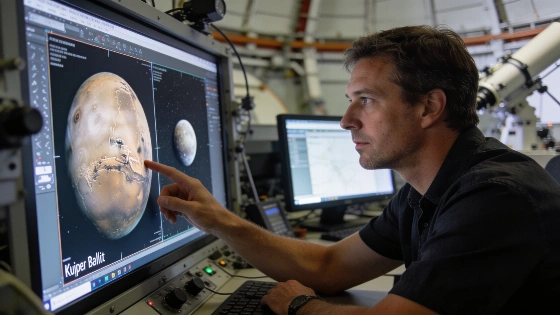
Two decades after Pluto was reclassified as a dwarf planet, new observations and ongoing debate among planetary scientists are challenging the criteria that define what counts as a planet in our solar system
In August 2006, the International Astronomical Union (IAU) voted to reclassify Pluto as a dwarf planet, reducing the number of recognized planets in the solar system from nine to eight. This decision, driven by discoveries of Pluto-like objects in the Kuiper Belt and the detection of Eris-a trans-Neptunian body similar in size to Pluto-sparked controversy that continues to shape planetary science. As the twentieth anniversary of the IAU vote approaches, astronomers are reassessing whether Pluto and similar bodies should be considered planets, and whether the current definition adequately reflects the diversity of worlds in the solar system.
Defining a Planet
The IAU's 2006 definition established three criteria for planethood: an object must orbit the Sun, possess sufficient mass for its gravity to form a nearly round shape (hydrostatic equilibrium), and have cleared its orbital neighborhood of other debris. Pluto meets the first two requirements but fails the third, as its orbit overlaps with Neptune's and it shares its region with other Kuiper Belt objects. This third criterion remains the most contentious, with critics arguing that it excludes not only Pluto but also other bodies that exhibit planetary characteristics.
Some planetary scientists, including those involved in missions such as New Horizons, have argued that the IAU's definition is too restrictive and does not account for geophysical properties that distinguish planets from smaller bodies. The debate is not merely academic; it influences how the public perceives planetary science and how researchers communicate discoveries. When New Horizons reached Pluto in 2015, it revealed a complex, geologically active world with nitrogen glaciers and a layered atmosphere, challenging the notion that Pluto is a minor or insignificant object.
Scientific and Historical Context
The controversy over Pluto's status intensified after the discovery of Eris in 2005, which forced astronomers to confront inconsistencies in the existing classification system. If Eris was not a planet, could Pluto remain one? The IAU's vote followed years of debate, with some proposals suggesting the solar system could have as many as 14 planets if all round objects above a certain size were included. Ultimately, the IAU opted for a narrower definition, but the decision left many dissatisfied, especially as new discoveries in the outer solar system blurred the boundaries between planets, dwarf planets, and large asteroids.
National pride also played a role in the debate, as Pluto was discovered by American astronomer Clyde Tombaugh in 1930. The reclassification was perceived by some as a demotion, despite the IAU's intention to clarify scientific terminology. The issue remains relevant as astronomers continue to discover new trans-Neptunian objects, raising questions about how to categorize bodies that do not fit neatly into existing definitions. For example, Japan's MMX mission to Mars' moon Phobos, covered in a recent Science Report article, highlights the ongoing need to refine planetary classifications as new data emerges from across the solar system.
Alternative Approaches and Ongoing Debate
Some researchers advocate for a geophysical definition of planets, emphasizing intrinsic properties such as roundness, internal differentiation, and geological activity. Under this approach, any object large enough to achieve hydrostatic equilibrium and exhibit planetary processes-such as volcanism, atmospheric dynamics, or magnetic fields-would qualify as a planet, regardless of its orbital context. This would restore Pluto's planetary status and extend the label to other dwarf planets like Ceres, Eris, Makemake, and Haumea.
However, expanding the definition could result in hundreds of recognized planets, many of which would be small and distant. Critics argue that this would dilute the significance of the term "planet" and complicate communication with the public. Others counter that the current hierarchy, which places gas giants at the top and dwarf planets at the bottom, is artificial and unsupported by the processes that shaped the solar system. The debate reflects broader tensions between historical tradition, public perception, and the evolving understanding of planetary science.
Implications for Future Discoveries
The question of Pluto's status is not merely symbolic. As surveys of the outer solar system continue, astronomers expect to find additional objects comparable in size to Pluto, and possibly even larger bodies that challenge the current classification scheme. If a Mars-sized or Earth-sized object were discovered in the Kuiper Belt, the IAU's definition would exclude it from planethood unless it had cleared its orbit-an increasingly unlikely scenario in the distant, debris-rich regions beyond Neptune.
Ultimately, the debate over Pluto's status underscores the limitations of existing definitions and the need for a classification system that can accommodate new discoveries. While nostalgia and national pride may influence public sentiment, scientific criteria must remain the basis for categorizing celestial bodies. Whether Pluto is reinstated as a planet or remains a dwarf planet, the discussion highlights the dynamic nature of planetary science and the challenges of defining categories in a universe that resists simple boundaries.
Understanding the IAU's "clearing the neighborhood" criterion is central to the Pluto debate. This requirement means a planet must dominate its orbital zone, gravitationally removing or incorporating smaller bodies over time. In practice, this is straightforward for massive planets like Jupiter, but much less so for distant, less massive objects in the Kuiper Belt, where orbital overlap and shared regions are common. The criterion's ambiguity has fueled ongoing debate, as it can exclude objects with clear planetary characteristics while including others with similar orbital complications. As planetary science advances, the challenge remains to develop definitions that reflect both physical properties and the complex dynamical history of the solar system.