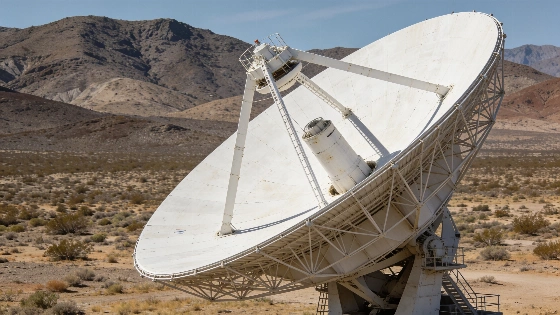
NASA has activated a new 34 meter antenna at Goldstone to increase the Deep Space Network's capacity as Artemis and other missions strain existing communication infrastructure
NASA's Deep Space Network has reached a critical threshold. With more than 40 spacecraft now relying on its antennas for communication across the Solar System and beyond, the network's ability to serve every mission simultaneously has become a technical bottleneck. The recent activation of a new 34 meter antenna at the Goldstone complex in California marks a direct response to this mounting pressure.
Network congestion and mission priorities
The Deep Space Network (DSN) is the backbone of NASA's communications with distant spacecraft, including Voyager 1, Voyager 2, and New Horizons. As the number of active missions has grown, so has the competition for limited antenna time. Human spaceflight missions, such as Artemis 1 in 2022 and the planned Artemis 2 in 2026, have been given priority during critical phases, reducing the availability for robotic science missions. This prioritization is not optional: crewed missions require continuous, high-reliability contact, which can displace routine data downlinks from planetary probes and observatories.
By 2021, NASA managers were already warning that the DSN could not keep pace with demand, even as new antennas were being added. The situation is further complicated by international partners and other space agencies increasingly relying on the DSN for their own missions, a trend that has accelerated as lunar and planetary exploration has become more global.
Technical expansion and project delays
The new Goldstone antenna, designated Deep Space Station 23 (DSS-23), is the fifth of six planned 34 meter dishes under NASA's Aperture Enhancement Project. DSS-23 began operations on August 3, tracking the Chandra X-ray Observatory. Each DSN complex-Goldstone in California, Madrid in Spain, and Canberra in Australia-hosts a mix of large 70 meter antennas and smaller 34 meter dishes, providing global coverage as Earth rotates.
Originally scheduled for completion in 2024, the expansion project has faced significant delays and cost overruns. A 2015 NASA Office of Inspector General report estimated the total cost at $362.4 million, but by fiscal year 2023, the figure had risen to $706 million, with the final antenna at Canberra now expected in 2029. These overruns reflect both the technical complexity of building precision radio telescopes and the challenge of upgrading infrastructure while supporting ongoing mission operations.
Historical context and operational consequences
The DSN's origins date to the early days of spaceflight, when NASA and the Jet Propulsion Laboratory established tracking stations in Nigeria, Singapore, and California in 1958. The network's current architecture, with powerful steerable dishes, was formalized in 1963. Since then, the DSN has supported every major deep space mission, from relaying Apollo 11's moonwalk to receiving data from Mars rovers and confirming the passage of the Voyager spacecraft into interstellar space.
Today, the DSN's workload is shaped not only by NASA's own missions but also by international collaboration and the prospect of a permanent lunar base in the 2030s. As reported in recent coverage, China's Chang'e 7 mission is among several international projects that will further increase demand for deep space communications. NASA has stated that future lunar infrastructure will eventually include a dedicated lunar network, but for now, the DSN remains the primary channel for both human and robotic exploration beyond Earth orbit.
Scientific access and future limits
The addition of DSS-23 provides a measurable increase in capacity, but it does not resolve the underlying constraint: the DSN cannot serve all missions at once. As more spacecraft are launched, mission teams must plan for reduced contact windows and potential data delays. The prioritization of crewed missions is a practical necessity, but it means that some science operations will be limited by communication availability rather than instrument capability or spacecraft health.
NASA's approach-incremental expansion, international cooperation, and eventual development of specialized lunar networks-reflects the reality that infrastructure often lags behind scientific ambition. The DSN's technical achievements are substantial, but the network's limits now shape the pace and scope of deep space science. Until new architectures are realized, every new mission will add to the competition for a finite resource.
Radio-frequency antennas like those at the Deep Space Network convert faint electromagnetic signals from distant spacecraft into usable data. The sensitivity of a dish depends on its diameter, surface accuracy, and receiver electronics. Larger antennas can detect weaker signals, but smaller dishes can be built and deployed more quickly. The DSN's global distribution allows continuous coverage as Earth rotates, but the total number of antennas sets a hard limit on simultaneous contacts. As mission traffic grows, careful scheduling and technical upgrades become essential to maintain scientific access across the Solar System.