

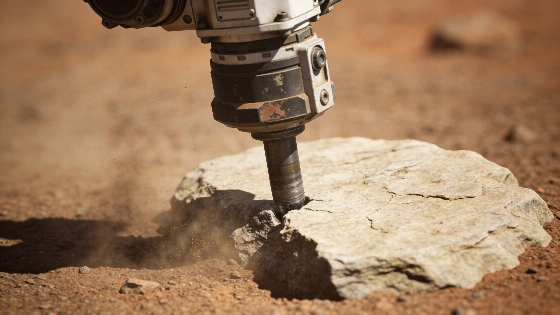
A flatter neighboring rock and a less-worn coring bit helped Perseverance drill 3.1 centimeters into a gabbroic target, yielding Singita after more than a year without a sample; its textures point to a deep crustal origin
At Badger Peak the rock was too hard to core. The team still considered a gabbro worth adding to Perseverance's collection, so the rover traveled about 100 meters (330 feet) to a different patch of light-toned rock in the Lac de Charmes region, outside Jezero crater.
A Better Coring Attempt
Visual and chemical data from the new workspace showed a composition similar to Badger Peak. The team chose a neighboring rock with a flatter surface for the drill stabilizers and used a coring bit with less wear.
This time the drill advanced about 3.1 centimeters (1.2 inches) into the rock. Sample acquisition followed, giving Perseverance its first sample in more than a year. The sample was named "Singita."
Clues From Singita
Singita is a gabbro, an igneous rock made mostly of calcium-rich plagioclase feldspar and pyroxene crystals. Its coarse crystalline texture is consistent with slow cooling deep beneath the Martian surface. NASA/JPL scientist Stack Morgan described the rock as material that may have been buried roughly 1 kilometer below the crust before impacts excavated it.
The same textures suggest the rock was modified and excavated by at least one large impact event, and possibly by multiple events. Jezero crater itself formed in a giant impact about 3.9 billion years ago, so the crystalline rock outside the crater could predate that event. Singita may be at least as old as Jezero and potentially several hundred million years older, but its precise age awaits laboratory analysis on Earth.
That possible antiquity makes Singita a candidate for one of the oldest rocks in Perseverance's collection, not a rock with an established numerical age. The rover's wider sampling campaign includes material from Jezero's crater floor, ancient river delta and rim. Perseverance landed in February 2021 and has been investigating these distinct terrains while collecting samples for possible future return to Earth; the mission overview describes that broader geological work.
At a reported driving milestone, Perseverance had gathered 29 rock and regolith samples across those settings. Singita adds a crystalline igneous rock collected beyond the crater interior to that varied record. Its position in the landscape preserves geological context that can be studied alongside the sample if material is eventually returned to Earth.
Another Rover Milestone
The earlier Badger Peak attempt showed why the choice of target and drill bit mattered: the rock's hardness had prevented coring. Singita's successful collection followed a change in both. After sampling it, Perseverance was expected to remain in the Lac de Charmes region and pursue two more samples, including one from a different, younger crystalline igneous rock.
Perseverance has now completed its 66th successful abrasion and collected Singita alongside it. The planned comparison between crystalline rocks of different ages could help scientists examine the region's geological history, while direct age measurements would require laboratory analysis of returned material.







