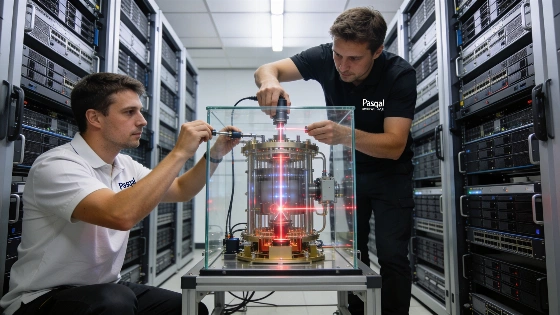
Pasqal has finalized its merger with Bleichroeder Acquisition Corp. II, forming Pasqal Holding SA. The company now trades on Nasdaq and plans to expand its neutral-atom quantum processor deployments and manufacturing capacity
Pasqal, a developer of neutral-atom quantum processors, has completed its business combination with Bleichroeder Acquisition Corp. II, a special purpose acquisition company previously listed as NASDAQ: BBCQ. The merged entity, now operating as Pasqal Holding SA, began trading its ordinary shares and warrants on the Nasdaq Stock Market on August 28, 2026, under the ticker symbols "PSQL" and "PSQLW". This move provides Pasqal with access to public capital markets as it seeks to scale its quantum hardware and commercial operations.
Neutral-Atom Quantum Hardware
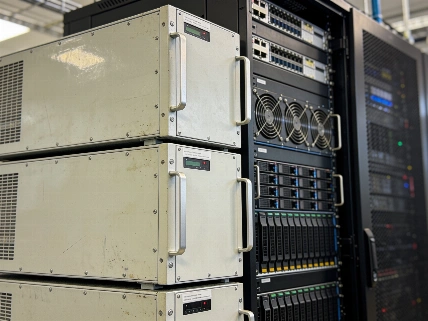
Pasqal's quantum processors are based on arrays of neutral atoms, which are manipulated using optical tweezers and laser control to encode and process quantum information. This platform is distinct from superconducting and trapped-ion approaches, offering potential advantages in connectivity and scalability. As of the merger, Pasqal reports seven deployed quantum processing units (QPUs) operating in standard data center environments, with three additional systems in production. These devices are used for both on-premises installations and cloud-based access, supporting research and commercial applications in fields such as energy, finance, and materials science.
Capital Deployment and Expansion Plans
The merger, approved by Bleichroeder shareholders on August 25, 2026, resulted in approximately $360 million in cash available to Pasqal at closing. According to the company, this capital will be allocated to expand QPU manufacturing, accelerate the development of its neutral-atom architecture toward fault-tolerant quantum computing, and deepen integration with high-performance computing (HPC) and enterprise cloud platforms. Pasqal's roadmap includes advancing from analog quantum processing to architectures capable of error correction and scalable logical qubit operation, though the company has not yet demonstrated full fault tolerance in hardware.
Commercial Deployments and Industry Partnerships
Pasqal's customer and partner ecosystem includes organizations such as Saudi Aramco, Crédit Agricole CIB, LG Electronics, NVIDIA, and the IBM Quantum Network. The company reports more than 25 active industry and research applications utilizing its quantum processors. Its hardware is designed for compatibility with existing data center infrastructure, and Pasqal is pursuing further integration with classical HPC environments and cloud platforms. For context on regional quantum infrastructure initiatives, see this report on Pasqal's joint venture to deploy neutral-atom quantum systems in Saudi Arabia.
Technical and Engineering Challenges
While Pasqal's neutral-atom systems have demonstrated programmable quantum control and are being used in commercial and research settings, significant engineering challenges remain before large-scale, fault-tolerant quantum computing is realized. Key limitations include the fidelity of multi-qubit gates, coherence times under realistic operating conditions, and the complexity of scaling control systems for larger arrays. The company's current deployments are primarily used for analog quantum simulation and early-stage algorithm development, with error correction and logical qubit demonstrations still in development. Independent benchmarking and peer-reviewed performance data for Pasqal's latest hardware have not yet been published, and the practical utility of these systems for tasks beyond classical simulation remains an open question.
Neutral-atom quantum processors use individual atoms trapped and manipulated by laser fields to serve as physical qubits. These systems can, in principle, offer high connectivity and flexible geometry, which are advantageous for certain quantum algorithms. However, achieving high-fidelity gate operations and maintaining coherence across large arrays are ongoing technical challenges. The distinction between physical and logical qubits is critical: while physical qubits are the directly controlled atomic systems, logical qubits require error correction across many physical qubits to achieve reliable computation. Demonstrating scalable logical qubits and fault-tolerant operation remains a central milestone for all quantum hardware platforms, including neutral-atom architectures.