NVision Quantum Technologies has secured EuroHPC funding to develop a roadmap for quantum processors that combine organic molecular spin qubits with photonic interconnects, aiming to address scaling and integration challenges in quantum computing hardware
NVision Quantum Technologies has moved a step closer to building quantum processors that could sidestep the wiring and scaling bottlenecks facing many current architectures. The company has been awarded €293,455 in Phase 1 funding by the EuroHPC Joint Undertaking under its Quantum Grand Challenge, with the explicit goal of mapping out a technical and commercial path for quantum chips that integrate organic molecular spin qubits and photonic interconnects from the outset.
Photonic-Interfaced Spin Qubit Design
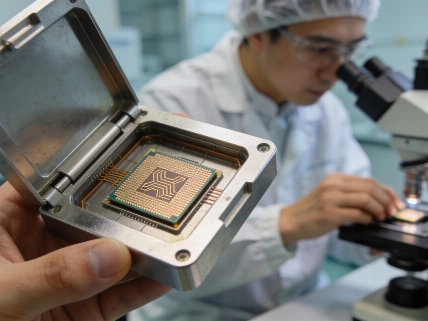
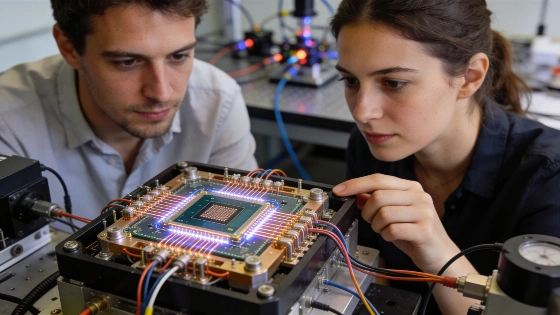
The core of NVision's proposal is a photonic-interfaced quantum computer (PIQC) platform. Unlike conventional spin-qubit processors that rely on short-range magnetic or capacitive coupling, the PIQC design embeds optical channels directly into the chip layout. This approach enables all-to-all photonic connectivity between modular quantum processing unit (QPU) tiles, allowing qubits to communicate optically across chip boundaries. The architecture is intended to be compatible with standard semiconductor and photonic foundry processes, a requirement for any realistic path to large-scale manufacturing.
Organic molecular spin qubits are attractive for their potential to operate at higher temperatures and their chemical tunability, but they have not yet demonstrated the coherence times, gate fidelities, or integration density of leading silicon or superconducting platforms. By pairing these qubits with photonic integrated circuits (PICs), NVision aims to overcome the physical wiring and crosstalk limitations that have constrained nearest-neighbor architectures. The company's roadmap will need to address whether this hybrid approach can deliver the error rates and connectivity required for fault-tolerant quantum computation.
Benchmarking and Roadmap Criteria
During the four-month QOSMOS project, NVision is tasked with establishing concrete benchmarking metrics, defining hardware-software integration milestones, and identifying initial target workloads. The company has indicated a focus on quantum simulation tasks relevant to chemistry and pharmaceutical research, where quantum advantage is most likely to be demonstrated in the near term. However, the technical documentation and independent benchmarking data for the PIQC platform remain limited at this stage.
To qualify for Phase 2 of the EuroHPC program, NVision must meet both technical and business criteria. Success would open access to up to €30 million in European Investment Bank venture debt financing, drawn from a €100 million InvestEU pool earmarked for scaling up quantum processor manufacturing in Europe. This funding structure is designed to bridge the gap between laboratory prototypes and volume production, but it does not guarantee that the underlying technology will meet the performance or reliability thresholds required for commercial quantum computing.
Engineering and Integration Challenges
Integrating organic molecular spin qubits with photonic circuits presents a series of unresolved engineering challenges. Achieving high-fidelity optical coupling, maintaining qubit coherence during photonic interconnect operation, and ensuring reproducible fabrication across foundry nodes are all open questions. The company's plan to define hardware-software integration milestones will need to address not only device-level performance but also system-level error correction, calibration, and control. Previous efforts to combine modular quantum processors with photonic links have shown promise in laboratory settings, but have yet to demonstrate robust, scalable operation outside controlled environments.
NVision's roadmap will be scrutinized for evidence that its PIQC architecture can deliver on the promise of modular, scalable quantum computing. The company's approach stands in contrast to other European efforts, such as neutral-atom and trapped-ion systems, which have also targeted quantum simulation workloads and hybrid integration with classical supercomputing infrastructure. For context, related efforts to simulate complex molecular systems on quantum hardware were reported earlier using neutral-atom processors, highlighting the diversity of approaches and the absence of a clear hardware frontrunner.
While the EuroHPC funding signals institutional interest in diversifying Europe's quantum hardware base, the technical evidence for scalable, fault-tolerant operation in organic spin-photonic systems remains preliminary. The next phase of the QOSMOS project will test whether NVision can move beyond architectural promise to deliver reproducible, benchmarked device performance at scale. Until then, claims of practical utility or commercial readiness for this platform should be treated as provisional, pending independent validation and transparent reporting of device metrics.
Physical qubits are the basic quantum systems-such as electron spins, trapped ions, or photons-that can be individually controlled and measured. Logical qubits, by contrast, encode information redundantly across multiple physical qubits using error-correcting codes, allowing the system to detect and correct errors that would otherwise destroy quantum information. Achieving fault-tolerant quantum computing requires not only high-fidelity physical qubits but also robust error correction, low crosstalk, and scalable control. The distinction between physical and logical qubits is central to evaluating whether a quantum processor architecture can move from laboratory demonstration to practical computation.