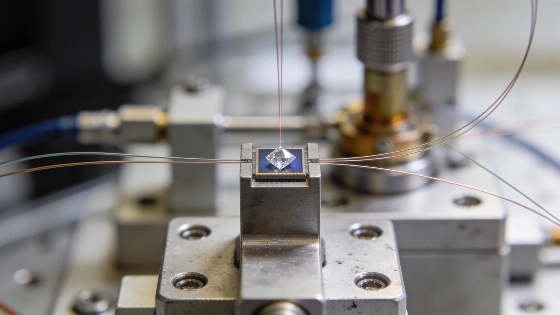
A diamond quantum computer in Dresden ran a three-qubit Grover search at 296.3 K. Its reported success probability outperformed earlier room-temperature searches, though the available summary gives no numerical score
A three-qubit Grover search has been demonstrated on a commercial quantum computer operating at room temperature. SAXON Q and the Fraunhofer Institute for Machine Tools and Forming Technology (IWU) reported a 77.3% success probability for finding one marked state among eight possibilities. The experiment used nuclear spins inside diamond as the computational register. The result, reported by The Quantum Insider on October 14, 2026, is close to a roughly 78% result cited for a cryogenic superconducting processor.
The experiment was conducted in June 2025 on a commercial NV-diamond system installed at Fraunhofer IWU in Dresden. The three-qubit search looked for a single marked item among eight; the stated classical benchmark under a comparable query limit was 37.5%. A separate version with two marked states reached 87.0%, against a classical benchmark of 46.4%.
The three-qubit result is a small-scale hardware benchmark, not evidence of practical quantum advantage over classical computing. It demonstrates an algorithm running on this diamond platform; it does not establish a speedup for larger or real-world search problems.
Nuclear spins in diamond
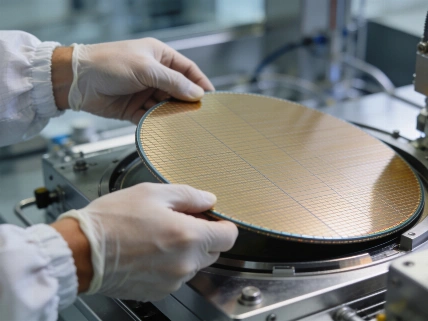
The hardware operated at an average temperature of 296.3 kelvin, or about 23.1°C, and consumed approximately 600 watts. The setup used no cryostat, vacuum chamber or optical traps. Room-temperature operation describes the diamond processor, while the system still relied on specialized optical and control equipment.
The three qubits were the nitrogen-14 nucleus associated with a nitrogen-vacancy (NV) center and two nearby carbon-13 nuclei in the diamond lattice. The NV center's electron spin served as an optical interface for state preparation, entangling operations and readout; it was not part of the three-qubit calculation register. The nuclear spins had reported T2 coherence times of 1.4 to 4.3 milliseconds, roughly 1,000 times longer than the NV electron spin.
Reported gate metrics included an average single-qubit Clifford fidelity of 99.90% and an average two-qubit gate fidelity of 95.7% in the subspace used. These figures describe operations in the tested system; the overall Grover success probability captures the performance of the complete small-scale search.
What the benchmark shows
The circuit description on arXiv specifies a three-qubit OpenQASM 2.0 circuit targeting bit string 101, written in the order c[2]c[1]c[0]. It first applies Hadamard gates to place the three qubits in a uniform superposition, then runs two full oracle-diffusion iterations of Grover's algorithm.
Grover's algorithm uses quantum interference to increase the probability of measuring a desired item in an unstructured search. The reported 77.3% success probability exceeds the stated 37.5% classical benchmark for this three-qubit task and is close to the cited superconducting result of about 78%. Those comparisons concern a specific small benchmark and do not, by themselves, show an advantage over classical computers on useful applications.
The paper is described as a preprint. In the wider industry, reports such as quantum-sector appointments track organizational activity; this experiment reports a specific performance result from a three-qubit diamond system.
Coherence and commercial limits
The carbon matrix surrounding the nuclear spins helps shield them from environmental disturbances. Their longer coherence times provide a window for carrying out operations, while gate fidelity and the reliability of a complete algorithm remain distinct performance measures.
The demonstration also sits alongside SAXON Q's commercial hardware roadmap: the company recently made its 128-qubit SXQ128 and 512-qubit SXQ512 modular multi-core systems commercially available. Those systems are separate from the platform used for this Grover experiment; the three-qubit result does not establish the performance of the larger systems.
The experiment's specific outcome is a three-nuclear-spin register running Grover's algorithm under ambient operating conditions. Its reported success probability and gate metrics characterize that benchmark, which searches a space of just eight items.