

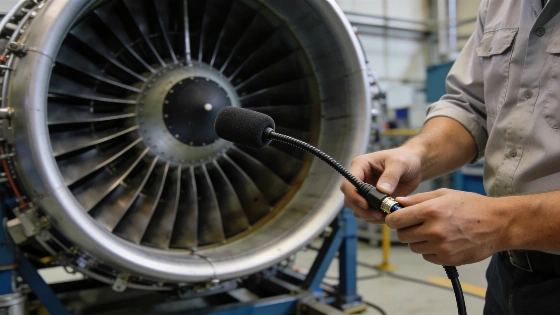
NASA Glenn's software spans jet exhaust and fan-stage acoustics, with tools ranging from fast early-design estimates to computationally intensive analysis of realistic flows and blade geometries
Fan blades can generate tonal sound as rotating rows interact, while turbulence produces broadband noise. NASA Glenn Research Center has developed software to help engineers predict these different sources as they design and analyze aircraft propulsion systems.
Jets and Exhausts
JeNo estimates the far-field sound spectrum from an axisymmetric jet at a specified observer location and across a chosen frequency range. It combines Lilley's Acoustic Analogy with mean-flow solutions from a Reynolds-Averaged Navier-Stokes (RANS) code. That makes its acoustic result dependent on the accuracy of the underlying aerodynamic prediction.
The method can produce results more quickly than alternatives such as Large-Eddy Simulations (LES) or Direct Numerical Simulation (DNS). Its validation has a defined limit: JeNo has been validated for unheated axisymmetric jets in subsonic and low-supersonic conditions. It should not be taken as validated for every exhaust shape or operating regime. Copies are available through NASA's Software Catalog.
MGBK predates JeNo and has been used to assess noise trends from complicated aircraft-engine exhaust nozzles. Researchers also used it to examine the noise-reduction benefits of chevrons, the serrated edges found on many turbofan nozzles. The code's catalog entry is available through NASA's Software Catalog.
Noise in Fan Stages
For early design work, V072 provides quick estimates of rotor/stator interaction tone noise using simplified representations of fan flow and geometry. Its predictions can guide choices such as blade and vane counts, as well as rotor-stator spacing and stator-vane sweep or lean. The model is intended to help compare design trends, rather than resolve every detail of a realistic flow. NASA lists V072 in its Software Catalog.
TFaNS also runs quickly and predicts tones from rotor/stator interaction. It includes acoustic coupling between blade rows, including transmission and reflection, then calculates how tones propagate to the far field. Like V072, it can be used during early design to study trends; copies are offered through the NASA Software Catalog.
Linflux addresses realistic three-dimensional flows and blade geometries, which requires substantially more computing resources than V072 or TFaNS. It predicts rotor/stator tone noise and has been rigorously validated against experimental data. For broadband noise, BFANS uses estimates of turbulence intensity and characteristic length scale to calculate sound from turbulence striking rotor-blade and stator-vane leading edges. Results can be combined with measurements from facilities such as NASA Glenn's 9'x15' Low Speed Wind Tunnel to help identify noisy fan-stage components. Both codes are listed in the Linflux and BFANS catalog entries.
RSI focuses on broadband noise created when fan-rotor wake turbulence meets fan exit guide vanes. Given the incoming turbulence characteristics, it calculates acoustic power spectra upstream and downstream of the stator, mode by mode, at each selected frequency. Those frequencies can be chosen freely and need not match harmonics of the fan's blade-passing frequency. Its catalog listing is available through NASA.
Propellers and Flow
WOBBLE estimates propeller tone noise when varying inflow angles produce unsteady blade loading. Users specify the inflow angle through aircraft yaw, pitch and roll; the code predicts axial and circumferential sound directivity. Its acoustic model accounts for unsteady sources, including blade thickness and loading effects. NASA's catalog entry for WOBBLE provides access information.
MPT estimates multiple pure tone noise, often called "buzz saw" noise, associated with rotor-locked shocks when fan blade-tip speed is supersonic. It takes flow predictions from a Computational Fluid Dynamics (CFD) code as input. Engineers can use it to examine effects of blade-to-blade differences arising during fabrication or hot-running operation, including variation in blade-setting angle and untwist. Copies can be requested through the MPT listing.
ADPAC is a validated CFD tool developed by the Allison Engine Company under contracts with Glenn Research Center. It solves coupled internal and external flows in short-duct turbofan engine concepts. The code can represent two-dimensional, axisymmetric, three-dimensional or mixed configurations. It also supports steady or unsteady flow, inviscid or viscous conditions, rotating and non-rotating components, along with bleed, leakage and injection. ADPAC was developed for propulsion-system aerodynamic analysis; its catalog page describes how to request a copy.
These calculations are predictions, not direct recordings of sound from an aircraft in operation. Their usefulness depends on the inputs and assumptions each model requires, and the source material specifies different validation limits for individual tools. NASA's related airflow research has also examined wing pressure changes using paint and cameras, as described in wing pressure measurements.
Tonal noise is concentrated at particular frequencies, while broadband noise spreads across a wider frequency range. The distinction matters because the sources and calculation methods differ: rotor-row interactions produce tones, whereas turbulence striking blade and vane edges can generate broadband sound. Engineers can request more information about the research, software or data from Clifford.A.Brown@nasa.gov.







