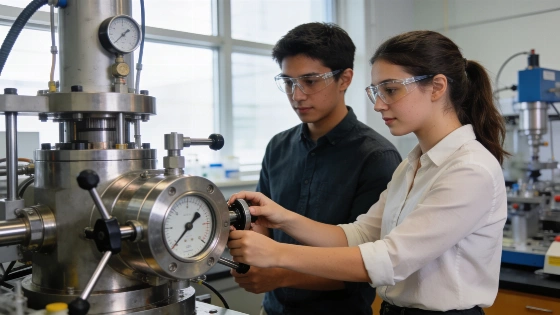
NASA SCoPE collaborated with Arizona State University's FORCE Summer School to provide undergraduate interns with hands-on training in science communication and public outreach, focusing on planetary research under extreme conditions
Developing the next generation of planetary scientists increasingly requires more than technical expertise. In summer 2026, NASA's Science Mission Directorate Community of Practice for Education (SCoPE) partnered with Arizona State University's Facility for Open Research in a Compressed Environment (FORCE) Summer School to address a growing need: equipping undergraduate interns with practical skills for communicating complex planetary science to diverse audiences.
FORCE Laboratory and Research Focus
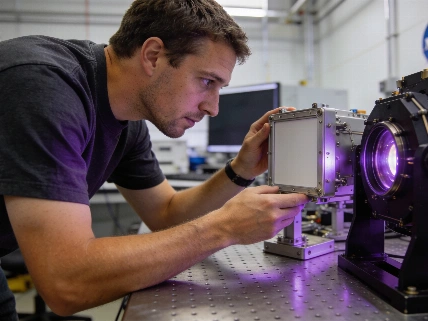
The FORCE laboratory specializes in high-pressure experiments that simulate the extreme conditions found deep within Earth and other planetary bodies. Using advanced equipment, researchers can recreate pressures and temperatures that drive planetary formation and evolution. This approach enables direct investigation of mineral behavior, phase transitions, and geophysical processes that are otherwise inaccessible. During the 2026 summer session, seven undergraduate interns participated in research projects designed to probe these planetary interiors, contributing to a broader understanding of how planets form and change over time.
Science Communication Workshops
Recognizing the importance of public engagement, NASA SCoPE facilitated two interactive workshops on June 25 and 26, followed by dedicated office hours. The training focused on translating technical research into accessible narratives, identifying central scientific themes, and planning effective interactions with non-expert audiences. Interns received guidance on preparing research posters and designing outreach stations, with an emphasis on clarity, accuracy, and audience engagement. This approach reflects a wider trend in planetary science, where researchers are expected to communicate findings not only to peers but also to the public and policymakers.
Public Outreach and Measurable Outcomes
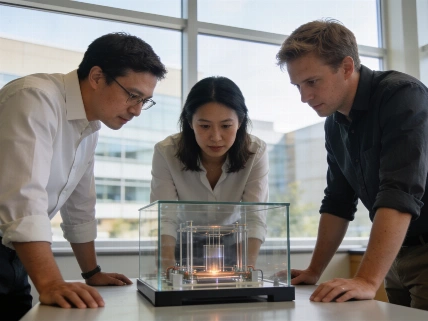
The program culminated in two outreach events. The FORCE Open House welcomed approximately 50 visitors from the general public, offering guided tours of the laboratory and hands-on demonstrations at themed stations. Attendees interacted directly with interns, who explained the scientific rationale behind high-pressure experiments and the relevance to planetary science. A separate poster session for Arizona State University faculty, staff, and students provided a forum for interns to present their research and receive feedback from the academic community. These events offered a practical test of the interns' communication skills and highlighted the value of structured training in bridging the gap between technical research and public understanding.
Broader Context and Future Directions
Integrating science communication into planetary research training is increasingly recognized as essential for building public trust and support for space science. NASA SCoPE's involvement in the FORCE Summer School aligns with broader efforts to connect learners with authentic NASA science experiences, as seen in other initiatives such as the development of AI models for solar activity forecasting (recently covered by Science Report). By embedding communication skills alongside technical training, programs like FORCE aim to produce scientists who are not only capable researchers but also effective ambassadors for their field.
Effective science communication in planetary research depends on the ability to distill complex experimental results into clear, accurate, and engaging messages. This process often involves translating data from high-pressure laboratory experiments-such as those conducted at FORCE-into narratives that connect with public curiosity about planetary formation and evolution. Success in public engagement requires not only technical accuracy but also an understanding of audience background, the limits of current knowledge, and the uncertainties inherent in experimental science. As planetary science continues to advance, the capacity to communicate its findings will remain a critical skill for researchers at every stage of their careers.