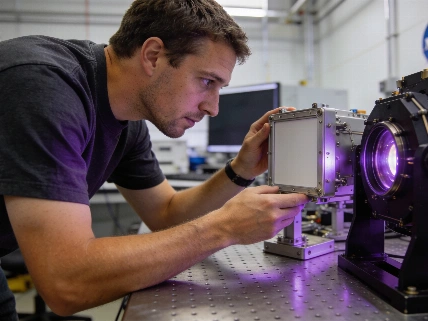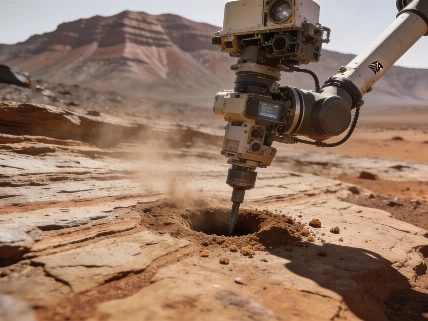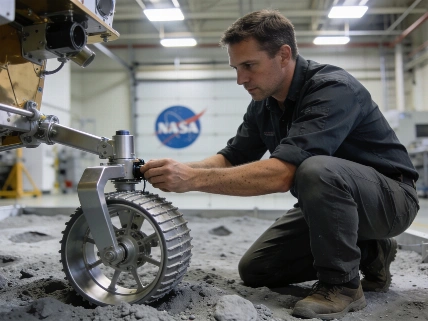
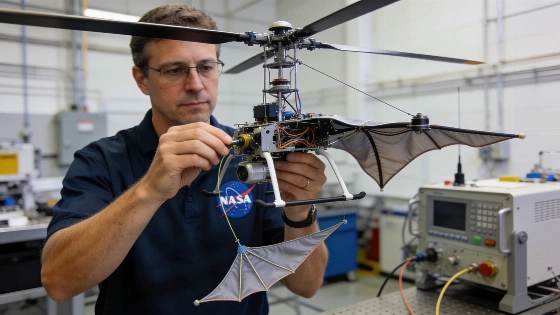
NASA's upcoming SkyFall mission will deploy three mini helicopters to Mars, each equipped with lightweight, flexible radar antennas designed to detect shallow subsurface ice deposits inaccessible to orbiting spacecraft
NASA is preparing to send a trio of small rotorcraft to Mars as part of the SkyFall mission, aiming to map shallow subsurface ice deposits that have remained out of reach for previous orbiters. Each helicopter will carry a flexible ground-penetrating radar antenna, engineered to survive repeated landings and to function at low altitudes where radar imaging of the uppermost Martian layers is most effective.
Flexible Antenna Design
The SkyFall helicopters are based on the Ingenuity rotorcraft, which demonstrated powered flight on Mars in 2021. However, SkyFall's design incorporates a new radar system using a Vivaldi-type antenna, originally developed in 1978, that has been miniaturized and adapted for the mission. The antenna is constructed from layers of polyester and Vectran-a strong, flexible material previously used in Mars rover airbags-reinforced with fiberglass tape springs. This configuration allows the antenna to bend during landings and spring back into position for data collection, despite being about 1.5 times longer than the helicopter's legs and weighing only 142 grams.
During extensive testing at NASA's Jet Propulsion Laboratory, the antenna endured 200 simulated Mars landings, more than double the number expected during the mission. The tests included repeated flexing, exposure to extreme temperatures, and verification that the radar system could still transmit and receive signals after each cycle. The flexible design is intended to prevent damage from contact with rocks or uneven terrain, a critical requirement for repeated operations on the Martian surface.
Scientific Objectives and Mission Status
SkyFall's primary scientific goal is to detect and map shallow water ice deposits within the first five meters beneath the Martian surface. While orbiting spacecraft have used radar to probe Mars for decades, their instruments cannot resolve the uppermost layers where ice is likely to be mixed with soil and rock. By flying low and slow, the SkyFall helicopters are expected to capture higher-resolution radar images, revealing fine layering and the extent of accessible ice. This information is vital for future crewed missions, both for safety assessments and for identifying potential resources such as water, oxygen, and fuel.
The SkyFall mission is currently in the hardware testing phase, with launch targeted for 2028 aboard NASA's Space Reactor-1 Freedom, the agency's first nuclear fission-powered interplanetary spacecraft. The mission will deploy three helicopters, each equipped with the flexible radar system, to survey multiple sites on Mars. The radar is designed to operate from just 15 centimeters above the ground, maximizing sensitivity to shallow subsurface features.
Engineering Challenges and Testing
Miniaturizing the Vivaldi antenna while maintaining its performance posed significant engineering challenges. The team needed to ensure that the antenna could withstand repeated bending without losing its shape or functionality. To achieve this, the antenna was built with a combination of lightweight materials and structural reinforcements, allowing it to flex during landings and recover for subsequent flights. The Environmental Test Laboratory at JPL subjected the system to rigorous simulations, including thermal cycling and mechanical stress, to validate its durability.
In addition to mechanical resilience, the radar system had to maintain signal integrity after each simulated landing. The successful completion of these tests marked a major milestone for the mission, demonstrating that the flexible antenna could meet the operational demands of repeated Mars flights. The SkyFall team continues to refine the design ahead of final flight qualification.
Context and Broader Implications
The search for accessible water ice on Mars is a central objective for planetary science and future exploration. Previous missions, such as the Perseverance and Curiosity rovers, have provided valuable surface and subsurface data, including the detection of polygonal fracture patterns that may indicate past water activity. For example, a recent study imaged extensive polygonal features in Mars' Valle Grande, offering clues about the planet's surface processes and the distribution of ice (see coverage of Curiosity's findings). SkyFall's radar-equipped helicopters are expected to complement these observations by directly probing the shallow subsurface at multiple locations, potentially refining models of Martian ice distribution and informing site selection for future missions.
Ground-penetrating radar (GPR) is a remote sensing technique that transmits radio waves into the ground and detects reflected signals from subsurface structures. The depth and resolution of GPR depend on the frequency of the radar and the properties of the material being surveyed. On Mars, GPR has been used from orbit to map deep ice and rock layers, but atmospheric and surface constraints limit its ability to resolve the uppermost meters. By deploying GPR on low-flying helicopters, SkyFall aims to overcome these limitations, providing detailed maps of shallow ice that are inaccessible to orbiters or stationary landers. This approach could significantly advance our understanding of Martian geology and resource availability for future exploration.