NASA has handed a compact GNSS navigation payload to Intuitive Machines for installation on Altus-1, testing whether Earth-based positioning signals can support spacecraft operating near the Moon
NASA has delivered its NavCube3-mini navigation payload to Intuitive Machines, which will integrate it into Altus-1, the company's first lunar relay satellite. The handover on July 13 moves the instrument from ground testing toward a technology demonstration that could help spacecraft determine their positions beyond Earth orbit.
A receiver for lunar distances
NavCube3-mini is designed to receive weak signals from Earth-based GPS and Galileo Global Navigation Satellite Systems (GNSS) while operating at lunar distances. GNSS receivers normally support navigation close to Earth, where satellite signals are relatively strong and the geometry of the signals is well understood. At the Moon, those signals are far fainter and arrive from a less favorable direction, making the measurement considerably more demanding.
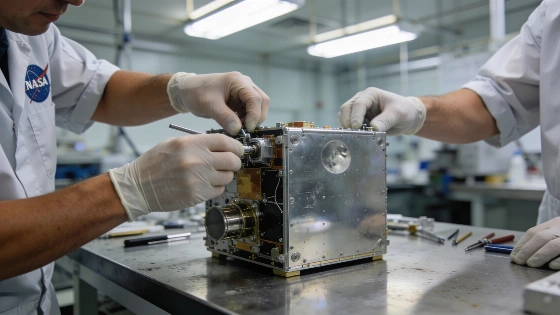
The payload is about half the size of a shoebox and weighs 3.5 pounds, or roughly 1.6 kilograms. It uses less than 20 watts of power, approximately the demand of a laptop computer, while calculating a spacecraft's position. The result is not a lunar GPS network: NavCube3-mini instead tests whether existing signals that extend beyond Earth can contribute to navigation in the lunar region.
The receiver builds on navigation work developed at NASA's broader portfolio of early-stage space technology projects and at NASA's Goddard Space Flight Center in Greenbelt, Maryland. Earlier developments extended GPS-based positioning to record-breaking distances from Earth. NavCube3-mini applies that progression to a spacecraft intended to operate as part of a lunar communications network.
Testing before integration
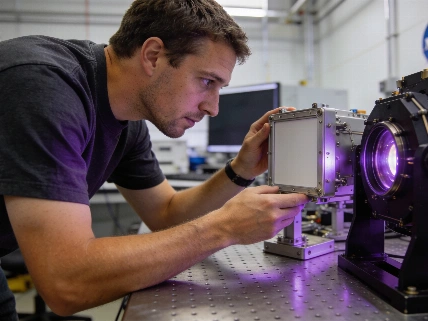
Before shipment, engineers at Goddard subjected the payload to tests intended to reproduce the stresses and conditions of spaceflight. Vibration testing simulated the mechanical environment of launch. Thermal-vacuum testing exposed the hardware to the combination of extreme temperatures and the near-vacuum encountered in orbit. Electromagnetic compatibility testing checked that the receiver could function alongside other spacecraft systems without creating or suffering disruptive interference.
Performance checks were carried out before and after each environmental test. Instead of waiting for a flight opportunity to provide navigation signals, engineers used high-fidelity simulations of the GPS and Galileo signals that the receiver is expected to encounter in lunar orbit. Comparing performance across the test campaign provided evidence that the payload continued to operate after mechanical, thermal, vacuum, and electromagnetic stresses.
Those tests establish readiness for integration, not successful operation in lunar space. The receiver must still function on the spacecraft, tolerate the conditions of its mission, acquire usable signals in the intended orbit, and produce position estimates that can be compared with independent navigation information.
Altus-1 and the relay network
Altus-1 is planned as the first satellite in a network of lunar relays being developed by Intuitive Machines under NASA's Near Space Network Services contract. The relay satellites are intended to provide communications and navigation support to missions operating around the Moon, including spacecraft and surface vehicles that cannot maintain a direct, reliable link with Earth.
That limitation is especially important near the lunar South Pole. Local terrain can block line-of-sight communications, while spacecraft and rovers moving through polar regions may need navigation support when Earth is low on the horizon or temporarily unavailable. A relay could route signals between those missions and Earth, although the usefulness of the service will depend on satellite coverage, orbital geometry, link performance, and the capabilities of the user spacecraft.
NASA says Artemis astronauts are expected to land in the lunar South Pole region in 2028. The date is a program target rather than a guarantee, and the relay network is not itself evidence that a sustained human presence has been achieved. Its role is to develop infrastructure that could support future missions as lunar activity expands.
What the demonstration can show
On Altus-1, NavCube3-mini will test GNSS-based navigation in the lunar environment and collect performance data for future navigation systems. The demonstration could reveal how accurately the receiver can determine position, how often it can obtain a usable solution, and how its performance changes with signal strength, spacecraft geometry, and operational conditions.
It will not by itself prove that every lunar spacecraft can navigate using GPS and Galileo. Results will be specific to the receiver, satellite orbit, antenna and spacecraft design, and the signal conditions encountered during the mission. Conventional lunar navigation may still require tracking from Earth, optical measurements, radio ranging, inertial systems, or combinations of these methods.
The payload therefore represents a measured engineering test rather than a completed lunar navigation service. Its significance lies in connecting a compact flight instrument with a commercial relay architecture and in showing whether signals designed for users near Earth can become one component of a more distributed navigation system around the Moon.
GNSS navigation works by comparing the arrival times of signals from multiple satellites whose positions are known. Tiny timing differences allow a receiver to estimate its location, but the calculation becomes harder as signals weaken and fewer useful transmitters are visible. In lunar space, the receiver must extract navigation information from signals intended primarily for Earth-orbiting users, making sensitivity, antenna performance, clock stability, and signal geometry central to the experiment.