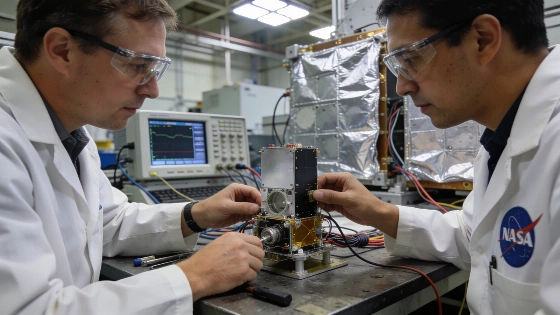
NASA has selected 18 new Phase I projects under its Innovative Advanced Concepts program, providing $3.2 million to support early-stage studies of technologies for future space exploration and astrophysics missions
NASA has announced the selection of 18 new Phase I projects under its Innovative Advanced Concepts (NIAC) program, allocating a total of $3.2 million to support early-stage studies of technologies that could shape the future of space exploration and astrophysics. These awards, each providing up to $175,000 for a nine-month feasibility study, are intended to assess the scientific and technical potential of concepts that remain at the edge of current engineering capability.
Scope of the Selected Projects
The 2026 NIAC Phase I cohort covers a wide range of topics, from lunar infrastructure and planetary exploration to advanced astrophysical observation techniques. Several projects focus on enabling sustained operations on the Moon, including systems for supporting robotic exploration of subsurface lava tubes, thermal management for small mobile robots, and the integration of radioisotopic heat sources into astronaut suits for survival during the Moon's prolonged nights. Other proposals address the challenges of Venus exploration, such as developing instrument technologies capable of withstanding the planet's extreme surface conditions.
Astrophysics and planetary science are also represented, with concepts for mapping Saturn's rings using swarms of miniature satellites, collecting samples from planetary rings, and developing new methods for observing black hole photon rings and gravitational waves. Some projects aim to advance interstellar mission capabilities, including power generation for deep-space probes and optical interferometry for imaging exoplanetary continents.
Funding and Evaluation Process
The NIAC program operates as an incubator for high-risk, high-reward ideas that could eventually transform NASA's mission portfolio. The Phase I awards are not endorsements of specific missions, but rather support for preliminary investigations to determine technical feasibility and identify major challenges. Researchers, known as NIAC Fellows, are tasked with evaluating the core assumptions of their concepts, modeling performance, and outlining the steps required for further development.
Each selected project receives up to $175,000 for a nine-month study period. The total funding for the 2026 Phase I round is $3.2 million. The program's structure is designed to filter out concepts that are not technically viable, while providing a pathway for promising ideas to advance to more detailed Phase II and III studies. This approach allows NASA to explore a broad spectrum of possibilities without committing to full-scale mission development at the earliest stage.
Examples of Awarded Concepts
The 2026 selections include proposals from NASA centers, universities, and private companies. Among the awarded concepts are: a controllable dust cloud to reduce solar insolation and potentially mitigate solar radiation reaching Earth; a solid-state propulsion system for autonomous reconnaissance of lunar karst features; quantum wind lidar for planetary and Earth science missions; and robotically assembled electromagnetic metamaterials for improved space situational awareness. The full list of selected projects reflects the diversity of technical challenges facing future exploration and the range of disciplines involved.
Several projects also address the growing issue of space debris and orbital congestion, building on recent advances in detection and tracking. For example, new approaches to remote sensing and situational awareness may complement techniques such as those described in recent studies using radio telescopes to monitor debris in geostationary orbit. This highlights the interplay between early-stage technology development and operational needs in the evolving space environment.
Scientific and Technical Uncertainties
While the NIAC program is designed to encourage bold thinking, most of the selected concepts remain at the theoretical or modeling stage. The transition from feasibility study to practical implementation depends on overcoming significant engineering, cost, and operational barriers. Many proposals involve technologies that have not yet been demonstrated in relevant environments, and some rely on physical effects or materials that are still under laboratory investigation. The program's phased approach is intended to identify these limitations early, allowing NASA to focus resources on concepts with the greatest potential for scientific return.
As with previous NIAC rounds, the 2026 selections illustrate the agency's willingness to consider unconventional ideas, but also underscore the need for rigorous evaluation before any concept can be integrated into a future mission. The outcomes of these Phase I studies will inform decisions about which technologies merit further investment and development.
Interferometry is a key technique referenced in several of the awarded projects, particularly those aiming to achieve high-resolution imaging of distant astronomical objects or planetary surfaces. Interferometry involves combining the signals from multiple telescopes or detectors to simulate a much larger aperture, greatly improving angular resolution beyond what a single instrument could achieve. This method is central to efforts such as mapping exoplanetary continents or resolving fine structures around black holes, but it also introduces challenges in calibration, signal processing, and data interpretation. The success of future missions employing interferometric techniques will depend on advances in both hardware and algorithms, as well as careful management of systematic uncertainties.