
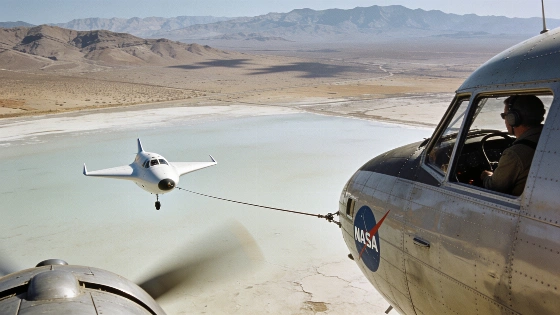
NASA's M2-F1 prototype, a wingless lifting body aircraft, completed its first unpowered glide flight on August 16, 1963, providing early evidence that spacecraft could return to Earth with controlled landings rather than ballistic descent
On August 16, 1963, NASA's M2-F1 experimental aircraft achieved its first unpowered glide flight, marking a pivotal test in the development of alternative spacecraft reentry methods. The M2-F1, notable for its wingless, lifting body design, was engineered to investigate whether a spacecraft could be safely controlled and landed like an airplane, rather than relying solely on parachutes and ballistic descent. This approach aimed to expand options for returning astronauts from orbit, a subject of intense interest during the early years of human spaceflight.
Testing the Lifting Body Concept
The M2-F1 was constructed as a lightweight, unpowered glider with a distinctive, bathtub-like fuselage. On its first glide test, the aircraft was towed to an altitude of approximately 1,585 meters (5,200 feet) by a C-47 Skytrain. Once released, test pilot Milt Thompson guided the M2-F1 through a controlled descent lasting about two minutes, culminating in a smooth landing on the dry lakebed at Edwards Air Force Base in California. The successful flight demonstrated that a lifting body could generate sufficient aerodynamic control for a safe landing, even without conventional wings.
This test was part of a broader NASA effort to evaluate new reentry vehicle architectures. The lifting body concept was seen as a potential alternative to the capsule-and-parachute systems used in the Mercury and Gemini programs. By enabling a piloted spacecraft to glide to a runway landing, engineers hoped to improve landing precision and reduce recovery risks.
Scientific and Engineering Implications
The M2-F1's glide flight provided direct evidence that a wingless lifting body could be flown and landed under pilot control. This result was significant at a time when the United States and the Soviet Union were competing to develop advanced spaceflight capabilities. Although NASA ultimately selected the capsule design for its early crewed missions, the M2-F1's performance validated the lifting body approach and justified further research into alternative reentry vehicles.
Subsequent lifting body programs, including the M2-F2, M2-F3, HL-10, and the U.S. Air Force's X-24A and X-24B, extended these tests to higher speeds and altitudes. Data from these flights informed the aerodynamic modeling and control strategies that would later be applied to the Space Shuttle program. The ability to land a spacecraft on a runway, rather than in the ocean or on land with parachutes, became a defining feature of shuttle-era mission architecture.
Legacy and Continuing Research
The M2-F1's successful demonstration marked the beginning of a series of lifting body experiments that shaped NASA's approach to reusable spacecraft. While the Mercury, Gemini, and Apollo missions relied on ablative heat shields and parachute landings, the lifting body research provided a foundation for the development of vehicles capable of controlled, horizontal landings. This legacy is evident in the design of the Space Shuttle and in ongoing studies of future crewed reentry vehicles.
NASA's continued interest in alternative landing technologies is reflected in more recent projects, such as the Lunar Environment Monitoring Station (LEMS), which was developed for deployment by Artemis astronauts to monitor seismic activity on the Moon's surface. Details about the LEMS instrument suite and its role in lunar exploration can be found in this report on NASA's Artemis lunar seismic station.
The M2-F1's test flights remain a reference point for engineers and mission planners considering the trade-offs between different reentry and landing strategies. The lessons learned from these early experiments continue to inform the design of spacecraft intended for both Earth and planetary landings.
Understanding the lifting body concept is essential for appreciating the evolution of spacecraft reentry design. Unlike traditional winged aircraft, a lifting body generates aerodynamic lift primarily from its fuselage shape rather than from wings. This allows for a compact, robust structure capable of withstanding the stresses of atmospheric reentry while still providing enough control for a pilot to steer and land the vehicle. The M2-F1's flights demonstrated that even a simple, unpowered prototype could achieve stable, controlled descent, paving the way for more advanced vehicles and ultimately influencing the design of reusable spacecraft like the Space Shuttle.