

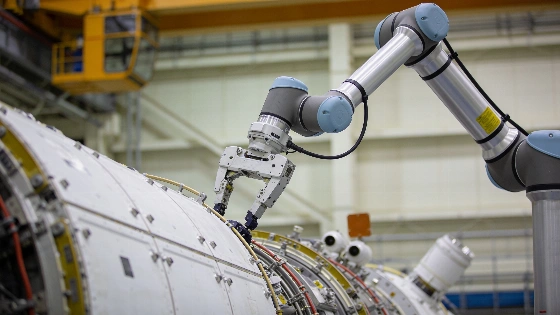
NASA's 2026 ISAM State of Play spans 368 pages and 11 functional areas. Its entry rules require hardware to exist as a ground prototype or flight demonstration while developer profiles point mission planners toward the teams and facilities behind the work
Some companies approached NASA's Langley Research Center hoping the guide could offer competitive intelligence. Questions about proprietary information put the project's impartiality to the test: the team says it holds no such material, and the reference is built around publicly documented capabilities.
Hardware Before Entry
The 2026 edition of NASA's In-Space Servicing, Assembly, and Manufacturing (ISAM) State of Play runs to 368 pages and covers capabilities across 11 functional areas. The entries must meet a physical-evidence threshold: hardware has to exist as a ground prototype or an in-flight demonstration. A presentation describing an idea alone does not qualify.
NASA presents the guide as an encyclopedia and roadmap for technologies that could let spacecraft be serviced, assembled, or manufactured in orbit rather than launched as fully integrated systems. The functional areas include robotic manipulation, refueling and structural assembly. The guide began in 2021, and the 2026 edition continues that catalog with developer profiles and facilities documentation alongside capability descriptions.
That rule separates current engineering work from concepts still on paper. The team reviews submissions for inclusion in a later edition when the technology has progressed enough to meet its criteria.
A Shared Reference
The resource began in 2021 as a way for NASA centers to use a common reference. It now brings together contributions from NASA centers at Ames, Glenn, Marshall, Kennedy and Johnson, along with international developers whose hardware meets the same threshold. Team member John Mulvaney describes the process as collaborative, with interviews helping check entries for accuracy and completeness.
Profiles of developers and documentation of facilities give mission designers context about who is building the hardware and where the work takes place. NASA makes the 2026 guide available for download as a planning reference. NASA's wider mission planning is covered in a JPL mission report that surveys planned work across the solar system.
From Launch to Orbit
ISAM technologies could support missions that conventional single-launch approaches cannot readily accommodate, including telescopes larger than launch vehicle fairings. The source also identifies mobile and resilient national security assets and commercial spacecraft that could receive technology upgrades in orbit without full replacement.
The cover features Astronaut F. Story Musgrave on the Space Shuttle Endeavour's robotic arm during preparations for Hubble's first servicing mission in 1993. NASA describes the 2026 ISAM State of Play as a reference to help mission designers understand both current capabilities and the developers and facilities behind them.







