

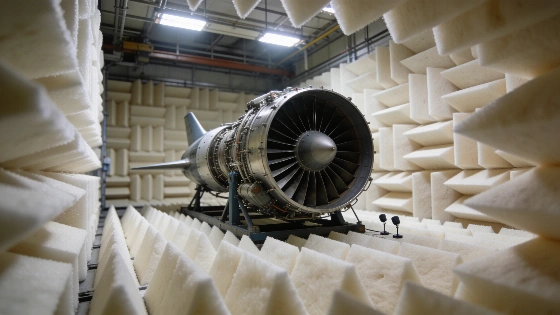
NASA Glenn's acoustic laboratories use sound-absorbing chambers, microphone arrays and engine test rigs to measure noise from jets and aircraft components, helping researchers assess quieter designs and improve predictions
About 17,000 fiberglass wedges line the walls and floor of NASA Glenn Research Center's Aero-Acoustic Propulsion Laboratory, where they absorb sound that would otherwise reflect back toward a test rig. The arrangement lets researchers measure engine noise in a controlled environment, but it does not reproduce every condition of flight. NASA Glenn uses the laboratory to connect acoustic measurements with airflow and engine design, producing data that the aviation noise-reduction community uses to evaluate theories and noise-prediction software.
Inside the acoustic dome
The Aero-Acoustic Propulsion Laboratory (AAPL) is a geodesic dome with a 65-foot radius. Its test area can be set up as either a hemi-anechoic chamber, which has a reflective floor, or an anechoic chamber designed to absorb sound throughout the test space. The custom fiberglass wedges are two feet thick.
Built in 1993, AAPL was the first known free-standing geodesic dome designed both to reduce sound transmission through its walls and absorb sound inside. It contains three rigs for studying engine noise. The Small Hot Jet Acoustic Rig (SHJAR) and Nozzle Acoustic Test Rig (NATR) examine jet flows and nozzle designs; NASA Glenn's DGEN 380 AeroPropulsion Research Turbofan (DART) supports research with a turbofan engine.
From nozzle flow to noise
SHJAR tests single-stream nozzles up to 5 centimeters in diameter at Mach 2.0 and 800 K. Researchers use the rig to investigate how nozzle geometry and jet flow relate to noise. Its measurement techniques include Rayleigh and Raman scattering, digital schlieren, and real-time particle image velocimetry, which tracks moving particles to measure flow.
Three-dimensional microphone arrays map where noise originates. NASA Glenn's Array48 phased-microphone system has also been used to locate sound sources in scale-model jet flows, a counter-rotating open-rotor fan model and a full-scale F404 military engine. Researchers combine acoustic measurements with airflow diagnostics such as hot-wire anemometry, laser Doppler velocimetry and Raman spectroscopy, allowing them to compare the sound field with measurements of the flow.
Measurements from SHJAR have captured changing temperatures in turbulent flows using Raman-based optical methods, as well as turbulent velocity correlations and the speed at which turbulence travels through hot jets. These data help test computer codes used to predict jet noise and inform nozzle design. The work has also examined jet plumes interacting with aircraft wings, flaps and tails; techniques developed on SHJAR have been used on the higher-fidelity NATR.
NASA Glenn engineers also developed rotating microphone-rake procedures in the 1990s to measure tonal mode content in engine noise-data that a stationary microphone cannot capture. The rotating microphones have been used in tests ranging from low-speed demonstrations to ground tests of full-scale turbofan engines.
The methods differ from those used in other aircraft tests: a separate NASA Langley airflow study used pressure-sensitive paint to map wing loads, as shown in an earlier wing experiment.
Testing concepts at scale
NATR is a free-jet wind tunnel for evaluating jet-noise-reduction concepts. Scale models of military and commercial engine nozzles can be tested in simulated takeoff and landing conditions at speeds up to Mach 0.35. A jet engine simulator supplies up to three air streams at different pressures and temperatures to represent turbofan flow. The rig helps researchers screen nozzle concepts before selecting the most promising designs for full-scale engine tests.
Microphones mounted along an overhead arc measure sound at different angles. Those readings help researchers relate the test results to noise heard as an aircraft passes overhead. The rig makes it possible to assess concepts at a fraction of the cost and time of a full-scale engine test, while its large anechoic space supports far-field measurements. NASA Glenn describes it as one of very few facilities worldwide able to make those measurements, and the only one where flow diagnostics and acoustics can be measured on the same rig.
Built to support the High-Speed Research program for commercial supersonic airliners, NATR has hosted NASA and industry tests over its 30-year history. A NASA-led 1997 test campaign first identified chevron nozzles later used on modern aircraft. Other studies have examined noise-prediction methods and lower-noise concepts for future engines, including dual-fan systems, as well as noise expected from supersonic airliners.
Noise beyond the jet
DART uses the DGEN 380 as the primary component of a flexible test bed for aeroacoustic and aerodynamic research. It supports studies of turbofan noise, engine controls, installation effects and measurement technologies. In tests completed in August 2019, researchers measured sound simultaneously with circumferential probes at the core-nozzle exit and microphone arrays at the sideline and farther away. The resulting data support analyses that separate noise sources and examine how sound from the engine core and other sources propagates.
NASA Glenn's Acoustical Testing Laboratory (ATL) serves aeronautics research and human space exploration. Its chamber can be configured for anechoic or hemi-anechoic testing. Dense rubber in the walls and ceiling absorbs or reflects outside sound, while 34-inch-deep fiberglass wedges on the walls and floor are designed to absorb 99% of incident sound above 100 Hz. A separate control room keeps noisy equipment and personnel apart from the test space.
ATL measurements have covered noise from International Space Station experiments, electric motors, aircraft-engine liners and a spacecraft cabin ventilation fan. The laboratory has also been used to calibrate microphones and assess an over-the-wing engine placement intended to reduce takeoff and landing noise. Its chamber makes controlled acoustic measurements; the results describe the test setup and do not by themselves establish how a design will sound in every operating condition.
An anechoic chamber limits reflected sound so microphones can record sound arriving from a test source with less interference from the room. A hemi-anechoic chamber retains a reflective floor, approximating some ground-related reflections while absorbing sound from other surfaces. The distinction matters because measured noise depends on both the source and the acoustic environment around it.







