NASA's SunRISE mission, designed to study solar radio bursts, will now launch aboard a SpaceX Falcon Heavy after technical concerns paused United Launch Alliance Vulcan Centaur flights
NASA's Sun Radio Interferometer Space Experiment (SunRISE) mission has been reassigned to launch on a SpaceX Falcon Heavy rocket, following a series of technical anomalies affecting United Launch Alliance's Vulcan Centaur. The change reflects ongoing reliability concerns with Vulcan's solid rocket boosters, which have prompted the U.S. Space Force to suspend national security launches on the vehicle until the issues are resolved.
Mission Objectives and Scientific Rationale
SunRISE is designed to investigate the origins and propagation of solar radio bursts-intense emissions associated with solar storms that can disrupt satellites, communications, and power infrastructure on Earth. The mission will deploy a constellation of six small satellites, each roughly the size of a mailbox, into a high Earth orbit. Working together as a synthetic aperture radio telescope, these spacecraft will track radio emissions from the Sun, providing data to improve models of space weather and early warning systems for solar storms.
The satellites will be positioned approximately 35,000 kilometers above Earth, just above geostationary altitude, and will fly in a formation spanning about 16 kilometers. Each satellite will extend a 2.5-meter antenna boom, enabling the array to function as a single, large radio instrument. The mission is led by the University of Michigan, managed by NASA's Jet Propulsion Laboratory, and operates under the Explorers Program at Goddard Space Flight Center.
Launch Vehicle Change and Technical Context
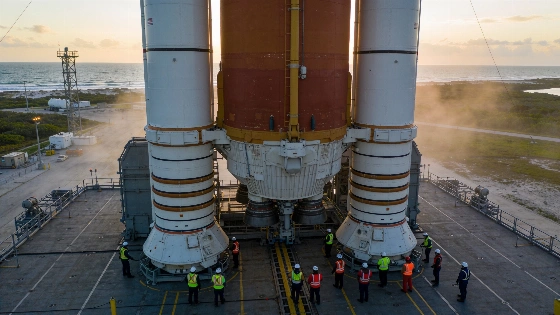
The decision to switch SunRISE from Vulcan Centaur to Falcon Heavy follows a recent Vulcan launch in which a solid rocket booster anomaly was observed-the second such incident in just four flights. Although the affected mission, USSF-87, reached its intended orbit, the recurrence of booster issues led the Space Force's Space Systems Command to halt further national security launches on Vulcan until corrective measures are implemented. This pause has triggered a broader reassessment of launch assignments, with several missions, including SunRISE, now remanifested on alternative rockets.
Falcon Heavy, SpaceX's heavy-lift vehicle, is capable of delivering up to 26,700 kilograms to geostationary transfer orbit. Since its debut in 2018, Falcon Heavy has completed 12 launches, including four for national security payloads. The SunRISE launch will be conducted as part of a rideshare mission sponsored by the U.S. Space Force, though the specific manifest details have not been publicly confirmed. The launch is currently scheduled for later in 2026, with the exact window yet to be announced.
Scientific and Operational Implications
SunRISE will not serve as a real-time alert system for solar storms, but its data are expected to refine predictive models of space weather. By capturing the timing and structure of solar radio bursts, the mission aims to help researchers understand how these signals precede the arrival of energetic particles that can threaten satellites and astronauts. Severe solar storms have previously caused disruptions to satellites and even posed radiation risks to high-altitude flights near Earth's poles, where the planet's magnetic field is weakest.
The SunRISE mission's approach-using a distributed array of small satellites to achieve interferometric radio observations-represents a technical advance in heliophysics instrumentation. The data collected will complement other NASA efforts to monitor and model solar activity, and may inform mitigation strategies for protecting orbital infrastructure. For context, NASA has also pursued airborne campaigns to study Earth's dynamic environment, as described in a recent report on new suborbital missions targeting wildfires, air quality, and glacier retreat.
Remaining Uncertainties and Next Steps
While the reassignment to Falcon Heavy addresses immediate launch reliability concerns, the SunRISE mission still faces operational challenges. The precise rideshare configuration, integration schedule, and commissioning timeline remain to be finalized. Additionally, the mission's scientific return will depend on the successful deployment and calibration of all six satellites, as well as the ability to maintain their formation and synchronize data collection. As with all space-based interferometric arrays, instrument sensitivity, calibration accuracy, and data downlink capacity will be critical to achieving the mission's objectives.
NASA and its partners have not yet released a detailed launch window or finalized the rideshare manifest. The mission's progress will be closely watched, both for its contribution to heliophysics and as a test case for adapting to evolving commercial launch capabilities and policy constraints.
Interferometry is a technique that combines signals from multiple telescopes or antennas to achieve the resolving power of a much larger instrument. In radio astronomy, this method allows widely separated antennas to act as a single, virtual telescope, greatly improving angular resolution. For SunRISE, the six small satellites will coordinate their measurements to reconstruct detailed images of solar radio bursts, enabling scientists to trace the origin and evolution of these signals across space. The success of such an array depends on precise timing, stable formation flying, and careful calibration to ensure that the combined data accurately represent the physical phenomena under study.