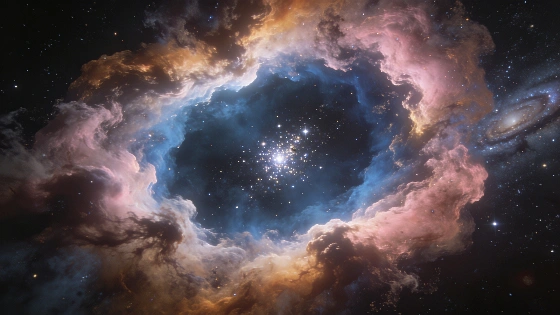
In a Sept. 3, 2026 image, NASA's Hubble Space Telescope shows N44's central void and dusty gas shell. Its roughly 210-by-140-light-year superbubble formed as stellar winds and supernovae drove gas away
At the center of N44, glittering stars occupy a vast void surrounded by dense, dusty gas. NASA's Hubble Space Telescope captured the nebula in an image dated Sept. 3, 2026. Formally designated LHA 120-N44, the emission nebula lies in the constellation Dorado, about 170,000 light-years from Earth in the Large Magellanic Cloud, a satellite galaxy of the Milky Way.
A Hollow at N44's Core
The central void is a superbubble spanning roughly 210 by 140 light-years, a measurement that describes the cavity rather than the full nebular complex. A shell of dense, dusty gas defines its edge, while bright stars occupy the hollow interior, as described by the European Space Agency.
Winds and Explosions
The stars at the void's center are associated with the young cluster NGC 1929. Their intense radiation and powerful stellar winds, followed by supernova shock waves from massive stars, have driven gas outward and excavated the cavity. Together, stellar winds and supernova ejecta sweep surrounding material into shells, creating the large-scale structures known as superbubbles.
Observations of the N44 complex have also detected high-velocity molecular gas near N44BC, an H II-region component on the rim of the expanding shell. A study of carbon-monoxide emission linked this gas to interactions between the molecular cloud and winds or supernova blasts from hot stars in LH 47. The same study reported that the shell's kinetic and thermal energy was comparable to the energy expected from stellar winds and supernovae in a pressure-driven bubble model.
As a superbubble expands, it can compress molecular material along its rim, potentially creating conditions for further star formation. Researchers have also cited N44 as a region where hot gas can escape beyond the visible shell.
Another LMC Region
A separate report on N159 covered another region in the Large Magellanic Cloud, providing a related view of the galaxy's star-forming environments.