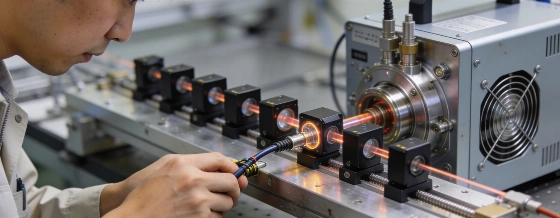
Mitsubishi Electric will lead two NEDO-backed projects aimed at solving control and readout bottlenecks in neutral-atom, trapped-ion, and superconducting quantum platforms intended for million-qubit-scale systems.
The hardest part of a million-qubit quantum computer may not be the qubits themselves. Mitsubishi Electric was selected on September 17, 2026, to lead two Japanese research and development projects focused on the control hardware needed to operate large neutral-atom, trapped-ion, and superconducting systems. The projects are ambitious infrastructure efforts, not evidence that a million-qubit processor has already been built.
Two control problems
The work is supported through the New Energy and Industrial Technology Development Organization's Research and Development Project to Strengthen Post-5G Information and Communication System Infrastructure, specifically its initiative to accelerate the development and demonstration of next-generation quantum computers for solving societal problems. Mitsubishi Electric is the lead organization for both selected projects: "Research and Development of Multi-Qubit-Control Laser Systems" and "Development of Ultra-Compact, Multi-Channel, Low-Noise Amplifier Modules for Large-Scale Superconducting Quantum Computers."
The two efforts address different hardware architectures. Neutral-atom and trapped-ion processors require precisely timed optical operations across arrays of atoms or ions. Superconducting processors instead rely on microwave control and cryogenic readout. The distinction is consistent with the way quantum-engineering programs at institutions such as MIT quantum research separate the physical-control layer from the algorithms and error-correction layer above it.
Neither project is described as a completed quantum computer or as a demonstration of a million-qubit machine. Independent reporting published on September 18 likewise described Mitsubishi Electric as beginning research after the selection, with no completed processor or demonstrated million-qubit system reported.
That distinction matters. The announcement concerns enabling infrastructure: systems intended to reduce control bottlenecks that become more severe as the number of quantum elements increases. In a large processor, wiring, optical paths, calibration routines, thermal budgets, signal integrity, and measurement bandwidth all become system-level constraints rather than isolated component specifications.
Lasers for atom arrays
The first initiative will develop multi-qubit-control laser systems for neutral-atom and trapped-ion quantum processing units. Mitsubishi Electric plans to combine its high-power industrial laser fabrication techniques with field-programmable gate array logic controllers. The stated objective is a low-latency optical platform with multiple channels that can trap, shuttle, and manipulate large arrays of atoms or ions.
In these architectures, the optical system is not a peripheral accessory. Laser frequency, timing, intensity, polarization, and beam placement determine whether individual particles can be confined and controlled without disrupting neighboring operations. Resonant optical interactions must be selective enough to address the intended transition while limiting unwanted excitation, heating, and crosstalk. At larger scale, the challenge is therefore not simply producing more laser power. It is coordinating many optical channels while preserving the timing and selectivity required by the processor.
Field-programmable gate arrays can provide parallel, deterministic timing for control sequences, but their usefulness depends on the complete system: clock distribution, feedback latency, calibration stability, optical routing, and synchronization with the quantum device. The announcement does not provide channel counts, wavelength specifications, timing measurements, optical losses, control fidelities, or results from a completed prototype. Those omissions prevent a quantitative assessment of how close the proposed system is to the demands of a practical processor.
Cryogenic microwave readout
The second project targets superconducting quantum computers through ultra-compact, multi-channel, low-noise amplifier modules. Mitsubishi Electric intends to use monolithic microwave integrated-circuit design to build cryogenic amplifier units that operate inside dilution refrigerators.
Low-noise amplification is central to superconducting-qubit readout. The microwave signal returning from a qubit is weak, and added noise can reduce the fidelity with which the system distinguishes measurement outcomes. In simplified terms, the amplifier must increase the signal before subsequent room-temperature electronics add enough noise to obscure the state-dependent response. Quantum-limited amplification is especially valuable because measurement quality affects both experiment readout and the feedback needed for error management.
Moving amplification closer to the qubits can reduce losses in long signal paths and support denser wiring architectures, but it creates an engineering trade-off. Components placed inside a dilution refrigerator must operate at cryogenic temperatures while adding limited heat and occupying limited space. Every additional channel also requires careful management of electromagnetic crosstalk, connector density, thermal conduction, calibration, and reliability.
The announcement gives no operating temperature, noise figure, cooling-power requirement, channel density, readout fidelity, or durability data, so the practical performance of the proposed modules cannot yet be judged. These are the measurements that would allow researchers to compare the technology with existing cryogenic amplifiers and microwave-readout chains.
The effort has a direct connection to the control challenge examined in earlier quantum research: better error correction depends not only on code design but also on reliable preparation, control, and measurement. A noisy readout chain can undermine the information needed to identify and manage errors even when the underlying qubit architecture is sound. Work discussed across the quantum-information literature, including studies published in Nature, treats measurement fidelity and correlated control errors as important parts of the system-level fault-tolerance problem.
Roadmap, not demonstration
Both projects will be carried out with Japan's National Institute of Advanced Industrial Science and Technology and academic partner institutions. The announcement frames their validation as a foundation for data-center-scale quantum integration in the 2040s, with modular control interfaces supporting Japan's national quantum-computing initiative.
The timeline is a development target rather than evidence that such systems will be deployed on schedule. The material does not report a working million-qubit processor, a logical-qubit count, an error-correction experiment, a useful algorithm, or independent performance testing. It also supplies no comparison with existing control electronics or optical systems. As in other large-scale scientific instruments, including accelerator facilities associated with CERN, the final capability will depend on the interaction of many subsystems rather than on a single headline component.
The measurable facts currently available are therefore limited but clear: Mitsubishi Electric has been selected for two research and development projects; one addresses optical control for neutral-atom and trapped-ion platforms; the other addresses cryogenic low-noise amplification for superconducting platforms; the projects target million-qubit-scale systems in the 2030s; and the proposed infrastructure is linked to data-center-scale integration in the 2040s. These are program goals, not processor specifications.
The industrial significance lies in treating control hardware as a first-order scaling constraint rather than leaving it implicit behind a qubit count. Yet the scientific and engineering case will depend on measurements that have not been reported here: latency, channel density, noise, thermal load, crosstalk, calibration stability, yield, and operation across many devices. Until those data exist, this is credible infrastructure research with an ambitious destination, not evidence that million-qubit quantum computing is ready for deployment.
A physical qubit is an individual controllable quantum system, while a logical qubit stores information across multiple physical qubits or other protected degrees of freedom to manage errors. These projects concern the hardware that prepares, manipulates, and measures physical qubits; they do not themselves demonstrate logical qubits or fault-tolerant computation. That makes the work important but preliminary: scalable control electronics and photonics are necessary foundations, and the absence of reported performance data means the announcement should be read as a serious engineering commitment rather than a completed quantum milestone.