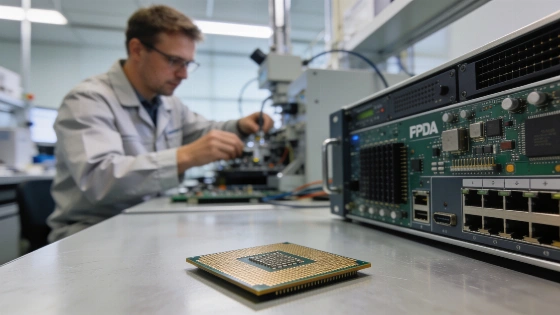
Fortaegis Technologies has raised an oversubscribed $50 million Series A to move its silicon-rooted Secure Compute architecture from technology validation toward commercial production across AI infrastructure, defense, telecommunications, critical infrastructure and automotive systems.
Fortaegis Technologies publicly confirmed an oversubscribed $50 million Series A on 14 September 2026, funding a push to move its hardware-rooted security architecture from technology validation toward commercial production. The Amsterdam startup says its approach can generate encryption keys from microscopic manufacturing differences in silicon rather than storing permanent keys on a chip. The company is targeting AI infrastructure, defense, telecommunications, critical infrastructure and automotive applications.
The company's Fortaegis Silicon Platform combines hardware, firmware, cryptography and software in one full-stack design. Its central physical claim is that unavoidable variation introduced during semiconductor manufacturing can provide a source of cryptographic entropy. That entropy is used to create dynamic encryption keys when they are needed.
This idea belongs to the broader field of physically unclonable functions, or PUFs. In such systems, microscopic differences created during fabrication can produce device-specific responses. A useful implementation must distinguish devices reliably, reproduce its response under changes in temperature and voltage, and prevent an observer from predicting or reconstructing the underlying secret. The NIST PUF definition describes the concept, but a definition alone does not validate Fortaegis's particular implementation.
Fortaegis says the keys are not permanently stored on-chip. If that architecture works as described, an attacker who steals a stored key would have less of a direct target because the key material is generated from the silicon's physical properties instead. That is a hardware-security strategy rather than a new form of quantum computing.
In practical PUF designs, enrollment data or helper information may be needed to reproduce a noisy physical response without revealing the secret itself. Error correction, privacy protection and cryptographic extraction therefore matter as much as the underlying silicon variation. The company's public announcement does not provide the entropy estimates, error rates, environmental stress results or independent attack analyses needed to assess those properties.
The company positions the system against two pressures at once: high-throughput artificial intelligence workloads and the possibility that future large-scale quantum computers could threaten some existing public-key encryption. The announcement does not establish that current quantum computers can decrypt deployed systems, nor does it show that Fortaegis has solved every implementation vulnerability associated with secure computing.
Quantum-safe security also depends on the complete protocol and threat model. A physical entropy source can help create or protect secret material, but it does not by itself select a post-quantum cryptographic algorithm, establish authentication security or prevent endpoint compromise. Work at institutions such as MIT and CERN illustrates why hardware, algorithms and systems engineering must be considered together when evaluating emerging computing-security architectures.
The oversubscribed Series A was led by returning investor Serendipity Capital, which had also backed Fortaegis at an earlier stage. The syndicate includes TEL Venture Capital, the corporate venture arm of Tokyo Electron, along with ASML, TNO, Prodrive Technologies, NP-Hard Ventures, NovaCapital, Access Ventures and Coalition Capital. Fortaegis says the money will support commercial production, expand FPGA deployment and advance a custom ASIC development pipeline.
Serendipity Capital has attributed its interest to an expectation that demand for hardware-rooted security will grow alongside AI and quantum technologies. That is a market rationale, not an independent assessment of Fortaegis's security performance. The new financing is intended to scale production and deployment, making manufacturing repeatability, supply-chain assurance and integration testing central engineering questions.
The company's leadership and board include Ilyas Khan, the Founder of Quantinuum, as Chairman, Boudewijn Wijnands as Founder and CEO, and Chris Miller, author of Chip War, as a U.S. Board Member. Those appointments and the investor list show that the company is seeking support from semiconductor, industrial and defense networks as it moves beyond startup development.
Fortaegis reports holding 17 patents with 14 more pending. Patent activity indicates that the company is protecting an architecture, not that every claimed performance or security property has been independently demonstrated. Patent filings generally describe claimed inventions; they are not substitutes for reproducible benchmarks, certification or peer-reviewed security evaluation.
In customer evaluations, Fortaegis reports secure machine-to-machine connection speeds more than 200 times faster than conventional software cryptographic approaches. The supplied announcement does not specify the evaluated hardware, workload, software baseline, key-management conditions, network configuration, statistical spread or whether the comparison includes the full system cost of deployment.
That missing context matters. A cryptographic operation can be faster in isolation while the complete security workflow remains constrained by communication links, authentication, memory access, firmware, hardware integration or the cost of replacing existing infrastructure. The figure is therefore best treated as a company-reported evaluation rather than a general performance result for all secure-computing workloads.
A scientifically useful benchmark would report the number and type of devices tested, repeated trials, latency and throughput distributions, confidence intervals, environmental conditions, comparator implementation and failure cases. It would also separate silicon key-generation time from encryption, authentication, key exchange and network-transfer overhead. No such sample size or statistical analysis is provided in the announcement.
The same caution applies to the phrase "quantum-resistant." Fortaegis describes its keys as quantum-resistant, but the announcement does not identify a formal security standard, threat model, certification process or independent cryptanalysis. A physical source of entropy can strengthen key generation; it does not by itself define the security of the surrounding cryptographic protocol or endpoint.
Peer-reviewed work in journals such as Nature commonly distinguishes a demonstrated physical mechanism from a validated system-level capability. The same standard is relevant here: independent laboratories would need to examine reproducibility, modeling resistance, side-channel leakage, fault injection, reverse engineering and the security of any helper data used during key reconstruction.
Fortaegis plans to scale deployment on field-programmable gate arrays while developing custom application-specific integrated circuits. An FPGA can provide a practical route for testing and adapting an architecture, whereas an ASIC can be optimized for a defined production design. Neither step alone proves manufacturing yield, long-term reliability, resistance to side-channel attacks or compatibility with every target market.
The distinction is important because Fortaegis is selling a full-stack security architecture rather than a single isolated component. Moving from a customer evaluation to broad use will require stable silicon behavior across devices, secure firmware, reliable cryptographic integration and evidence that the physical entropy source remains usable under operating variation. The announcement supplies no device-yield data, independent audit or field-deployment results.
ASIC production also introduces physical risks that may not appear in an FPGA demonstration. Process changes, packaging, aging, voltage fluctuations and temperature shifts can alter the measurable response of a silicon structure. A production program therefore needs characterization across manufacturing lots and operating conditions, along with procedures for rejecting weak devices and securely handling enrollment information.
The company's funding gives it the resources to pursue those engineering questions, but it is not itself technical validation. The strongest evidence currently described is a company announcement, a reported customer speed comparison and a stated plan to expand FPGA deployment and ASIC development. That is enough to identify a serious hardware-security direction, not enough to establish universal protection against post-quantum threats.
Silicon-rooted key generation is a credible hardware-security concept because manufacturing variation is physical and difficult to reproduce exactly. The decisive test will be whether Fortaegis can document entropy quality, attack resistance and system-level performance across real deployments rather than selected evaluations. Until those data are available, the $50 million round is best understood as financing the transition from protected architecture to verified product engineering-not proof that the post-quantum security problem has been solved.
Fortaegis's approach also belongs beside other European efforts to harden communications against future quantum threats, including the earlier network work that combines quantum key distribution with post-quantum cryptography. The distinction is that Fortaegis places its claimed security root in silicon properties and key generation rather than in a communications platform alone.
A physical unclonable source is not the same thing as a complete cryptographic system. The silicon variation must produce sufficiently unpredictable and stable output, while the protocol must protect keys during use and the surrounding hardware must resist leakage. That is why Fortaegis's funding matters as an engineering commitment, but the available evidence supports a measured conclusion: it has raised capital to develop a promising hardware-rooted security architecture, while its broad security and performance claims still require detailed independent testing.