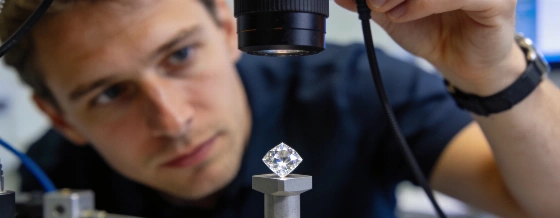
University of Pennsylvania researchers entangled an electron spin with three nuclear memory qubits in diamond at room temperature using one dynamical decoupling sequence rather than a chain of pairwise gates
A four-qubit quantum state has been created in a diamond register in 14.8 microseconds using a single control sequence at room temperature. The University of Pennsylvania experiment replaced the usual series of pairwise entangling gates with one parallel operation that deliberately uses interactions normally treated as crosstalk. The peer-reviewed study appeared online in Nature Nanotechnology on 14 September 2026.
The diamond register
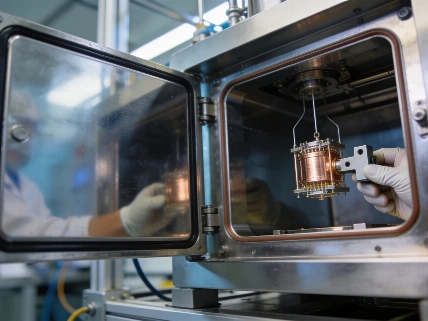
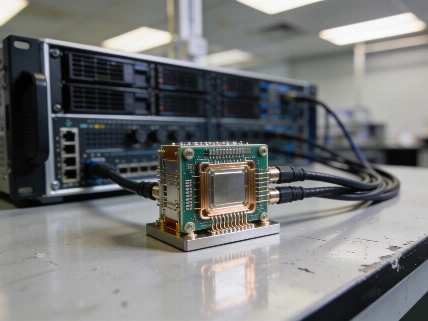
The device is a nitrogen-vacancy center in diamond. Its central electron spin served as one qubit while three nearby carbon-13 nuclear spins acted as memory qubits. The experiment therefore combined an electron-based control element with longer-lived nuclear-spin storage within one solid-state system.
Researchers prepared a four-qubit Greenberger-Horne-Zeilinger state in which the four spins share genuine multipartite entanglement. The work experimentally generated this GHZ state from one electronic NV-center spin and three weakly coupled nuclear qubits. This is not a claim that the register performed a useful algorithm or contained a logical qubit. It is a demonstration of state preparation and control on four physical qubits under ambient room-temperature conditions.
The key engineering choice was to stop treating every unintended phase shift as purely harmful. In a conventional central-spin register the electron is coupled to individual nuclear spins through sequential two-qubit gates. Non-targeted nuclei can accumulate phase errors during those operations. The Penn method instead tunes the pulse interval and repetition count of an XY8 dynamical decoupling sequence so that several weak couplings produce coordinated conditional rotations.
One sequence instead of four
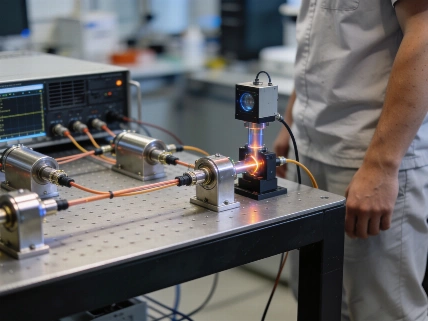
The control sequence uses dynamical decoupling, a pulse-based method commonly employed to suppress unwanted evolution of a spin. Here the timing is selected to make the sequence resonant with the relevant perpendicular hyperfine couplings. The same interaction that creates crosstalk in a sequential protocol becomes the mechanism for parallel entanglement.
The reported four-qubit operation took 14.8 microseconds compared with about 139.9 microseconds for the sequential comparison. That is approximately a tenfold reduction in gate duration. The researchers report a four-qubit fidelity of 0.92(4) for the parallel protocol versus 0.69(3) for the sequential approach; for three qubits the corresponding values were 0.88(3) and 0.77(3). The relevant perpendicular hyperfine coupling was approximately 60 kilohertz, placing the operation near the physical interaction limit identified for the register.
Those figures describe this specific entangling experiment rather than a universal processor benchmark. The result does not establish a general computational speedup over classical machines because no computational task or classical runtime comparison was reported. Nor does it show that the sequence will retain its performance as the number of coupled spins increases.
How entanglement was checked
The team used multiple quantum coherence phase-amplification measurements to test the prepared states. Multiple quantum coherences, or MQCs, probe coherence orders associated with collective spin correlations and were used here to confirm genuine four-qubit entanglement rather than a mixture of independent pairwise correlations. This verification is central to the claim: the experiment demonstrated preparation and characterization of an entangled state, not execution of a quantum algorithm.
The evidence comes from a peer-reviewed study in Nature Nanotechnology. Statistical simulations of 500 randomly sampled weakly coupled central-spin registers indicated that comparable parallel sequences exist across a majority of naturally occurring configurations. The simulations support the generality of the control idea, but they are not additional laboratory demonstrations and do not substitute for device-by-device calibration.
The distinction matters because hyperfine couplings vary between naturally occurring registers. A sequence that is well matched to one set of frequencies may require different pulse timing or repetition count in another. Calibration drift, imperfect control pulses and interactions outside the selected target set can still affect the realized state. The comparison with sequential gates shows that crosstalk can be reorganized into a useful operation, not that crosstalk has disappeared.
From register to system
The approach fits into the same engineering conversation as surface code testing: improving quantum hardware depends not only on adding qubits but on controlling interactions and suppressing errors across the full register. In this diamond experiment the immediate gain is lower entangling latency and higher measured state fidelity for a small physical system. Like other results reported in Nature-family journals, its significance lies in a specific advance in experimental control rather than in a complete computing architecture.
The proposed control framework could be adapted to other diamond color centers such as SiV or ST1 and to defect registers in silicon carbide or silicon. The input evidence supports those as possible extensions of the methodology rather than completed demonstrations. Applications mentioned for the method include quantum error-correction protocols, quantum memory nodes and room-temperature quantum sensing, but the experiment itself did not implement a fault-tolerant code, a networked memory or a field sensor.
That boundary is important. The register contains four physical qubits, not four logical qubits protected against errors. The reported fidelity is a state-level result for a particular prepared entangled state, not proof of long-term stability, scalable connectivity or fault-tolerant computation. No independent replication is identified in the supplied material, and the simulations do not resolve fabrication variation or calibration overhead in larger devices.
What Penn has demonstrated is narrower and more useful than a sweeping claim about quantum computing: a carefully timed pulse sequence can convert an unwanted interaction into a parallel entangling resource in a room-temperature diamond register. The tenfold timing improvement and higher measured fidelities make that a credible control advance, while the absence of a logical-qubit demonstration or application benchmark keeps it firmly in the laboratory-prototype category. In quantum hardware, that is the right verdict: a meaningful result because it improves how physical qubits are manipulated, not because it has already solved scaling.
Entanglement links the quantum states of separate physical systems so that their joint state cannot be described as independent single-spin states. It is not the same as a logical qubit, which encodes information across physical qubits to detect or correct errors. A fast entangling gate can therefore strengthen a future architecture without by itself providing error correction or a useful quantum computation.