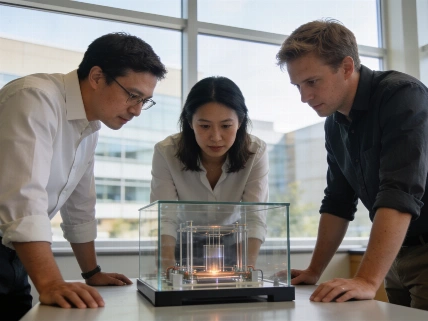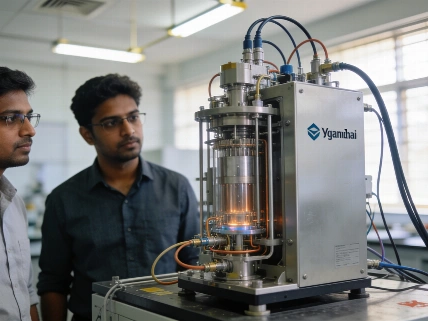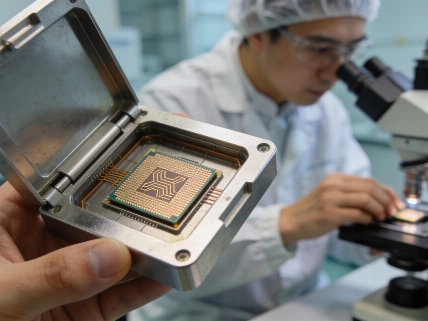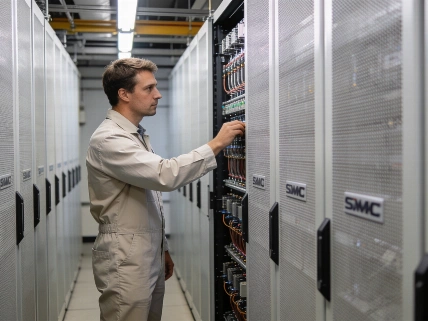
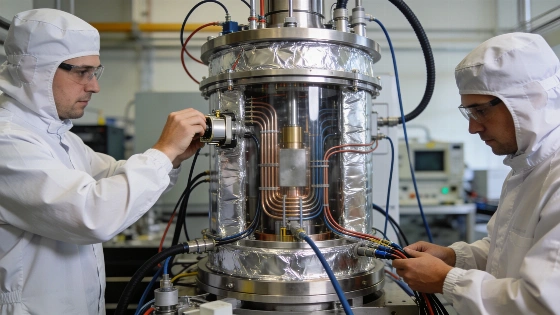
Maybell Quantum is deploying four dilution refrigerators at the Roadrunner Quantum Lab in Albuquerque, providing shared cryogenic infrastructure for quantum hardware startups and researchers as part of New Mexico's quantum technology initiative
Maybell Quantum, a Denver-based supplier of cryogenic infrastructure, has announced the deployment of four dilution refrigerators at the Roadrunner Quantum Lab (RQL) in Albuquerque, New Mexico. These refrigerators are engineered to reach millikelvin temperatures, a regime essential for operating superconducting and spin-qubit quantum processors. The installation marks Maybell Quantum as the third major equipment provider to anchor the RQL, joining Qunnect and QuEra Computing in supporting the state's growing quantum technology ecosystem.
The four dilution refrigerators are designed to provide ultra-low temperature environments for quantum devices, enabling the operation of superconducting circuits and semiconductor spin qubits that require temperatures below 100 millikelvin to maintain quantum coherence. According to the company, the shared infrastructure model will allow up to five startup teams and 20 to 30 researchers to access the cryogenic systems, control electronics, and networking equipment without the need to build dedicated laboratory facilities. This approach is intended to lower the capital and operational barriers that have historically limited early-stage quantum hardware development.
Shared Cryogenic Access
Acquiring and configuring high-performance dilution refrigerators is one of the most significant capital challenges for quantum hardware startups. These systems typically require substantial investment, long lead times, and specialized technical expertise for installation and maintenance. By centralizing cryogenic resources at the RQL, Maybell Quantum aims to reduce duplication of infrastructure and accelerate the pace at which new quantum devices can be fabricated, tested, and benchmarked. The company is also recruiting local engineering and technical staff in Albuquerque to support lab operations and assist with integration for new tenants.
The installation is scheduled for completion by September 2026, with researchers expected to begin using the refrigerators as soon as calibration is finalized. The financing model combines direct purchases by Roadrunner Venture Studios with additional units supplied by Maybell Quantum, reflecting a public-private partnership structure. The RQL's target capacity is to host at least five startup teams and up to 30 onsite researchers, providing a collaborative environment for quantum hardware development and testing.
Full-Stack Quantum Testbed
With the addition of Maybell Quantum's dilution refrigerators, the RQL now offers a full-stack quantum testing environment. Qunnect provides an open-access quantum networking loop, while QuEra Computing operates a $4 million neutral-atom quantum testbed. This combination allows startups, university researchers, and scientists from national laboratories-including Sandia National Laboratories and Los Alamos National Laboratory-to access centralized resources for device development, benchmarking, and integration across multiple quantum platforms. The facility is already being used by regional research teams ahead of its formal public opening, which is scheduled for the fall.
The expansion is part of New Mexico's $450 million statewide quantum initiative, which began with a $25 million public-private partnership established in August 2025 between Economic Development New Mexico and Roadrunner Venture Studios. The initiative is intended to position the state as a hub for quantum research and commercialization, with a focus on infrastructure, workforce development, and industry partnerships. Maybell Quantum's involvement reflects the increasing demand for cryogenic hardware as quantum computing research scales from laboratory prototypes to multi-user facilities.
Engineering and Scalability Challenges
While shared cryogenic infrastructure can lower entry barriers for startups, significant engineering challenges remain. Dilution refrigerators require careful thermal management, vibration isolation, and ongoing maintenance to ensure stable operation at millikelvin temperatures. Wiring, filtering, and control electronics must be compatible with the noise and thermal constraints of quantum devices. As more teams share the same infrastructure, scheduling, calibration, and cross-talk between experiments become practical concerns that must be managed to maintain device performance and measurement integrity.
Maybell Quantum's deployment at the RQL is part of a broader effort to scale its manufacturing and support operations to meet global demand from research institutions, hyperscale data centers, and national laboratories. However, the transition from laboratory-scale demonstrations to reliable, multi-user quantum testbeds will require continued investment in engineering, technical support, and operational protocols. The company has not disclosed detailed performance metrics for the installed refrigerators, and independent benchmarking of system stability and uptime will be important for evaluating the long-term impact of the shared infrastructure model.
Each dilution refrigerator in the RQL deployment is engineered to reach temperatures in the millikelvin range, typically below 20 mK, which is necessary for operating superconducting and spin-qubit devices. The facility is designed to support at least five startup teams and 20-30 researchers, with installation scheduled for completion by September 2026. The total investment in the statewide quantum initiative is reported at $450 million, with an initial $25 million allocated through a public-private partnership. The RQL's existing anchors include Qunnect's quantum networking loop and QuEra Computing's neutral-atom testbed, providing a range of quantum hardware and networking capabilities under one roof.
Cryogenic operation is a fundamental requirement for many leading quantum computing platforms. Superconducting qubits and semiconductor spin qubits both rely on extremely low temperatures to suppress thermal noise and maintain quantum coherence. Dilution refrigerators achieve these temperatures by mixing helium-3 and helium-4 isotopes, enabling continuous cooling well below 1 kelvin. However, the complexity, cost, and maintenance demands of these systems have historically limited access to well-funded research groups and large companies. Shared cryogenic infrastructure, as implemented at the RQL, is intended to make advanced quantum hardware development more accessible to a broader range of teams, but it does not eliminate the technical challenges of device fabrication, calibration, and error mitigation that remain central to the field.