A detector assembly for NASA's COSI gamma-ray telescope was raised from a laboratory table on July 8, 2026, revealing hardware designed to study matter, antimatter and dying stars as the mission prepares for a planned 2027 launch.
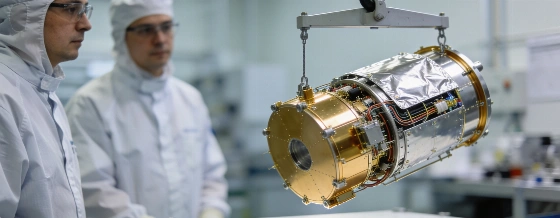
A small detector box lifted slowly from a laboratory table on July 8, 2026, carrying the most tangible part of COSI's scientific ambition: a wide-field gamma-ray telescope intended to examine some of the Milky Way's most energetic processes. The image records an engineering moment rather than an astronomical result, but it shows the instrument's detector assembly moving into a form that can be inspected and handled as a complete unit.
UC Berkeley engineers and managers watched as the assembly was raised in the laboratory. Four silver coverings on the top of the detector box conceal flex circuits, the signal-carrying connections that link the detectors to the readout electronics. That pathway is central to the instrument's job: radiation interacting with the detector must ultimately become an electronic signal that the telescope can process.
The photograph is therefore more than a record of machinery being moved. It exposes the physical interface between the sensing elements and the electronics responsible for reading them, while also showing why scientific instruments depend on careful mechanical integration before they can produce measurements.
COSI is the Compton Spectrometer and Imager, led by John Tomsick of the University of California, Berkeley's Space Sciences Laboratory. The mission is intended to study soft gamma rays, including signals that can help researchers trace the production of elements in supernova-related processes. Unlike visible-light telescopes, it will investigate astrophysical events through highly energetic photons that can carry information about nuclear reactions, radioactive decay and extreme stellar environments.
COSI is designed as a wide-field gamma-ray telescope. Gamma rays occupy the highest-energy portion of the electromagnetic spectrum, so the mission's scientific target is not ordinary visible-light scenery but energetic activity in the Milky Way and beyond. Its stated goals include studying the creation and destruction of matter and antimatter and examining the final stages of stellar lives.
Those goals make the detector assembly the scientific core of the mission. A telescope can only study distant high-energy events if its detectors capture the incoming signals and its readout electronics preserve the information needed for later interpretation. The image does not show those future observations, and it does not establish that COSI has begun collecting science data; it shows hardware being assembled and moved in a laboratory.
The instrument remains in preparation rather than operation. A NASA mission listing places COSI among upcoming missions in September 2026. Independent reporting also describes preparations for a planned 2027 launch, while another account identifies Cape Canaveral as the expected launch site. These updates establish an active development and launch-preparation phase, not an observatory already collecting data in orbit.
The mission brings together the University of California, Berkeley's Space Sciences Laboratory, the University of California, San Diego, the Naval Research Laboratory, NASA's Goddard Space Flight Center, Northrop Grumman, Space Dynamics Laboratory, the Italian Space Agency and other research institutions. That list reflects the distributed engineering structure behind a modern space observatory, in which detector hardware, electronics and mission systems must be integrated across organizations.
The four covered flex circuits are a useful reminder that the most consequential parts of a telescope are often hidden from the final public image. The detector box may appear compact, yet its scientific output depends on signals moving reliably from the sensing hardware to the electronics that read them. COSI's eventual conclusions about gamma-ray sources will rest on that chain of physical components as much as on the analysis performed after data arrive.
In a detector, incoming radiation is converted into signals that electronics can record and analyze. The flex circuits shown here carry those signals away from the detectors to the readout system, where the information can be prepared for scientific use. That conversion is what separates a telescope's physical hardware from the gamma-ray evidence researchers will eventually interpret.
The scene also differs sharply from the finished astronomical imagery familiar to the public. In an earlier Hubble report, the central evidence was a processed view of a nebula; here, the evidence is a detector assembly before it has produced any comparable view of the sky.
COSI's scientific value will be determined by measurements from its gamma-ray detectors, not by the appearance of the hardware alone. Still, the July 8 image captures a necessary threshold: the instrument's sensing components and signal connections are being treated as an integrated assembly rather than as isolated parts.
That distinction matters. A laboratory photograph cannot reveal the telescope's eventual sensitivity, the quality of its observations or the discoveries it may make. It does show that the mission's path to studying matter, antimatter and stellar death runs through concrete engineering work, including the careful protection and routing of detector signals.
The strongest reading of this image is therefore neither a discovery claim nor a promise of one. It is evidence of a mission instrument taking physical shape, and that is the right scale at which to judge it: COSI has reached a visible hardware milestone while its scientific verdict still depends on measurements yet to be made.
NASA's continuing designation of COSI as an upcoming mission is consistent with that cautious interpretation. The current reporting does not establish a new detector mass, budget or separate launch date for the detector assembly itself. The clearest timing information is the reported preparation for a 2027 mission launch, leaving the instrument's eventual performance and scientific findings to be determined after deployment and commissioning.