
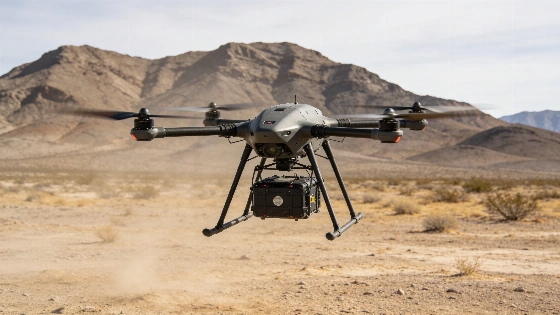
NASA's SPLICE system has completed simulated lunar descent and landing maneuvers aboard an Alta-X drone near Armstrong Flight Research Center, testing navigation designed for difficult lunar and planetary terrain.
A drone has completed simulated lunar descent and landing maneuvers with NASA's Safe and Precise Landing - Integrated Capabilities Evolution system, or SPLICE, putting the agency's precision-navigation technology through a terrestrial flight test designed around the demands of landing beyond Earth.
The experiment was flown on an Alta-X drone near NASA's Armstrong Flight Research Center in Edwards, California. An independent summary dates the flight to Aug. 27, 2026, and reports that the operation was coordinated with Edwards Air Force Base air traffic control. The aircraft carried the guidance and navigation system through maneuvers that reproduced key elements of a lunar descent without leaving Earth.
The test matters because a landing vehicle must do more than reach the vicinity of its destination. It must determine where it is, guide its trajectory and process navigation information quickly enough to reach a selected surface area. SPLICE combines specialized navigation, guidance and processing techniques for that purpose, according to NASA's description of the experiment.
Real-time processing is central to the intended use of the system. During descent, navigation data can help identify hazards and support decisions about where a vehicle should proceed, while guidance converts those decisions into a flight path. The available reporting describes this as a technology demonstration aimed at improving hazard detection and precision landing, not as a completed lunar mission.
An image dated Aug. 27, 2026, shows the remotely piloted four-rotor Alta-X carrying the experiment during the flight. The photograph records the hardware in operation; it does not itself measure the system's landing accuracy or establish how the technology would perform during an actual lunar mission.
Researchers at NASA's Johnson Space Center in Houston developed SPLICE. During the reported testing, the system successfully completed simulated lunar descent and landing maneuvers. The result is therefore a technology demonstration in a controlled Earth-based environment rather than a landing on the Moon.
That distinction is central. The test shows that the navigation architecture can be exercised through representative descent and landing maneuvers on a drone, but the available account does not provide numerical results for position error, descent speed, landing dispersion, processing time or performance under lunar lighting and terrain conditions. Without those measurements, the announcement supports a technical milestone but not a complete assessment of mission readiness.
The system is intended to help spacecraft land in hard-to-reach and previously unknown areas of high scientific interest. NASA identifies the Moon, Mars, icy worlds and other destinations as potential settings for the technology. These destinations differ sharply in gravity, surface structure, illumination and atmospheric conditions, so a successful drone test cannot be treated as a direct substitute for flight validation at each one. NASA presents the broader goal as enabling safe and precise landings in terrain that may be scientifically valuable but difficult to access.
Landing precision determines which parts of another world can be approached safely. A system that can guide a vehicle toward scientifically valuable terrain could expand access beyond broad and relatively predictable landing zones. That is the practical significance NASA assigns to SPLICE.
The value of the experiment is best understood alongside the hardware challenge itself. Guidance calculates how a vehicle should move, navigation estimates its position and motion, while onboard processing turns sensor information into decisions quickly enough to control the descent. The available description identifies all three functions within SPLICE, but it does not identify the individual sensors, algorithms, test thresholds or comparative performance of earlier systems.
NASA's space technology work also spans instruments built for very different environments, including a gamma-ray detector being prepared for astronomy. SPLICE belongs to another part of that engineering landscape: it is not designed to collect distant cosmic radiation but to help a spacecraft reach and operate near a planetary surface. Further details about NASA's wider technology portfolio are available through NASA technology programs.
The strongest conclusion is therefore measured rather than promotional. SPLICE has cleared a simulated lunar descent and landing test on an Alta-X drone, demonstrating that its guidance, navigation and processing functions can be exercised together in flight. The evidence supports continued development for lunar and planetary landing applications, while the missing performance data mean the experiment does not yet establish how accurately or reliably the system would land on another world.
In navigation testing, "successful" describes completion of the stated maneuver or test objective. It does not automatically mean that every operational requirement has been met. A full mission assessment would require defined accuracy targets, environmental testing and measurements that allow engineers to compare the system's estimated position and commanded trajectory with the vehicle's actual motion.
Those details are not included in the available account. The evidence is enough to identify what happened and why NASA is testing the technology, but not enough to rank SPLICE against alternative landing systems or predict a specific lunar mission outcome. This distinction between a completed demonstration and demonstrated operational readiness is also consistent with the evidence standards expected in high-impact scientific publishing, including journals such as Nature.
Guidance and navigation systems work by repeatedly estimating a vehicle's state from available measurements and updating its trajectory. In a simulated descent, the aircraft provides a controllable platform for testing that loop: navigation determines the vehicle's position, guidance selects the required path and onboard processing supports the next control decision. The flight therefore demonstrates integrated operation, while the exact precision depends on the sensors, algorithms, environmental conditions and performance thresholds that were not reported here.