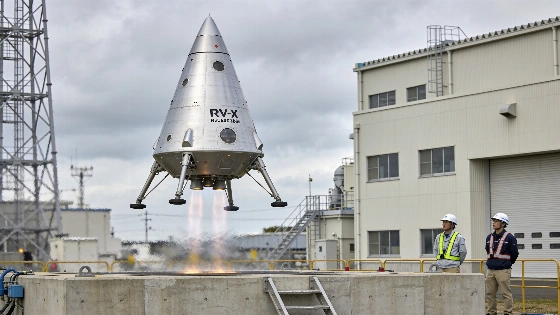
Japan Aerospace Exploration Agency has conducted a 40-second test flight of its RV-X prototype, marking a significant milestone in the country's pursuit of reusable launch vehicles and advancing international collaboration in spaceflight engineering
Japan has advanced its ambitions in reusable launch technology with the first successful test flight of the RV-X prototype, an experimental vehicle developed by the Japan Aerospace Exploration Agency (JAXA) and Mitsubishi Heavy Industries. The brief demonstration, conducted at JAXA's Noshiro test facility on July 11, marks a concrete step toward the development of reusable orbital rockets, a capability currently realized by only a few international programs.
Test Flight and Technical Details
The RV-X prototype, standing 7.3 meters tall and powered by a single engine, executed a controlled vertical takeoff and landing maneuver. During the 40-second test, the vehicle ascended just over 10 meters above the ground and traversed approximately 15 meters horizontally before performing a soft landing on the opposite side of the concrete pad. The flight was designed to validate guidance, propulsion, and landing systems under real-world conditions, with all major objectives reportedly achieved.
This demonstration places Japan among a select group of nations and companies that have achieved vertical takeoff and landing with reusable rocket stages. Comparable milestones have been reached by SpaceX with Falcon 9, Falcon Heavy, and Starship, Blue Origin's New Glenn, and China's Long March 10B. The RV-X's performance is reminiscent of early "hopper" tests by SpaceX, which used similar low-altitude flights to refine landing technology.
International Collaboration and Future Plans
The RV-X serves as a precursor to the CALLISTO project, a joint initiative involving JAXA, France's CNES, and Germany's DLR. CALLISTO aims to develop a single-stage, reusable rocket capable of vertical launch, landing, and refurbishment. The RV-X's successful test is expected to inform operational procedures and technical design for CALLISTO, which will further Japan's entry into the competitive field of reusable launch services.
Japan's current flagship rocket, the H3, entered service in 2023 but was not designed for reusability. While the H3 offers improved efficiency over its predecessor, the H-2A, it has experienced partial failures in two of its eight launches and remains less cost-effective than reusable alternatives. The RV-X and subsequent projects are intended to address these limitations by enabling repeated use of launch hardware.
Operational Challenges and Next Steps
Developing reusable rockets involves more than technical demonstration; it requires establishing reliable maintenance, turnaround, and launch pad operations. JAXA has emphasized the importance of verifying these procedures through repeated experimental flights. The next planned RV-X test aims for a higher altitude of up to 100 meters, with additional lateral movement and hover capability before landing.
Japan's progress in reusable launch technology comes amid a broader international trend toward cost reduction and operational flexibility in spaceflight. Other nations are also advancing private and public sector launch capabilities, as seen in India's upcoming attempt to launch its first privately developed orbital rocket, Vikram-1, which will test key systems and deliver small payloads to orbit (India's private sector launch preparations).
Scientific and Engineering Implications
The RV-X test provides valuable data on the performance of reusable rocket systems under controlled conditions. Engineers will analyze telemetry from the flight to refine guidance algorithms, landing accuracy, and vehicle durability. These insights are critical for scaling up to larger, orbital-class vehicles and for integrating reusable stages into operational launch services.
While the RV-X's initial flight was limited in altitude and duration, it establishes a foundation for more ambitious tests and international collaboration. The transition from experimental hops to routine, high-altitude recoveries will require further technical advances and operational experience, but the successful demonstration marks a tangible advance for Japan's space program.
Vertical takeoff and landing (VTVL) technology is central to the development of reusable rockets. In a VTVL system, a rocket launches vertically, completes its mission or test maneuver, and then returns to land upright using controlled engine burns and guidance systems. This approach allows for the recovery and refurbishment of major rocket components, reducing costs and enabling more frequent launches. Achieving reliable VTVL operations requires precise control of thrust, navigation, and landing gear, as well as robust procedures for post-flight inspection and maintenance. The RV-X test represents an early but essential step in validating these capabilities for future Japanese and international launch vehicles.