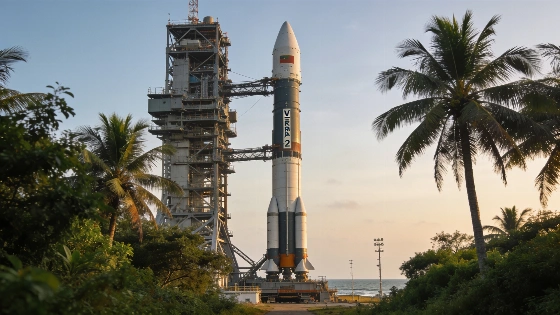
Skyroot Aerospace will attempt to launch Vikram-1, India's first privately developed orbital rocket, from Sriharikota on July 18. The mission aims to deliver multiple small payloads to low Earth orbit and test key launch systems
India's commercial space sector is poised for a significant milestone as Skyroot Aerospace prepares to launch Vikram-1, the country's first privately developed orbital-class rocket. The mission, scheduled for July 18 from the Satish Dhawan Space Centre on Sriharikota island, will test the vehicle's ability to deliver small satellites to low Earth orbit and assess the performance of its core systems under operational conditions.
Vikram-1 Targets India's First Private Orbital Launch
Vikram-1 is a four-stage, solid-fueled launch vehicle designed to serve the growing market for small satellite deployment. According to Skyroot Aerospace, the rocket stands approximately 25 meters tall and is engineered to carry up to 350 kilograms of payload to a 450-kilometer Sun-synchronous orbit. The upcoming flight, named Aagaman, meaning "Arrival," will carry a mix of customer and demonstration payloads, including technology from German and Indian startups, as well as Skyroot's own SCOPE satellite for in-flight data collection.
The launch window for Vikram-1 opens at 11:30 a.m. India Standard Time, or 06:00 GMT and 2:00 a.m. EDT, on July 18, with live coverage planned by Skyroot Aerospace. If weather or technical issues delay liftoff, the window extends through August 4. The mission's primary objective is to validate the rocket's flight systems, guidance, and payload deployment mechanisms, rather than to deliver operational satellites for immediate use.
Skyroot Aerospace, based in Hyderabad and founded in 2018, previously achieved a suborbital flight with its Vikram-S vehicle in 2022, marking the first time a private Indian company reached space. The Vikram-1 mission represents a step forward, as it targets a stable orbit and involves the deployment of multiple payloads.
Demonstration Payloads Will Test New Space Technologies
Among the payloads are a technology demonstration from DCUBED in Germany, the Solaras S3 nanosatellite pathfinder from Grahaa Space in India, and Embrace, a robotic arm designed by Cosmoserve Space to test debris-capture technology. Symbolic payloads include a small gold rocket sculpture and a jewelry piece created with lab-grown gems.
India's entry into private orbital launch capability comes amid a global surge in demand for small satellite launches, with established and emerging providers seeking to address limited launch availability. Skyroot's approach is to offer dedicated, on-demand launches for small payloads, a market segment that has seen rapid growth but remains supply-constrained.
The company's leadership, including former Indian Space Research Organisation engineers, emphasizes the importance of iterative testing and data-driven improvement as it moves toward routine commercial operations.
Flight Data Will Shape Skyroot's Commercial Plans
While the Vikram-1 mission is a technical demonstration, its outcome will inform the company's future launch cadence and reliability. The mission's success or failure will also be closely watched by India's space sector, which has seen increased private participation following regulatory changes.
The broader context of commercial launch competition is illustrated by recent developments such as SpaceX's Starship test flights, which have also focused on deploying new satellite technologies, as discussed in Science Report's coverage of Starship's Starlink V3 deployment mission.
Skyroot's test flight is not intended to mark the start of routine launches, but rather to gather in-flight data, validate design choices, and identify areas for refinement. The company has stated that lessons from this mission will guide further development, with the goal of establishing a reliable, flexible launch service for small satellites from India.
Vikram-1's payloads are scheduled for deployment at an altitude of approximately 450 kilometers if the mission proceeds as planned. Confirmation of successful orbit insertion and payload separation will depend on telemetry received during and after the flight. As with all inaugural launches, technical risks remain, and the mission's outcome will shape the trajectory of India's private launch sector.
Why Orbital Insertion Is the Mission's Critical Test
Understanding orbital insertion is central to interpreting the significance of this mission. Orbital insertion refers to the precise maneuver in which a rocket or spacecraft transitions from a suborbital trajectory to a stable orbit around Earth.
This process requires accurate timing, velocity, and guidance to ensure that the payload achieves the intended altitude and inclination. Successful orbital insertion is a prerequisite for most satellite operations, and any deviation can result in mission failure or loss of payload.
For new launch vehicles, demonstrating reliable orbital insertion is a critical step toward commercial viability and scientific utility.