Japan's Institute for Molecular Science has launched 'Shunkai,' a neutral-atom quantum computer integrating optical tweezer arrays and room-temperature control, with an initial 50-qubit platform and plans for future scaling
The Institute for Molecular Science (IMS) in Japan has announced the operational deployment of 'Shunkai,' a neutral-atom quantum computer platform that integrates both hardware and software stacks. Developed through a partnership involving IMS, Hitachi, Ltd., and Infleqtion, Inc., the system is the first in Japan to offer a full-stack neutral-atom architecture, combining user-level software with direct control of physical qubits based on neutral rubidium atoms. The project is led by Professor Kenji Ohmori under the Japanese Cabinet Office / JST Moonshot Research and Development Program, with the stated goal of advancing toward fault-tolerant quantum computing using neutral-atom technology.
Neutral-Atom System and Architecture
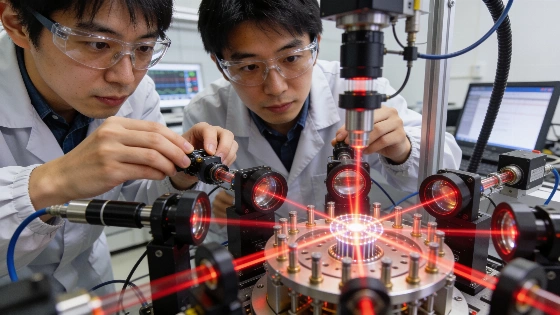
Shunkai's quantum processing unit (QPU) traps individual neutral rubidium atoms in a two-dimensional array using optical tweezers-tightly focused laser beams manipulated through high-numerical-aperture objective lenses. Quantum logic gates are implemented by applying targeted microwave and laser pulses, while high-resolution fluorescence imaging enables single-atom readout. Unlike superconducting or trapped-ion systems, Shunkai operates at room temperature, eliminating the need for cryogenic dilution refrigerators. The platform's architecture allows for dynamic reconfiguration: atoms can be physically moved within the array during computation, supporting all-to-all connectivity and flexible circuit topologies.
Integration and Control Stack
The system's software and control stack, developed by Hitachi, orchestrates the full workflow from user-level programming to low-level laser and microwave control. Infleqtion contributed the QPU hardware and electronics, while IMS coordinated the integration and experimental validation. The initial deployment features approximately 50 physical qubits, with a roadmap targeting 500 qubits in a subsequent phase and an aspirational goal of 10,000 physical qubits by 2031. The project's roadmap includes staged external access, with partial cloud-based availability for academic and corporate researchers to test algorithms and quantum error correction protocols as the system scales.
Roadmap, Limitations, and Commercialization
Shunkai's launch marks the transition to Stage 2 of the Ohmori Moonshot Project, which aims to demonstrate a fault-tolerant quantum computer by March 2031. The system's current scale-50 physical qubits-places it within the noisy intermediate-scale quantum (NISQ) regime, where error rates and circuit depth remain limiting factors for practical computation. The platform's room-temperature operation and dynamic atom transport offer potential advantages in connectivity and reconfigurability, but the engineering challenge of scaling to thousands of high-fidelity qubits with robust error correction remains unresolved. Commercial application development is being pursued by Yaqumo Inc., an academic spin-out, while IMS plans to integrate Shunkai with its high-performance computing facilities to establish a hybrid quantum-classical research hub. For context, recent developments in quantum hardware-including efforts to advance silicon spin-qubit processors-highlight the diversity of approaches and the ongoing challenge of scaling quantum systems beyond laboratory prototypes, as seen in coverage of new silicon spin-qubit initiatives.
Technical Evidence and Open Questions
At launch, Shunkai's 50-qubit platform provides a testbed for algorithm development, quantum error correction experiments, and benchmarking of neutral-atom control techniques. The system's performance metrics-such as gate fidelity, coherence time, and readout fidelity-have not yet been independently published, and the transition from physical to logical qubits with error correction remains a future target. The project is supported by the Japanese government's Moonshot R&D Program and the MEXT Quantum Leap Flagship Program, reflecting a broader national strategy to establish sovereign quantum infrastructure. While the roadmap is ambitious, the practical realization of a fault-tolerant, large-scale neutral-atom quantum computer will depend on sustained advances in device yield, control precision, error correction, and system integration.
Neutral-atom quantum computers use individual atoms as physical qubits, trapping and manipulating them with laser light in optical tweezer arrays. Each physical qubit is a single atom whose quantum state can be controlled and measured. However, physical qubits are susceptible to errors from environmental noise, imperfect control, and measurement limitations. To achieve reliable computation, multiple physical qubits must be combined into logical qubits using quantum error correction codes, which detect and correct errors during operation. The transition from physical to logical qubits is a central challenge for all quantum computing platforms, as it requires high-fidelity gates, stable coherence, and scalable architectures. The distinction between physical and logical qubits is critical for evaluating claims of fault tolerance and practical utility in quantum computing.