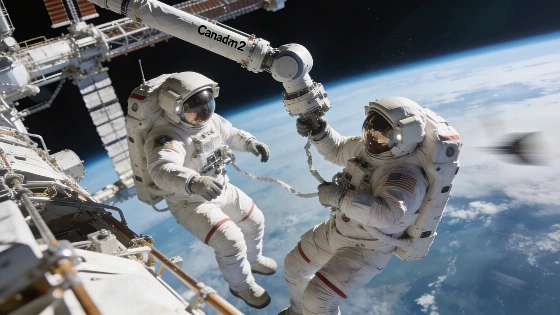
NASA astronaut Anil Menon and ESA's Sophie Adenot removed a nonfunctional antenna from the International Space Station during a six-hour spacewalk, but time constraints postponed installation of the replacement hardware
On August 18, 2026, astronauts aboard the International Space Station (ISS) conducted a scheduled extravehicular activity (EVA) to address a critical communications hardware issue. NASA astronaut Anil Menon and European Space Agency (ESA) astronaut Sophie Adenot, the first French woman to perform a spacewalk, were assigned to remove and replace a failed Space-to-Ground Antenna (SGANT) that had been out of service since November 2025. The operation was essential for maintaining the station's high-speed data relay capabilities with ground control.
Spacewalk Objectives and Execution
The primary goal of the EVA was to remove the malfunctioning SGANT from its mount on the station's truss and install a replacement unit. The failed antenna had lost its ability to track NASA's data relay satellites, forcing the ISS to rely on a secondary antenna for critical communications. Menon and Adenot began their spacewalk at 08:29 EDT (12:29 GMT), switching their suits to battery power before exiting the Quest airlock. The planned duration for the operation was six and a half hours, reflecting the complexity of the task and the need for careful handling of large, delicate hardware in microgravity.
During the EVA, the astronauts successfully detached the failed antenna, but encountered delays while disconnecting electrical connections and securing the assembly for transport. These challenges consumed more time than anticipated, leaving insufficient margin to install the replacement antenna within the scheduled window. Mission controllers instructed the crew to stow the removed hardware securely and deferred the installation of the new antenna to a future EVA.
Mission Timeline and Technical Details
The spacewalk concluded at 14:52 EDT (18:52 GMT), with a total duration of 6 hours and 23 minutes. This was the 282nd EVA in support of ISS assembly and maintenance, and the fifth conducted from the station in 2026. For Menon, it marked his second spacewalk, bringing his cumulative EVA time to 12 hours and 50 minutes. For Adenot, it was a milestone first, making her the first female and fifth overall French astronaut to perform a spacewalk, following Jean-Loup Chrétien, Jean-Pierre Haigneré, Philippe Perrin, and Thomas Pesquet.
The failed SGANT had been non-operational for approximately nine months, with the ISS relying on its backup antenna to maintain communications with Mission Control in Houston. The replacement antenna, now awaiting installation, is expected to restore full redundancy once the task is completed. Mission planners are evaluating whether to add the installation to an upcoming EVA or schedule a dedicated outing.
Operational Implications and Next Steps
While the removal of the failed antenna was completed, the delay in installing the replacement leaves the ISS temporarily dependent on a single operational SGANT for high-speed data transmission. This configuration maintains essential communications but reduces redundancy, increasing operational risk until the new hardware is in place. The decision on when to complete the installation will depend on crew availability, EVA scheduling, and the prioritization of other maintenance tasks.
The challenges encountered during this EVA highlight the unpredictable nature of extravehicular operations, where even routine hardware replacements can be complicated by unforeseen technical or mechanical issues. The need for a follow-up spacewalk is not unusual in ISS maintenance, as similar delays have occurred in past missions, including those involving complex satellite servicing and orbital infrastructure upgrades. For context, the importance of reliable communications infrastructure in orbit has been underscored by recent developments in satellite monitoring, such as the deployment of new tracking satellites to enhance situational awareness in geostationary orbit, as discussed in a recent Science Report article.
Historical and Scientific Context
This EVA represents a continuation of the ISS's long-term maintenance strategy, which relies on regular spacewalks to replace aging or failed components. The use of U.S. extravehicular mobility unit (EMU) spacesuits and the station's robotic arm, Canadarm2, enabled precise handling of the large antenna assembly. The operation also provided valuable experience for Adenot, expanding ESA's pool of astronauts with EVA proficiency and contributing to international collaboration in orbital maintenance.
As the ISS approaches three decades of continuous operation, the frequency and complexity of maintenance EVAs are expected to increase. Each outing provides data on hardware longevity, crew workload, and the evolving risks associated with operating a large, aging orbital platform. The lessons learned from this and similar missions inform planning for future space station operations and the design of next-generation orbital infrastructure.
Spacewalks, or extravehicular activities (EVAs), are among the most technically demanding operations in human spaceflight. Astronauts must work in pressurized suits, exposed to vacuum, temperature extremes, and radiation, while manipulating tools and hardware designed for microgravity. Every EVA is meticulously planned, with detailed procedures for each step and contingency protocols for unexpected complications. The duration of a spacewalk is limited by suit life support systems, crew fatigue, and the need to minimize risk. Successful completion of EVA objectives depends on both technical preparation and the ability to adapt to real-time challenges outside the station.