Archaeologists have recovered large oak beams from a well-preserved Iron Age structure near the River Main in Aschaffenburg, Germany, offering new evidence for complex Celtic construction, trade, and settlement over 2,400 years ago
Archaeological excavations beside the River Main in Aschaffenburg, Bavaria, have uncovered a remarkably well-preserved Iron Age timber structure, providing new insight into the engineering capabilities and organizational complexity of Celtic communities in Central Europe during the late first millennium BCE. The discovery was made during construction work for a storm-water overflow basin, when workers encountered substantial wooden remains whose age and significance were initially unclear.
Excavation and Preservation
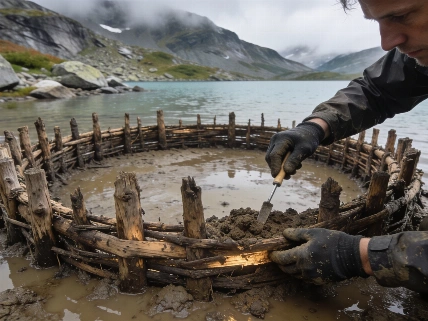
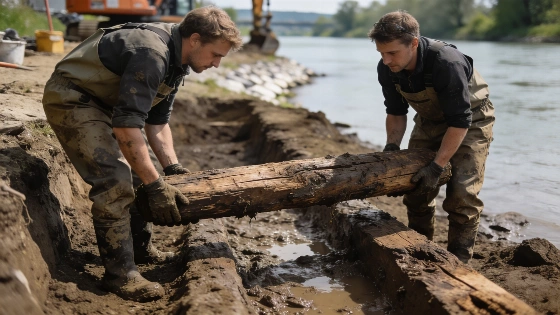
Specialists from the Bavarian State Office for Monument Preservation (BLfD) conducted a rapid assessment and, using dendrochronological analysis, dated the oak beams to between 372 and 352 BCE. The structure's preservation is exceptional, with waterlogged conditions helping to maintain the integrity of the timbers. Archaeologists, conservators, and scientists have so far recovered approximately one third of the surviving beams, each measuring three to four meters in length and weighing up to 250 kilograms. The beams were carefully detached and lifted by crane, then cleaned and placed in wet storage to prevent deterioration during further study.
Detailed 3D laser scanning is underway to document each timber, with visible tool marks providing evidence of Iron Age woodworking techniques. The project also includes plans to conserve and eventually display part of the structure and its associated stone wall at the local Stiftsmuseum, making the evidence accessible for both research and public engagement.
Function and Interpretation
The precise function of the structure remains under investigation. Archaeologists have identified a wooden platform on the river-facing side, suggesting it may have served as a landing or transfer point for boats, facilitating the movement of goods between the river and a settlement located above. The main construction incorporates substantial dry-stone walls and a complex timber framework, indicating significant planning and labor investment. One interpretation is that the structure protected an access route from the river to the settlement, but alternative uses remain possible pending further analysis.
The scale and sophistication of the construction suggest it was not a temporary installation. Researchers believe the builders adapted the design to cope with challenging, damp ground conditions, requiring skilled labor and the organized transport of materials. The oak trees likely originated in the Spessart region and were floated down the Main, while stone for the walls was brought in separately. The structure's visibility from the river may have also served as a statement of the settlement's importance and the community's ability to mobilize resources.
Evidence for Organization and Trade
Scientific sampling and geoarchaeological analysis are ongoing, with additional dating results pending. The project involves collaboration between archaeologists, geoarchaeologists, archaeobotanists, and conservation specialists, who are examining sediments, soil layers, and plant remains to reconstruct the environmental and settlement context. The Bavarian Environment Agency is producing adhesive profiles of the Iron Age soil layers for its collection, contributing to a broader understanding of the site's chronology and landscape history.
Numerical evidence highlights the scale of the project: each oak beam measures three to four meters and weighs up to 250 kilograms, with roughly a third of the surviving timbers recovered so far. The dendrochronological dating places the construction securely between 372 and 352 BCE, making it one of the best-preserved Iron Age timber structures in Germany. Archaeological work is expected to continue through 2026, coordinated with ongoing construction at the site.
This discovery adds to a growing body of evidence for complex Iron Age infrastructure in Europe. Comparable investigations, such as the documentation of long-term settlement development on Montbellant hill in Burgundy, have also revealed the importance of riverine and overland connections in shaping ancient communities. For example, recent research on Gallic oppida and their transformation over centuries can be found in this analysis of settlement layers in Burgundy.
Public Access and Research Outlook
The site will be open to the public during Germany's Open Monument Day, offering visitors a chance to view the excavation and learn about ongoing research. The Stiftsmuseum will also display previously unseen Celtic finds from Aschaffenburg. Tours will be available through the city, with registration details to be announced.
While the full significance of the structure will depend on further analysis, the evidence so far points to a community capable of organizing large-scale construction, managing distant material procurement, and deploying skilled craftspeople. The Aschaffenburg site offers a rare opportunity to study Iron Age engineering and social organization in detail, with implications for understanding regional interaction and economic networks in late prehistoric Europe.
Dendrochronology, or tree-ring dating, is a method used to determine the age of wooden materials by analyzing growth ring patterns. In archaeological contexts, dendrochronology can provide precise calendar dates for timber felling, construction, or repair, especially when local reference chronologies are available. The method requires well-preserved wood and a sufficient number of rings to match against established sequences. In the case of the Aschaffenburg structure, dendrochronological analysis of the oak beams allowed researchers to date the construction to a narrow range in the late fourth century BCE, offering a secure chronological anchor for interpreting the site's development and use.