IonQ researchers have demonstrated a real-time quantum error correction decoding pipeline for large-scale trapped-ion quantum computers, processing MegaQuOp-scale workloads on a single Apple M4 Max CPU and addressing classical decoding bottlenecks
IonQ researchers have reported the implementation of a real-time quantum error correction (QEC) decoding pipeline capable of handling workloads at the MegaQuOp scale-meaning millions of quantum operations-on a single Apple M4 Max CPU. The work, published as a preprint on arXiv, focuses on the classical decoding challenge that arises as quantum processors scale to hundreds of logical qubits and millions of gates. The demonstration targets the Walking Cat Architecture (WCA), IonQ's proposed large-scale trapped-ion quantum computing platform, and evaluates whether classical decoding can keep pace with the demands of fault-tolerant quantum computation.
Decoding Pipeline and Hardware
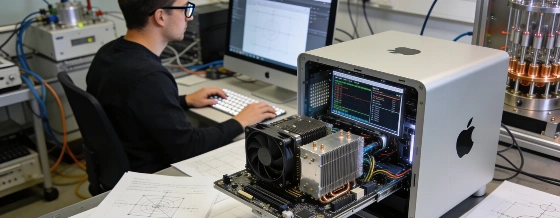
The decoding stack was executed entirely on a 12-core Apple M4 Max CPU, without the need for specialized accelerators such as FPGAs or GPUs. The pipeline processed workloads involving up to 408 logical qubits, 68 low-density parity-check (LDPC) code blocks, and 20 magic state factories, corresponding to a total of 11,680 physical qubits. The system handled circuits with over 1 million T gates and 1.3 million logical measurements, maintaining near-zero computational backlog under typical error rates. The decoding architecture uses two concurrent sliding-window decoders: a continuous error decoder with a five-cycle window for tracking Pauli frames, and a low-latency outcome decoder with a two-cycle window for resolving measurement outcomes and error-detected measurement checks.
Performance and Stretch Metrics
To assess the practical impact of decoding latency, the team measured the operational "stretch"-the time delay induced by decoding backlog-across several benchmark circuits. For syndrome extraction cycle (SEC) times between 1 and 5 milliseconds, and a physical two-qubit gate error rate (pCNOT) of 10⁻⁴, the stretch remained below 0.3% for all tested workloads. Even at a higher error rate of 5 × 10⁻⁴, the worst-case stretch did not exceed 12%. These figures suggest that, for the tested architecture and error rates, classical decoding bandwidth is unlikely to become a bottleneck as IonQ's hardware scales toward larger systems.
Engineering Optimizations
The decoding pipeline incorporates several engineering strategies to reduce memory traffic and computational overhead. Instead of rebuilding complex parity-check graphs when cat-state measurements occur, the system reuses a static Tanner graph and updates only the probability priors dynamically. Log-likelihood ratios (LLRs) are stored per error node, rather than as edge messages, reducing memory footprint and cache contention. These optimizations enable the pipeline to process syndrome data in real time, even as the number of logical qubits and measurement cycles increases.
Benchmark Circuits and Roadmap Implications
The researchers evaluated the decoder on three large-scale fault-tolerant circuits compiled for the WCA: a measurement-induced phase transition circuit with 102 logical qubits and over 1 million T gates; a disordered Heisenberg model with 102 logical qubits and 139,000 T gates; and a larger Heisenberg model with 408 logical qubits and 555,000 T gates. The results indicate that, under the tested conditions, the classical decoding stack can keep pace with the quantum hardware's syndrome extraction rate. This finding addresses a key concern for scaling fault-tolerant quantum computers, where classical processing must not lag behind quantum operations. Related research has explored alternative decoding strategies, such as AI-based decoders for surface-code data, as discussed in recent benchmarking of AI decoders on Google's quantum datasets.
Quantum error correction is a foundational requirement for building practical quantum computers. Physical qubits are highly susceptible to errors from environmental noise, control imperfections, and measurement uncertainty. Logical qubits encode information redundantly across many physical qubits using error-correcting codes, allowing errors to be detected and corrected without destroying the encoded quantum information. Real-time decoding is essential: if the classical processor cannot keep up with syndrome extraction, errors may accumulate faster than they can be corrected, undermining the benefits of error correction. The IonQ demonstration shows that, with careful engineering, classical decoding can be performed in software on commodity hardware at scales relevant for near-term fault-tolerant quantum computing. However, further increases in qubit count, circuit depth, or error rates may require additional hardware acceleration or algorithmic advances to maintain real-time performance.