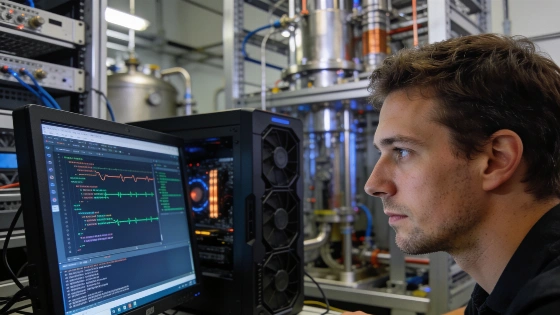
Quantum X Labs has reported that its AI-based quantum error correction decoder achieved higher decoding accuracy than standard matching algorithms on Google's public surface-code dataset, using only synthetic training and GPU acceleration
Quantum X Labs Inc. has announced new benchmark results for its AI-driven quantum error correction (QEC) decoder, reporting improved decoding accuracy on Google's public surface-code experimental dataset compared to established matching-family algorithms. The company's decoder, trained exclusively on synthetic data, was evaluated against Google's correlated-matching and PyMatching baselines for the same surface-code configuration, with results indicating a measurable performance advantage under the tested conditions.
Surface-Code Decoding and Benchmarking
The experiment focused on the surface code, a leading quantum error-correcting code architecture for superconducting qubit platforms. Quantum X Labs' AI-QEC decoder was trained using only simulated syndrome data, without exposure to real hardware measurements during training. The model was then tested on Google's released experimental dataset, which contains syndrome records and error events from actual quantum hardware. The decoder's performance was compared to minimum-weight perfect matching (MWPM) solvers, including PyMatching and Google's correlated-matching approach, both widely used as baselines in the field.
Generalization and GPU Acceleration
A central technical challenge in quantum error correction is achieving low-latency, high-accuracy decoding on real hardware, where noise characteristics can differ from simulation. Quantum X Labs reports that its AI decoder demonstrated "zero-shot" generalization: it achieved higher decoding accuracy on real experimental data than the standard MWPM solvers, despite being trained only on synthetic samples. The decoder integrates syndrome information and error weighting, and is implemented to leverage NVIDIA CUDA-Q for GPU acceleration, aiming to reduce computational latency and support real-time decoding requirements for future fault-tolerant quantum systems.
Numerical Results and Roadmap
While the company has not released detailed error rates or absolute accuracy figures, the reported improvement over PyMatching and correlated-matching baselines suggests that AI-based decoders may offer practical benefits for near-term quantum hardware. The demonstration was performed on Google's public surface-code dataset, which is widely used for benchmarking decoder performance. Quantum X Labs states that its next steps include extending the synthetic-to-real decoding pipeline to additional hardware platforms, code topologies, and device centers, under the direction of Chief Quantum Technology Scientist Prof. Nir Sharon. The company positions this result as a milestone toward scalable, commercially relevant QEC workflows.
Context and Related Developments
Quantum error correction remains a critical bottleneck for scaling quantum computers beyond the noisy intermediate-scale quantum (NISQ) regime. Recent efforts have focused on improving decoder algorithms, integrating AI and machine learning, and benchmarking performance on real hardware datasets. For example, initiatives such as the microgrant program described in a recent Science Report article are supporting open-source development of QEC tools, reflecting the field's emphasis on reproducibility and independent validation. However, the practical deployment of AI-based decoders will require further evidence of robustness, scalability, and integration with diverse quantum hardware platforms.
Quantum error correction is the process of detecting and correcting errors that occur in quantum bits (qubits) due to noise, decoherence, and imperfect control. Surface codes are a leading approach, encoding logical qubits across a two-dimensional array of physical qubits and using repeated syndrome measurements to identify error patterns. Decoders are algorithms that interpret these syndrome measurements to infer and correct errors in real time. Achieving high decoding accuracy with low latency is essential for fault-tolerant quantum computing, but remains challenging due to the complexity of error processes and the need for rapid classical processing. AI-based decoders offer a potential route to improved performance, but their generalization to real hardware noise and integration into operational systems are active areas of research.