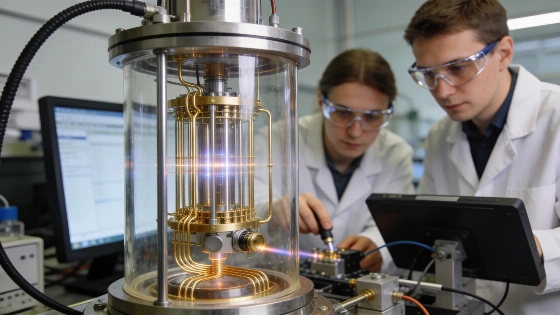
A new collaboration between IonQ, NVIDIA, and qBraid demonstrates a 54% reduction in logical error rates for deep Trotterized quantum chemistry simulations using trapped-ion hardware and active mid-circuit error detection
Quantum error rates have long set the ceiling for what today's hardware can simulate, but a recent experiment by IonQ, NVIDIA, and qBraid claims to have slashed logical errors by 54% in a demanding quantum chemistry simulation-provided the right error mitigation is applied at the right moment. The result, achieved on a barium trapped-ion system with hybrid quantum-classical processing, directly challenges the assumption that post-processing alone can rescue deep quantum circuits from noise accumulation.
Active Error Detection in Hardware
The core of the experiment was a 6-qubit encoded simulation step, executed on IonQ's barium-based quantum processor, a platform closely related to the company's upcoming IonQ Tempo architecture. Rather than relying on passive post-selection, the team implemented active mid-circuit measurement (MCM) to detect and correct errors as they occurred. Ancilla qubits were measured and reset mid-circuit, allowing corrupted operations to be discarded or corrected before errors could propagate through the computation. This approach was paired with the Generalized Superfast Encoding (GSE), which maps fermionic operators to qubits using local stabilizers and lower Pauli weights, reducing circuit depth and embedding error-detecting structure directly into the algorithm.
To benchmark the effect, the researchers compared logical error rates between circuits using active MCM and those relying on deferred, end-of-circuit stabilizer readout. The difference was stark: the 54% reduction in logical error rate vanished entirely when error detection was postponed, confirming that real-time intervention-not just post-processing-was responsible for the observed fidelity gain.
Clifford Noise Reduction and Machine Learning
Beyond mid-circuit measurement, the experiment incorporated the Clifford Noise Reduction (CliNR) protocol. This method prepares verified Bell and Clifford resource states, measures local stabilizers, and teleports accepted Clifford operations onto the data register, aiming to halt error propagation before it can cascade through the code block. The combination of GSE and CliNR was designed to address the "deep Trotter dilemma"-the exponential noise growth that plagues long, gate-heavy quantum simulations of fermionic systems.
Choosing which stabilizer pairs to measure in deep circuits is a combinatorial challenge. To optimize this, the team trained a machine-learning model on an NVIDIA GH200 Grace Hopper Superchip, using over 57,000 samples to score candidate stabilizer pairs. During inference, the model rapidly selected the most effective verification operators from 105 candidates, outperforming random selection and reducing the overhead of error detection.
Benchmarking the Quantum-Classical Stack
The experiment's hardware stack combined IonQ's barium trapped-ion quantum processing unit (QPU) with NVIDIA's GPU-accelerated classical computing. The CUDA-Q and cuStabilizer software libraries managed the hybrid workflow, integrating quantum circuit execution with classical machine learning and error analysis. The 6-qubit encoded simulation step was chosen as a representative benchmark for deep Trotterized quantum chemistry, a regime where noise typically overwhelms the signal in noisy intermediate-scale quantum (NISQ) devices.
Empirical data showed that the logical error rate dropped by 54% compared to direct physical Trotter execution when active error mitigation was used. However, when stabilizer measurements were deferred to the end of the circuit, the fidelity gain disappeared, underscoring the necessity of in-flight error detection for any practical improvement. This finding echoes the challenges faced by other quantum simulation efforts, such as those described in an earlier breakdown of structure-preserving compilation for fermionic systems.
Limits and Open Questions
While the reported error reduction is significant for a 6-qubit encoded step, the experiment does not establish that the same approach will scale to larger, more complex simulations or to full fault-tolerant quantum computing. The demonstration was performed on a development system, and the logical error rates, while improved, remain above the thresholds required for practical quantum advantage in chemistry or materials science. The reliance on machine learning for stabilizer selection introduces additional classical overhead, and the integration of quantum and classical resources remains a nontrivial engineering challenge.
Despite these caveats, the experiment provides concrete evidence that active, hardware-level error detection can outperform passive post-selection in deep quantum circuits. The result is a measured advance in error mitigation, not a claim of error correction or fault tolerance. As with all such demonstrations, independent replication and extension to larger systems will be necessary before the approach can be considered a general solution to the deep Trotter dilemma.
Quantum error mitigation and error correction are often conflated, but they address different challenges. Error mitigation techniques, such as active mid-circuit measurement and stabilizer selection, aim to reduce the impact of noise without fully correcting every error. These methods can improve the fidelity of quantum computations in the NISQ era, where full error correction is not yet feasible. However, true fault tolerance requires encoding logical qubits across many physical qubits, with repeated error detection and correction cycles that can suppress logical error rates below a defined threshold. The experiment by IonQ, NVIDIA, and qBraid demonstrates that targeted error mitigation can deliver measurable gains, but the path to scalable, fault-tolerant quantum computing remains defined by the engineering realities of noise, overhead, and system integration.