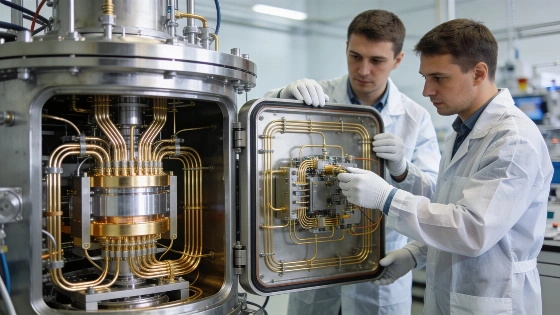
IBM Quantum's Nighthawk r2 processor introduces a dissipative qubit reset, reducing idle times and boosting circuit throughput to over 100,000 per second. The 120-qubit device claims a 25-fold speedup over previous IBM hardware in practical benchmarks
IBM Quantum's latest hardware release, the Nighthawk r2 quantum processing unit (QPU), has shifted the practical limits of circuit throughput by introducing a hardware-based dissipative qubit reset. The company reports that this 120-qubit superconducting processor, deployed as ibm_phoenix, can execute more than 100,000 quantum circuits per second-an order-of-magnitude leap over its previous Heron QPU fleet, which typically managed around 4,000 circuits per second.
Active Dissipative Reset
The central engineering change is the move from conditional reset protocols-where qubits are reinitialized using microwave pulses and measurement cycles-to a dedicated dissipative reset element paired with each programmable qubit. By coupling qubits directly to a cold thermal bath via tunable couplers, the effective relaxation time (T1) for state reset drops from roughly 200 microseconds to about 25 nanoseconds. This allows inter-circuit idle times to shrink to as little as 1 microsecond, enabling rapid, repeated circuit execution without the long delays that previously limited throughput.
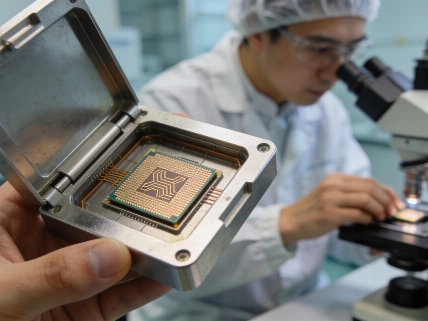
IBM reports that this approach also suppresses state initialization errors by a factor of 25 compared to earlier hardware, while maintaining two-qubit gate error rates on par with the Heron generation (approximately 0.3%). The architecture includes 120 programmable qubits, 218 inter-qubit couplers, and 120 independent reset elements, with a total of 458 reset-related components distributed across the square-lattice chip.
Benchmarking and Circuit Depth
In practical terms, the Nighthawk r2 processor has demonstrated the ability to execute quantum circuits containing over 7,500 gates, meeting a key 2026 IBM Quantum Roadmap milestone. The device was used to estimate observables using probabilistic error amplification (PEA) and to run doped Clifford sampling experiments, which are designed to probe computational regimes beyond the reach of current classical simulation. In one application benchmark, the processor delivered a 12-fold speedup for neutron-scattering simulation tasks, generating material spectra suitable for direct laboratory comparison in under a minute.
For context, the processor's maximum reported circuit throughput-over 100,000 circuits per second-reflects the combined effect of rapid reset, reduced initialization error, and high-fidelity gate operations. This figure is based on IBM's internal benchmarking and is not yet independently verified. The company's technical announcement emphasizes that the dissipative reset is "neighbor-safe," allowing adjacent qubits to be reset dynamically during computation, a feature relevant for future quantum error correction protocols.
Engineering and Scalability Limits
While the Nighthawk r2's reset architecture addresses a longstanding bottleneck in superconducting quantum processors, it does not resolve all challenges associated with scaling to fault-tolerant quantum computing. The device operates at cryogenic temperatures, and the complexity of wiring, calibration, and thermal management increases with qubit count and circuit depth. The reported 7,500-gate executions are significant for near-term quantum simulation, but remain well below the requirements for large-scale error-corrected algorithms.
IBM's roadmap continues to target higher circuit depths and logical qubit demonstrations, but the Nighthawk r2's main contribution is to reduce the overhead of state preparation and idle time, making it possible to run more circuits in less wall-clock time. This is a meaningful step for benchmarking, calibration, and certain quantum simulation tasks, but does not by itself establish practical quantum advantage for general-purpose computation. Related advances in quantum processor infrastructure, such as the reported earlier cryogenic interconnects, will be necessary to support further scaling.
Classical Comparison and Utility
Claims of quantum advantage or utility must be evaluated against the strongest available classical methods. The Nighthawk r2's 12x speedup for neutron-scattering simulations is benchmarked against IBM's own previous hardware, not against state-of-the-art classical simulation on high-performance computing clusters. The doped Clifford sampling experiments are designed to probe computational regimes that are difficult for classical algorithms, but the precise boundary between quantum and classical tractability remains an active area of research. As with all such demonstrations, independent verification and fair classical baselines are essential for substantiating claims of quantum utility.
IBM has made the Nighthawk r2 processor available via its cloud platform, with technical details published on the IBM Quantum Blog and a performance webinar scheduled for September 10. The company's willingness to expose the hardware to external users will provide opportunities for independent benchmarking and scrutiny, which are critical for assessing the true impact of the dissipative reset architecture.
IBM's Nighthawk r2 QPU demonstrates that hardware-level engineering can remove a major bottleneck in quantum circuit throughput, but the leap from rapid reset to scalable, fault-tolerant quantum computing remains substantial. The device's performance gains are real for calibration, benchmarking, and certain simulation tasks, but the field still faces unresolved challenges in error correction, wiring, and reproducibility. As quantum hardware matures, the value of each architectural advance will depend on transparent benchmarking, independent replication, and a clear-eyed comparison with classical alternatives-rather than on headline circuit counts or speedup factors alone.
Qubit reset is a critical step in quantum computing, as each computation must begin with qubits in a well-defined ground state. Traditional reset methods rely on waiting for natural relaxation or using measurement-based feedback, both of which introduce significant idle time and potential error. Dissipative reset, as implemented in the Nighthawk r2, uses engineered coupling to a cold environment to rapidly return qubits to their ground state, minimizing both time and error. This approach is especially important for algorithms requiring frequent state reinitialization, mid-circuit resets, or repeated sampling, and will play a central role in future error-corrected quantum architectures.