

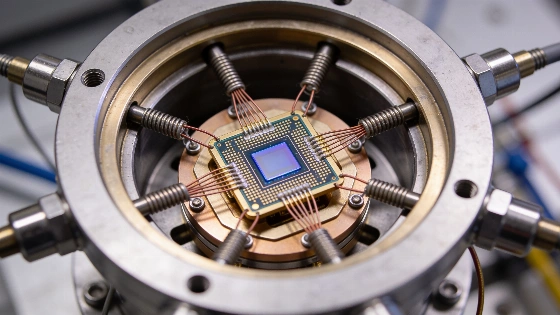
Q-CTRL's IBM Quantum Functions release runs a 30-site Fermi-Hubbard workload on Nighthawk r2 in 23 seconds, reporting less than 1% RMSE deviation from Heron r3 while classical comparisons depend on the solver used
Nighthawk's square lattice raises average qubit connectivity by 60% over heavy-hex Heron chips, reducing SWAP routing overhead while amplifying residual crosstalk. That trade-off is central to interpreting Q-CTRL's reported benchmark results. IBM describes Nighthawk r2 as a 120-programmable-qubit processor with square-lattice connectivity, capable of executing circuits with more than 7,500 quantum operations and delivering up to 100,000 samples per second.
The Routing Trade-off
Fire Opal's Dynamics Simulator automates Hamiltonian mapping, Trotter-Suzuki synthesis, qubit routing and deterministic crosstalk suppression through the Python interface q-ctrl/dynamics-simulator. Q-CTRL says the pipeline suppresses coherent errors without requiring extra measurement shots. IBM places Q-CTRL-powered dynamics simulation in its Quantum Functions catalog, where the service models time evolution from a physical model, initial state and time-evolution parameters, and returns traces of observables.
A separate Nighthawk r1 validation found that staggered dynamical decoupling increased median effective coherence time from 27 μs to 160 μs. That result provides hardware context; it is distinct from the Nighthawk r2 runtime benchmark.
Benchmark Runtime
On Nighthawk r2 (ibm_phoenix), the 30-site Fermi-Hubbard chain used 60 qubits and 30 Trotter steps, with 4,497 two-qubit gates and a two-qubit depth of 152. Q-CTRL reports a 23-second QPU pipeline runtime.
The Heron r3 (ibm_boston) reference took 4 minutes 25 seconds for a 30-site workload, including noise characterization. Q-CTRL describes the Nighthawk execution as 12 times faster. Its Heron results also included workloads of up to 60 sites and a separate 31-site run using 90 Trotter steps and 13,829 two-qubit gates. IBM separately describes early large-scale application demonstrations as running up to 12 times faster on Nighthawk than on Heron; its reported multiplier refers to application demonstrations, not all quantum simulations.
IBM has also reported other application-specific comparisons: a quantum-dynamics experiment by Algorithmiq involving a heterogeneous material ran eight times faster on Nighthawk r2 than on Heron. IBM said Q-CTRL and other partners had executed more than 34 billion circuits on Nighthawk r2, reporting performance improvements of up to 19 times over previous IBM processors. These broader device and partner figures are distinct from Q-CTRL's 30-site runtime measurement. IBM's Nighthawk overview provides its processor specifications.
Accuracy and Baselines
Q-CTRL reports an RMSE of 7.895 × 10⁻³ for the Nighthawk result, described as less than 1% deviation from the Heron r3 baseline. The benchmark concerns a specific simulated workload; it does not establish that Nighthawk is faster for every quantum simulation or that the result is a general quantum-computing advantage.
Classical comparisons use different baselines. Q-CTRL's earlier Heron results were reported as up to 3,000 times faster than an ITensor CPU baseline and 36 times faster than symmetry-exploiting tensor networks on an NVIDIA H200 GPU. For Nighthawk r2, the company reports a lower-bound runtime more than 400 times faster than GPU-accelerated classical solvers. A separate photonic optimizer report described a planned comparison with classical methods; planned comparisons should not be conflated with these reported execution timings.
Catalog Access
The Dynamics Simulator is available through the IBM Quantum Functions Catalog to IBM Quantum Premium, Flex and On-Prem Plan users. Workloads are offered in Small, Medium and Large tiers. It joins Q-CTRL's Performance Management and Optimization Solver functions in the catalog. IBM's Quantum Functions documentation describes the dynamics tool as a service for simulating quantum many-body dynamics and modeling time evolution.







