IBM has connected and cooled its first modular cryogenic cells, reaching a hardware milestone for its planned IBM Quantum Starling system. The approach aims to address wiring, cooling, and integration challenges in scaling superconducting quantum processors.
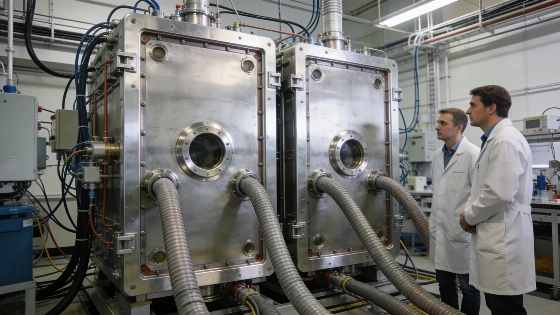
IBM has reported the successful integration and cooldown of its first modular cryogenic cells, a step toward its roadmap for a fault-tolerant quantum computer. The demonstration, conducted at IBM's Poughkeepsie, New York quantum facility, involved joining two rectangular, aluminum-framed cryogenic modules into a single thermal environment and cooling the assembly to below 15 millikelvin. This temperature regime is required for the operation of superconducting qubits, which are highly sensitive to thermal noise and environmental disturbance.
Modular Cryogenic Architecture
Traditional superconducting quantum processors are housed in cylindrical cryostats, often referred to as "chandeliers," which limit the number of qubits and wiring due to spatial constraints and heat load. IBM's modular approach replaces these with box-shaped cryogenic cells designed to sit side by side, each providing 2.75 cubic meters of vacuum volume and 0.53 square meters of wiring surface area. According to IBM, this yields up to 12 times more wiring capacity than its previous Quantum System One fridges, with each cell engineered to accommodate and cool at least 2,000 physical qubits.
When two cells are joined, quantum cables are routed through a shared opening, protected by multi-layered thermal shielding tunnels. This design aims to maintain dilution-refrigerator base temperatures below 15 millikelvin without increasing cooldown times. Initial tests showed that the dual-module assembly could be cooled from room temperature to 4 kelvin in under five days, before reaching the sub-15 millikelvin regime required for quantum operation.
Interconnects and Processor Integration
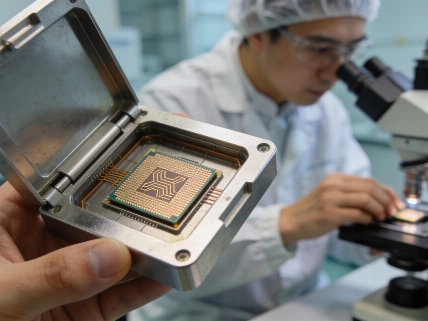
The modular system is built to support direct chip-to-chip quantum links using IBM's proprietary L-coupler technology. L-couplers are meter-scale quantum cables designed to operate at cryogenic temperatures, enabling quantum state transfer and entangling gates between separate physical chips. This architecture is intended to reduce the length and complexity of interconnects compared to traditional coaxial cabling, which can introduce heat and crosstalk when scaling to thousands of qubits.
IBM plans to install its Nighthawk processors into the modular cells later this year for system-level operational testing. The company's roadmap targets a system with at least 1,000 programmable qubits by 2027, using L-couplers to link multiple processors. The ultimate goal is to provide the hardware foundation for the IBM Quantum Starling system, which is scheduled for delivery in 2029, though the practical realization of fault-tolerant quantum computing will depend on further advances in error correction and system integration.
Engineering Challenges and Roadmap
Scaling superconducting quantum hardware beyond current limits requires addressing not only qubit coherence and gate fidelity, but also the engineering of cryogenic infrastructure, wiring, and thermal management. The modular cell approach is designed to mitigate heat bottlenecks and crosstalk by expanding physical capacity and optimizing cable routing. However, the integration of thousands of physical qubits into a single, operationally stable system remains an open challenge, with error rates, calibration drift, and device variability all posing significant obstacles.
IBM's announcement follows a broader industry trend toward modular and multi-chip quantum architectures, as seen in efforts by other companies to standardize and scale quantum hardware. For example, recent collaborations in the field have focused on manufacturing processes for modular trapped-ion systems, as discussed in a recent Science Report article on scalable trapped-ion hardware. While the physical platforms differ, the underlying engineering challenges of wiring, cooling, and integration are shared across quantum technologies.
Physical and Logical Qubit Distinction
IBM's current milestone concerns the physical infrastructure for scaling physical qubits, not the demonstration of logical qubits or full error correction. The company's roadmap projects over 1,000 programmable qubits by 2027, but the transition from physical to logical qubits-where information is encoded redundantly to detect and correct errors-remains a major hurdle. Achieving fault tolerance will require not only hardware advances but also improvements in error-correction codes, real-time decoding, and system-level stability. As with all quantum hardware announcements, the distinction between physical and logical qubits is critical for evaluating progress toward practical quantum computation.
In superconducting quantum computing, a physical qubit is a controllable quantum system-typically a superconducting circuit-operating at millikelvin temperatures. Logical qubits are constructed by encoding information across multiple physical qubits using error-correcting codes, allowing the system to detect and correct certain types of errors. The number of physical qubits required per logical qubit depends on the error rates and the code used, with current estimates often requiring hundreds or thousands of physical qubits for each logical qubit. The engineering of modular cryogenic infrastructure is a necessary step, but not a sufficient condition, for realizing large-scale, fault-tolerant quantum computers.