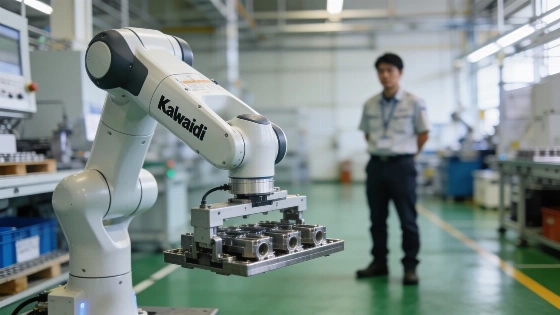
Kawasaki plans to combine remote operators with Noetra's physical AI in Kaleido from around 2030 before attempting autonomous industrial work in less structured environments by 2040
Kawasaki is not promising an autonomous humanoid workforce at the start of the next decade. Its plan is more cautious: combine remote human control with Noetra's physical AI platform in Kaleido and gradually transfer selected tasks to software as the system develops.
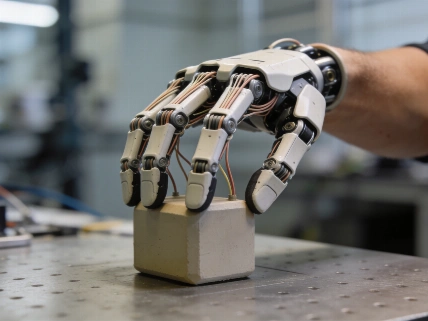
The proposed deployment could begin as early as 2030 with facility patrols and parts transport in factories and warehouses. Kawasaki is also discussing Kaleido with potential customers in the automotive and semiconductor industries. More demanding work such as product assembly would come later and would require the robot to coordinate its arms and hands around tools, workpieces and changing conditions.
That distinction matters because teleoperation and autonomy are not interchangeable. In an early deployment, a human operator could supervise or directly control the machine while the physical AI system handles an increasing share of routine actions. The arrangement would give Kawasaki a route to test the robot in industrial settings without treating a limited demonstration as proof that the machine can manage an entire workplace independently.
According to reporting on the planned integration, Kaleido is intended to become the first concrete user of Noetra's physical AI technology. The status remains a plan rather than a completed deployment or commercial delivery. Noetra is developing an omni-modal foundation model targeted for fiscal 2028 and physical-world AI designed to account for the physical properties of objects and environments by fiscal 2030.
In robotics, a physical-world model must connect perception with action rather than merely classify images or generate language. It may need to estimate whether an object is rigid, deformable, heavy, slippery or attached to another surface, then select a movement that remains safe when those estimates are uncertain. The supplied roadmap describes that ambition, but it does not report benchmark datasets, laboratory trials, confidence intervals, failure rates or independent evaluations of Noetra's system.
Kawasaki has worked on Kaleido since 2015. The company has already shown autonomous walking with obstacle avoidance using LiDAR-based localization and has demonstrated remote-operated disaster-rescue tasks. LiDAR can provide geometric information about nearby surfaces and obstacles, while localization helps a robot estimate its position relative to an environment. Those capabilities establish useful pieces of a robotic system but do not establish reliable autonomous manipulation in a busy factory.
Walking through a mapped space is a different engineering problem from identifying a part, selecting a grasp, adjusting force and recovering when an object or person is not where the system expected. Research programs at MIT and the broader robotics literature emphasize this separation between locomotion, perception, manipulation and robust control; progress in one subsystem cannot automatically be treated as evidence of end-to-end autonomy.
Kawasaki's March 2026 roadmap places remote-assisted work in controlled environments around 2030. It places autonomous operation in unstructured environments around 2040. Those dates describe development targets rather than measured performance or confirmed commercial availability.
The timeline also exposes the central limitation of the proposal. A humanoid robot operating around people must perceive its surroundings, estimate the physical properties of objects, plan movements and adapt when lighting, equipment layout or human behavior changes. Noetra's platform is intended to provide that physical-world layer, but the supplied plans do not report a success rate, number of trials, failure rate, intervention rate or independent evaluation of the integrated system.
The measurable timeline is therefore more informative than a claim of imminent autonomy: Kaleido has been under development since 2015; remote-assisted industrial work is targeted around 2030; and autonomy in unstructured environments is targeted around 2040. These milestones indicate a staged research and deployment strategy rather than a finished robot that can already replace human supervision.
Assembly is the harder test. Patrols and transport can still fail, but assembly demands precise manipulation while the robot responds to contact with objects and tools in real time. Studies discussed in Nature's robotics research commonly treat sensing, planning, contact and control as coupled problems. The available material does not provide assembly results for Kaleido, so the future role of Noetra's platform in that work remains prospective.
Kawasaki also plans to combine Noetra's technology with its physical AI collaboration with NVIDIA. Announced in May, the collaboration focuses on more complex and precise autonomous movements. The company could therefore draw on separate AI models and computing technologies while applying them to the same humanoid platform, although the material does not specify how the systems would be integrated or how their performance would be evaluated together.
Noetra's development effort involves Sony, SoftBank, NEC and Honda. Kawasaki is also an investor. Those relationships help explain the industrial ambition behind the platform, but investment and collaboration are not evidence that the resulting system has achieved reliable autonomy.
The broader target is equally expansive. Kawasaki aims to have tens of thousands of robots in operation by 2040, including wheeled robots, quadruped machines and hospital transport robots alongside humanoids. The company's strategy is therefore not limited to making Kaleido look or move more like a person. It is an attempt to distribute work across several robot types while increasing the proportion of decisions handled by AI.
That strategy should be judged by operational evidence rather than by the appearance of the machine. The relevant questions are whether operators can intervene when perception fails, whether unusual cases trigger safe recovery and whether the robot's performance remains dependable outside controlled conditions. None of those questions is answered by autonomous walking alone.
Kawasaki's plan is credible as an engineering sequence because it preserves human involvement while the system is tested in narrower tasks. It is not evidence that full autonomy is close. The company has identified a long transition from remote assistance to more independent operation, and the 2040 target makes clear that the difficult step is not movement but dependable judgment in an unstructured physical environment.
In this context, shared control means that a human and an automated system divide responsibility for one task rather than that the robot operates independently. The human may monitor or intervene while software handles perception and routine motion, but the reliability of that division depends on clear failure handling and effective intervention. Work on human-robot interaction at institutions such as MIT treats the quality of this handoff as an engineering variable, not merely a user-interface detail.
Until integrated Kaleido trials report repeatable performance, intervention data and clearly defined safety outcomes, the proposal should be read as a long-term industrial program rather than a demonstrated autonomous capability. No published evidence in the supplied reporting confirms that Kaleido has been launched at a customer facility, that final customers have signed contracts, or that the robot has achieved independently measured reliability in production.