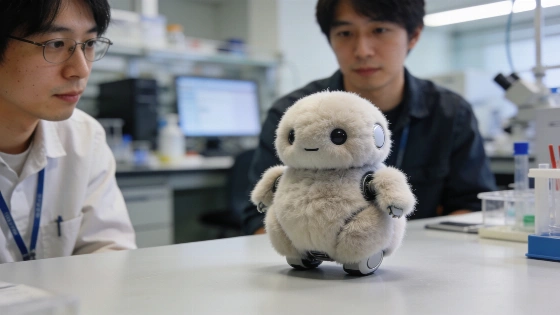
A Japanese team built MOFU, a spherical robot that expands and contracts its body to test whether volumetric movement makes machines seem more alive. Nearly 500 participants rated its lifelikeness in controlled video experiments
Can a robot that expands and contracts its entire body appear more alive to humans than one that simply rolls or spins? That question drove a recent study from The University of Electro-Communications and Sony Corporation, where researchers built MOFU-a spherical, mobile robot designed to test whether whole-body shape changes can enhance the perception of animacy in machines.
Instead of relying on facial expressions or articulated limbs, MOFU uses a geometric mechanism called a Jitterbug structure to alter its overall volume. A single motor-driven linear actuator allows the robot to expand from 210 to 280 millimeters in height, while a differential two-wheel drive lets it move or rotate. The team deliberately avoided animal mimicry, opting for a soft, fluffy exterior and an abstract spherical form. Mechanical noise was minimized with direct-drive motors and low-noise components, and the robot operates untethered on an internal battery.
Testing Animacy Perception
To evaluate whether these volumetric movements affect how animate the robot appears, the researchers conducted three online video experiments. After filtering out incomplete or invalid responses, 498 participants watched 20-second clips of MOFU performing different movement patterns. Animacy was rated using six items from the Japanese version of the Animacy subscale of the Godspeed Questionnaire Series, each on a five-point scale.
In the first experiment, both expansion-contraction and rotational movement increased perceived animacy compared to stationary conditions. However, there was no clear difference between expansion-contraction-only and rotation-only movement. The second experiment tested whether using two robots instead of one would change the effect, but found no significant difference in animacy ratings between one and two MOFUs. In the third experiment, the team combined expansion, contraction, and rotation with locomotion. Here, participants rated the robot as more animate when it moved with shape changes than when it simply traveled around. The researchers note that this last experiment had fewer participants than planned, so its findings are less robust and require replication.
Numbers and Mechanisms
MOFU's expansion mechanism is driven by a single motor, changing its height by 70 millimeters. The robot's movement is controlled by a differential two-wheel drive, allowing both straight travel and rotation. The study's participant pool, after exclusions, consisted of 498 individuals who each rated animacy on six five-point items. The experiments were conducted using 20-second video clips, not in-person interaction, and the results were published in the peer-reviewed journal PLOS ONE.
Limits and Open Questions
While the findings suggest that whole-body volume changes can influence how lifelike a robot appears, the study's design leaves important questions unresolved. All evaluations were based on online videos, so participants could not touch, hear, or physically interact with MOFU. The researchers acknowledge that factors like tactile softness, mechanical sound, and real-world presence may affect responses. Future studies will need to test these variables in person and compare volumetric movement directly with other forms of robotic expression, such as articulated limbs or facial displays. The team also points to the need for larger sample sizes and more diverse movement parameters, including speed and timing.
For context, the challenge of making robots appear more relatable or trustworthy is not limited to social robots. In industrial and construction settings, as seen in recent field deployments, engineers must balance technical performance with human acceptance and safety. The MOFU study highlights a different aspect of this challenge: how subtle design choices in movement and form can shape human perception, even before a robot is deployed in the real world.
Despite the technical novelty, the evidence remains preliminary. The study demonstrates that volumetric movement can increase perceived animacy in controlled video settings, but it does not establish that such robots will be more effective, accepted, or safe in practical applications. The absence of in-person testing and the limited sample size in some experiments mean that claims about real-world impact are, at best, suggestive. For now, MOFU stands as a research prototype-a tool for probing the boundaries of human-robot interaction, not a blueprint for commercial deployment. The real test will come when such systems are evaluated in environments where tactile, auditory, and social cues interact, and where the stakes of human trust and comfort are higher than in a short online survey.
Understanding animacy in robots requires careful distinction between programmed movement and genuine autonomy. Animacy perception studies often use controlled stimuli-such as video clips or scripted demonstrations-to isolate specific design features. However, these settings cannot capture the full complexity of real-world interaction, where users respond to a combination of movement, appearance, sound, and context. As research progresses, the field will need to develop more robust methods for evaluating how design choices affect not just perceived lifelikeness, but also trust, comfort, and willingness to engage with robots in everyday settings.