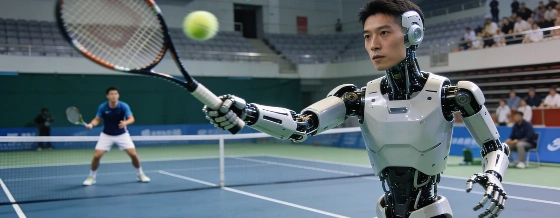
Galbot's humanoid robots demonstrated autonomous tennis play against human athletes at the Second World Humanoid Robot Games, completing over 100 consecutive rallies and highlighting advances in real-world robot perception and control
Humanoid robots developed by Galbot have completed more than 100 consecutive rallies in a live tennis match against human players at the Second World Humanoid Robot Games (WHRG) in Beijing. The demonstration, staged during the event's opening ceremony, was presented as the first live autonomous humanoid robot tennis match, with the robots operating without direct human control on the court. According to Galbot, the robots were able to perceive the ball, make real-time decisions, and move independently to execute serves, returns, and recoveries in a dynamic sporting environment.
The WHRG event brought together 2,056 robots from 666 teams representing 16 countries, with new competitions designed to test the limits of humanoid robot autonomy in real-world scenarios. The Galbot tennis demonstration was intended to move beyond laboratory conditions, challenging robots to adapt to unpredictable ball trajectories, variable lighting, and the presence of human opponents. During the match, the robots autonomously tracked fast-moving tennis balls, repositioned themselves, and executed a range of strokes, including forehands, backhands, and recovery shots. In doubles play, the robots also collaborated with human partners, adjusting their positioning in response to evolving game situations.
Galbot's robots rely on a new AI framework called LATENT (Learning Athletic Humanoid Tennis Skills from Imperfect Human Motion Data). LATENT is designed to help robots learn complex tennis movements by breaking down human demonstrations into smaller, reusable motion primitives. Unlike systems that require highly accurate motion-capture data, LATENT can work with "quasi-realistic" data collected from amateur players using compact motion-capture setups. In early development, researchers gathered approximately five hours of primitive tennis movements, which the system then organized into a latent action space for robotic interpretation and refinement.
Training for the Galbot robots combined reinforcement learning and large-scale simulation, enabling the system to select and sequence motion primitives in response to changing game conditions. This approach allowed the robots to adjust their actions based on the incoming ball's speed and direction while maintaining coordinated, natural movement. According to Galbot, the use of imperfect human data is intended to address a major challenge in robot learning: acquiring fast, precise, and dynamic skills without the need for extensive, high-fidelity human demonstrations.
During the demonstration, the robots completed over 100 consecutive rallies, a figure reported by Galbot as a record for humanoid robot tennis. The company did not disclose the total number of attempts or the frequency of failures, and independent verification of the performance was not available at the time of reporting. The demonstration highlighted the robots' ability to recover balance after losing stability and to continue play without human intervention, but it remains unclear how the system would perform under less controlled conditions or with more varied opponents.
While the Galbot match focused on tennis, the broader WHRG event included robots competing in a range of tasks, reflecting a growing emphasis on real-world deployment and evaluation. The shift toward dynamic, unpredictable environments marks a departure from earlier robotics competitions, which often relied on scripted or highly controlled laboratory tasks. This trend is also visible in other recent demonstrations of humanoid robots in industrial and public settings, such as those described in coverage of Chinese robotics firms presenting humanoids for aviation and security roles.
The Galbot demonstration raises questions about the reliability, safety, and practical limits of current humanoid robot autonomy. While the robots operated without direct teleoperation during the match, the extent of human oversight, pre-programmed behaviors, and environmental constraints was not fully detailed. As with many robotics demonstrations, the gap between controlled event performance and routine real-world deployment remains significant. Further independent evaluation will be necessary to determine whether such systems can operate safely and reliably outside curated environments.
Reinforcement learning is a machine learning technique in which an agent learns to make decisions by receiving feedback in the form of rewards or penalties based on its actions. In robotics, reinforcement learning is often combined with simulation to allow robots to practice complex tasks virtually before attempting them in the physical world. This approach can accelerate skill acquisition and reduce the risk of hardware damage during early training. However, transferring skills from simulation to real-world environments-known as the sim-to-real gap-remains a major challenge, as physical conditions, sensor noise, and unmodeled variables can significantly affect robot performance.