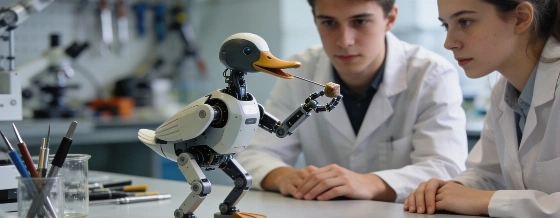
Hugging Face and Pollen Robotics have introduced Microduck, a $399 open-source bipedal robot designed for hands-on AI and reinforcement learning research, with pre-orders open and shipments planned before Christmas 2026
Hugging Face, in collaboration with Pollen Robotics, has announced Microduck, a compact open-source robot intended to lower the barrier for physical artificial intelligence (AI) experimentation. The system is positioned as an accessible platform for developers, researchers, and students to explore reinforcement learning and robot control in real-world settings. Microduck is expected to begin shipping before Christmas 2026, with pre-orders now available at $399, excluding taxes and shipping.
Microduck stands 25 centimeters tall and weighs under 800 grams. The robot features 15 motors, a camera, a small depth sensor, and two inertial measurement units (IMUs). Its articulated beak is capable of basic object manipulation, enabling the robot to combine locomotion with simple pick-and-place tasks. According to the developers, Microduck can walk, crouch, sit, recover from common falls, and even roller-skate, demonstrating a range of movement behaviors that can be programmed and refined by users.
Hardware and Software Platform
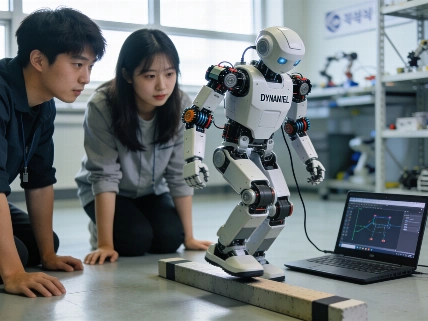
Unlike many desktop robots that focus on social interaction or teleoperation, Microduck is designed for physical action and learning. The platform is intended to support reinforcement learning, a machine-learning approach in which robots improve their behavior through trial and error. The robot's small size and low weight allow for safe, repeated experimentation on a desk or in a classroom, reducing the risk and cost associated with larger, heavier robots. Microduck is engineered to recover from many falls autonomously, minimizing the need for manual resets during failed trials.
The system ships with pre-trained behaviors, including gamepad control, laser-dot following, and basic movement routines. These are intended as starting points for further development. Hugging Face and Pollen Robotics have released open-source software for robot control, simulation, and reinforcement learning, along with a dedicated repository for sim-to-real transfer tools. This enables users to train behaviors in simulation before deploying them on the physical robot, although reliably bridging the gap between simulated and real-world performance remains a recognized challenge in robotics.
Experimentation and Multi-Robot Research
Microduck's open-source approach is intended to foster experimentation in both individual and multi-robot scenarios. The platform supports coordinated behaviors such as racing or collaborative tasks, allowing researchers to investigate multi-agent reinforcement learning without the expense of full-sized robots. The company highlights that the combination of affordable hardware and accessible software is designed to make physical AI research more widely available, particularly for educational and early-stage research environments.
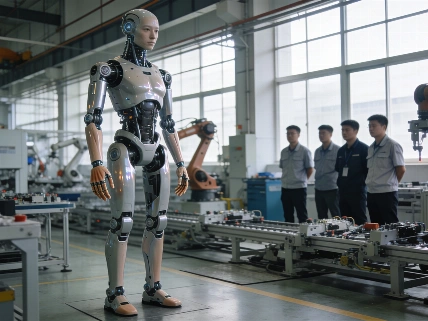
For context, the robotics field has seen a surge in compact, programmable robots aimed at research and education. At the 2026 World Robot Conference in Beijing, for example, several companies demonstrated humanoid and quadruped robots for industrial and security applications, as covered in a recent Science Report article on Chinese robotics demonstrations. Microduck distinguishes itself by focusing on reinforcement learning and open-source development, rather than proprietary or closed systems.
Technical and Practical Considerations
Microduck is available in four color options-Cream, Graphite, Lavender, and Sky-with initial deliveries planned for North America, Europe, and the UK. The robot's hardware specifications are tailored for hands-on experimentation: its 15 actuators provide multiple degrees of freedom for bipedal movement, while the onboard camera and depth sensor enable basic perception tasks. The inclusion of two IMUs supports balance and fall recovery, which are critical for repeated learning cycles in physical environments.
While the platform is designed for accessibility, several limitations remain. The robot's small size restricts payload and environmental interaction, and its sensors are basic compared to those found in industrial or research-grade robots. The sim-to-real transfer process-moving behaviors learned in simulation to the physical robot-remains an open research problem, with performance often degrading due to unmodeled physical effects, sensor noise, or hardware variability. The company has not yet released independent benchmark results or systematic evaluations of learning performance, and the extent of human supervision required during advanced experiments is not fully documented.
Microduck's open-source repositories provide a starting point for community-driven development, but the platform's long-term impact will depend on adoption by researchers and educators, as well as the reliability of its hardware and software in sustained use. The system's affordability and modularity may help broaden participation in physical AI research, but its capabilities should be understood as complementary to, rather than replacements for, larger and more capable research robots.
Reinforcement learning is a machine-learning technique in which an agent-such as a robot-learns to achieve goals by interacting with its environment and receiving feedback in the form of rewards or penalties. In robotics, reinforcement learning is often first developed in simulation, where the agent can attempt thousands of actions without risk of hardware damage. However, transferring learned behaviors from simulation to real-world robots is challenging due to differences in physical dynamics, sensor noise, and unmodeled environmental factors. This sim-to-real gap is a central research problem, and platforms like Microduck are intended to provide accessible testbeds for investigating these challenges in practical settings.