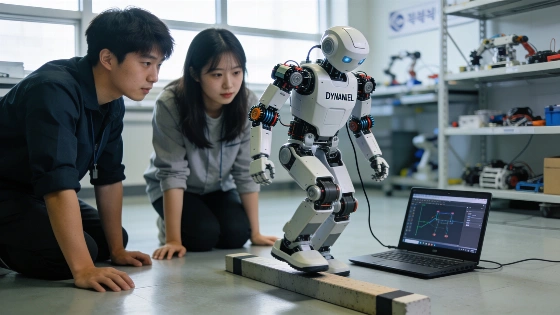
ROBOTIS has launched the Open Humanoid GYM Project, giving university teams direct access to humanoid robots and simulation tools for hands-on AI behavior development, bridging the gap between virtual training and physical deployment
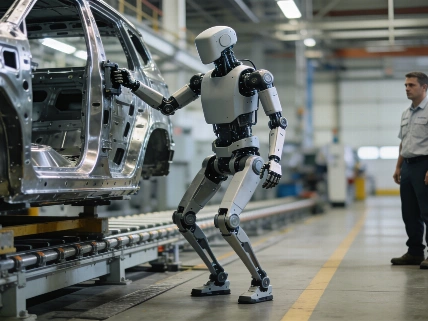
University students in South Korea are now programming and testing humanoid robots on real hardware, not just in simulation. ROBOTIS, a Seoul-based robotics company, has opened its AI Sapiens K1 platform and DYNAMIXEL actuator technology to students through the Open Humanoid GYM Project, a move that shifts robotics education from theory to direct experimentation with physical machines.
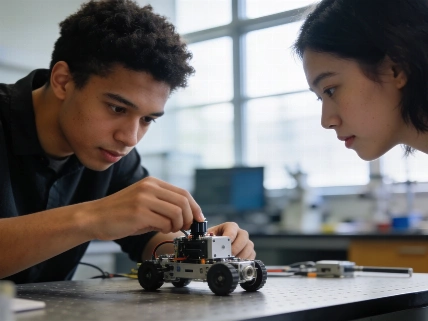
Unlike most academic robotics programs, which often stop at simulation or rely on limited hardware access, the Open Humanoid GYM Project provides selected university and graduate teams with both virtual environments and actual humanoid robots. The first cohort, running from July 21 to August 21, included teams from Gachon University, Seoul National University, Yonsei University, and SeoulTech. Participants were tasked with developing and deploying full-body behaviors, such as obstacle navigation, using the AI Sapiens K1 platform as the core hardware and DYNAMIXEL components for joint actuation.
Each team began by designing motion strategies and control policies in simulation, focusing on areas like reward function tuning and motion generation. Once a behavior was validated virtually, it was transferred to a physical robot for real-world testing. This sim-to-real approach allowed students to observe discrepancies between simulated and actual performance, collect failure data, and iteratively refine their algorithms. The process exposed participants to the practical challenges of transferring AI-driven behaviors from controlled digital environments to unpredictable physical systems-a gap that remains a major obstacle in robotics research and deployment.
ROBOTIS structured the program to include technical mentoring from industry engineers, ensuring that students received guidance on both software and hardware integration. The company also established OH! Seminar! as a parallel initiative, offering technical talks, company tours, and forums for sharing development experiences. This open forum is designed to foster collaboration and knowledge exchange among students, researchers, and industry professionals, rather than isolating development within individual teams.
From Training to Competition
The Open Humanoid GYM Project is not limited to laboratory exercises. ROBOTIS has introduced OH! Challenge! to connect student-developed technologies with real-world competitions, including events in fighting, marathon running, obstacle courses, and soccer. The company plans to provide participants with opportunities to test their robots in competitive settings, where the unpredictability of physical environments and the need for robust control strategies become immediately apparent.
Measured outcomes from the first cohort included successful deployment of obstacle-running behaviors by the Gachon University Graduate School team, who focused on enabling their humanoid to navigate physical barriers. While the company has not released detailed success or failure rates, the program's structure-requiring repeated cycles of simulation, real-world testing, and policy refinement-mirrors best practices in contemporary robotics research. This hands-on approach stands in contrast to earlier industry efforts, such as those described in reported earlier, where unified AI models for home robots were demonstrated primarily in controlled environments.
By combining open-source hardware and software, simulation tools, and direct access to physical robots, ROBOTIS is attempting to lower the barrier for practical humanoid robotics research. The company's approach is notable for its emphasis on open development and industry mentoring, rather than proprietary lock-in or closed demonstration. However, the evidence so far is limited to a single cohort of university teams, and the company has not disclosed independent evaluation or systematic performance metrics. The real test will come as these student-developed behaviors are exposed to the variability and failure modes of public competitions and operational environments.
ROBOTIS' Open Humanoid GYM Project marks a shift in robotics education and research, but it is not a guarantee of rapid progress in humanoid deployment. The company's willingness to provide students with real hardware and open development tools is a welcome departure from closed, demonstration-only models. Yet, without transparent reporting of failure rates, safety incidents, and independent evaluation, the project's broader impact remains unproven. For now, the initiative stands as a promising experiment in bridging the gap between simulation and reality, but its long-term significance will depend on whether it can deliver reliable, transferable skills and robust robot behaviors outside the laboratory.
Sim-to-real transfer is a central challenge in robotics, referring to the process of moving behaviors or control policies developed in simulation into physical robots operating in the real world. Simulations can accelerate development by allowing rapid iteration without risk of hardware damage, but they often fail to capture the full complexity of real environments-such as sensor noise, mechanical wear, and unpredictable obstacles. Effective sim-to-real transfer requires careful modeling, robust control strategies, and extensive real-world testing to ensure that behaviors learned virtually remain reliable and safe when deployed on actual machines.