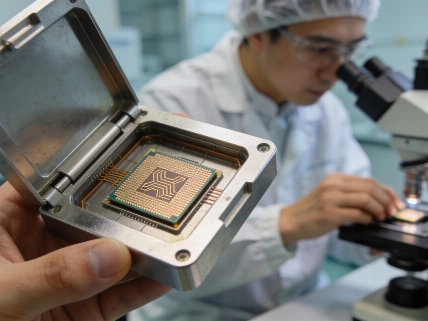

A four-step process aims to help enterprise managers pinpoint where quantum computing could deliver measurable value, avoid hype, and integrate new solutions with existing IT infrastructure
Quantum computing's promise of solving problems beyond the reach of classical machines has triggered a wave of interest among enterprise leaders. Yet the reality is that most organizations remain unsure how to distinguish genuine quantum opportunities from speculative hype-and the cost of missteps is rising as vendors push for early adoption. The real challenge is not just understanding quantum hardware, but identifying where, if anywhere, quantum methods can outperform established classical solutions in a business context.
Pinpointing the Right Problem
For enterprise managers, the first critical step is not to chase quantum for its own sake, but to systematically uncover computational bottlenecks within their own operations. This means mapping out where current algorithms or workflows hit hard limits-such as excessive runtimes, poor accuracy, or outright infeasibility on classical hardware. Only by interviewing technical teams and reviewing application logs can organizations build a concrete list of candidate problems. At the same time, managers must educate themselves on the quantum computing landscape: which modalities exist, what use cases have been credibly demonstrated in their sector, and which vendors or open-source libraries are available for experimentation.
Industry-specific use cases are not always obvious. For example, while quantum algorithms have shown theoretical promise in optimization, chemistry, and machine learning, most practical deployments remain limited by hardware noise, circuit depth, and integration complexity. Reviewing sector benchmarks and staying current with technical reporting-such as the earlier breakdown of silicon spin-qubit engineering-can help filter out overhyped claims and focus attention on tasks where quantum methods might plausibly deliver value.
Evaluating Feasibility and ROI
Once candidate problems are identified, the next step is a rigorous feasibility and return-on-investment assessment. This involves comparing the projected performance of quantum algorithms against the best available classical alternatives. If a classical solution can match or exceed the expected outcome, quantum is unlikely to justify the additional cost and complexity. For each use case, teams must estimate the total cost-including software, hardware access, consulting, and integration-and weigh it against the potential operational benefit.
Building a credible project plan requires assembling a team with both domain and quantum expertise. Some organizations may opt for in-house innovation teams, while others will need to contract external consultants or leverage vendor support. It is essential to investigate the technical maturity of potential quantum providers, scrutinize available application libraries, and ensure that any proposed solution can be integrated with existing IT systems. Budgeting must account for all costs, including machine time, software licenses, and personnel. Only after a detailed plan is in place should the proposal advance to management for approval.
Testing and Integration Challenges
Execution begins with proof-of-concept experiments, typically using simplified "toy" models to minimize resource consumption and accelerate feedback. These models allow teams to test algorithms on different quantum platforms, comparing gate speeds, qubit fidelities, and error rates. Most current quantum hardware remains noisy and limited in scale, so early-stage testing often relies on synthetic data and cross-platform benchmarking. As development progresses, teams must transition to more realistic models and focus on optimizing for a single platform, while continuing to validate accuracy and compatibility.
Integration with existing IT infrastructure is rarely straightforward. Even after a working quantum solution is demonstrated, significant engineering effort is required to ensure compatibility, reliability, and user acceptance. This includes extensive documentation, training for staff not involved in development, and rigorous testing for edge cases and unintended side effects. Ongoing monitoring and iterative improvement are necessary, as user feedback may reveal new requirements or highlight usability issues that were not apparent during initial development.
Limits of Current Quantum Deployment
Despite the structured approach, most enterprise quantum projects remain at the proof-of-concept or pilot stage. Hardware limitations-such as short coherence times, limited qubit counts, and high error rates-constrain the size and complexity of problems that can be tackled. For example, leading superconducting and spin-qubit platforms typically offer tens to low hundreds of physical qubits, with gate fidelities in the 99% range and coherence times on the order of tens to hundreds of microseconds. These figures are insufficient for most error-corrected, large-scale applications, and even for NISQ (noisy intermediate-scale quantum) tasks, classical algorithms often remain competitive.
Organizations that move too quickly risk investing in solutions that cannot be scaled or maintained, while those that wait for perfect hardware may miss early learning opportunities. The most effective strategy is a measured, evidence-led approach: identify real computational pain points, rigorously compare quantum and classical options, and proceed only where the technical and economic case is clear. Quantum technology will not deliver universal advantage overnight, but careful, incremental adoption can position enterprises to benefit as the field matures-without falling prey to hype or premature obsolescence.
Quantum error correction is central to the long-term viability of quantum computing in enterprise settings. Physical qubits are the actual quantum devices-such as superconducting circuits or electron spins-that can be directly manipulated and measured. However, these physical qubits are highly susceptible to noise and decoherence, leading to errors during computation. Logical qubits encode information redundantly across multiple physical qubits using error-correcting codes, allowing the system to detect and correct certain errors. Achieving fault-tolerant quantum computation requires not only high-fidelity gates and long coherence times, but also the ability to scale up the number of physical qubits per logical qubit-often by an order of magnitude or more. Until error correction is reliably demonstrated at scale, most enterprise applications will remain limited to proof-of-concept experiments and hybrid quantum-classical workflows.