France's expanded quantum roadmap sets a 1,000-logical-qubit target for 2032. Alice & Bob reports testing its cat-qubit architecture on three superconducting chips, without publishing performance figures in the available summary
France's revised roadmap now targets 1,000 logical qubits by 2032, raising the bar for companies competing in the government's PROQCIMA procurement program. Managed by the French Defense Innovation Agency (AID) and the Direction générale de l'armement (DGA), the program aims to develop two French universal quantum-computer prototypes, each with at least 1,000 logical qubits and ready for industrialization by 2032. Alice & Bob's Phase 1 report describes hardware tests of the components behind its bosonic cat-qubit approach, but the reported logical error rate has not yet fallen below the error-correction threshold.
Three test chips
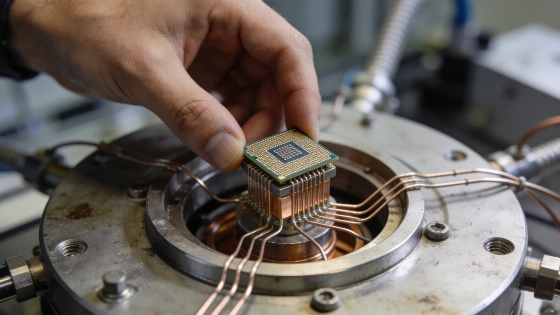
Alice & Bob says it assembled and operated three independent superconducting demonstrators: two built on six-qubit chips and one on a 12-qubit chip. The Phase 1 work, which began in 2024, tested building blocks of its error-correction architecture on hardware. The company also used its MnR software to monitor and recalibrate the qubits. These demonstrators were not a completed processor with 1,000 logical qubits or a report of a useful quantum computation. The company's account of the hardware results was published by HPCwire.
The reported tests included noise-biased CNOT gates between cat qubits, which Alice & Bob says preserved the architecture's built-in protection against bit-flip errors. The team also carried out measurement-and-reset sequences on auxiliary qubits, a step used in reading error syndromes and preparing for another correction cycle. Alice & Bob said the procedure's performance broadly met program targets.
The company also ran several cycles of a three-qubit repetition code and measured the logical error rate across the register. Its report described that rate as not yet below threshold. Alice & Bob additionally reported a non-Clifford gate on a cat qubit, an operation needed for universal fault-tolerant computing and a step toward producing magic states. These results document tests of individual hardware and error-correction components, rather than a demonstrated fault-tolerant processor.
Alice & Bob also built a digital twin of its processor using experimental telemetry. A digital twin is a model informed by data from a real system; here, the stated purpose was to establish the coherence and fidelity parameters needed to operate below the fault-tolerant error threshold. That is a modeling and feasibility step. It does not establish that the chips operated below that threshold.
What the figures show
The reported hardware comprises three demonstrators: two with six qubits each and one with 12. Alice & Bob's account does not give numerical coherence times, fidelity values, or physical error rates. The reported qubit counts therefore describe the size of the demonstrators, while the logical-error measurement and the company's statement that it remains above threshold describe the reported error-correction result.
A chip's qubit count alone does not reveal whether its qubits can support reliable logical operations. A logical qubit encodes information in a way intended to detect or correct errors affecting the underlying hardware. Establishing one requires evidence about error rates and correction performance, not simply a physical-qubit count. The program's target is at least 1,000 logical qubits in each of its two planned prototypes.
The results describe Phase 1 feasibility work on Alice & Bob's cat-qubit architecture. The company reported tests of CNOT operations, measurement and reset, repetition-code cycles, logical-error measurement and a non-Clifford gate. The logical error rate remains above threshold, so these reported tests do not establish fault-tolerant operation.
A procurement stage
PROQCIMA is a 10-year, €500 million ($561 million) French quantum procurement framework managed by AID and DGA. The first phase began in 2024 and received €60 million. The five original candidates were Alice & Bob, Pasqal, Quandela, Quobly and C12. The planned selection process called for three candidates to continue after the first four years and two finalists after eight years.
Pasqal later announced that it would end its participation in the defense program, also known as LSQUARE or PROQCIMA. La Tribune reported the company's decision following its completion of the stated Phase 1 technology goals and its Nasdaq listing. Alice & Bob, C12, Quandela and Quobly remained among the program participants.
Phase 2 is described as a €150 million competitive phase for 2026-2028, with €30 million per company. It is intended to reduce the group to three finalists. After 2030, the program plans to select two industrialization winners, with a target of 2,048 logical qubits. Those are program milestones, not results already achieved by Alice & Bob.
After a May 2026 national quantum strategy update, France accelerated the roadmap from 128 logical qubits to 1,000 by 2032 and doubled the program's annual budget. The change raises the program's stated target; it does not by itself establish that any candidate has demonstrated the required hardware performance.
Model and machine
The digital twin and the chip demonstrators answer different questions. The chips test hardware components; the model uses telemetry to represent processor behavior and help identify required coherence and fidelity parameters. The report describes the digital twin's purpose as establishing parameters for operation below the fault-tolerant threshold.
The distinction between simulation and hardware is familiar in quantum research. A separate simulation study modeled a quantum protocol without running it on a quantum processor. Alice & Bob's account does include chip operation, but its digital twin remains a model, and the reported chip tests do not establish a fault-tolerant computation.
In a cat-qubit error-correction architecture, the central question is whether information can be encoded and protected so that the logical error rate falls below a useful threshold. A threshold depends on the error-correction scheme and measured hardware performance. Alice & Bob's reported results include a logical-error measurement, with the rate still above threshold, alongside tests of the operations used in its architecture.