A live Nvidia GTC Berlin demonstration showed Pollen Robotics' small bipedal machines responding unevenly to commands, while revealing how cloud training and a digital twin contributed to their movement
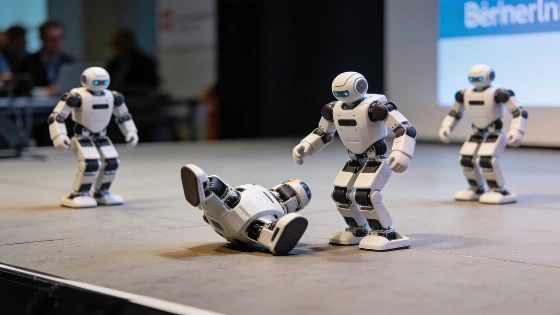
Three of the four robots toppled when Jensen Huang asked them to take a nap. The fourth kept walking before falling onto its side. At Nvidia's GTC Berlin event on Wednesday evening, the small machines later righted themselves after some tumbles, offering a live look at both their physical abilities and their inconsistent responses.
The robots are Microducks, developed by Pollen Robotics. Each is roughly 25 centimeters tall and weighs less than 0.9 kilograms. They walked onto the stage without being carried, then responded to Huang's directions to sit and stand. When he asked them to somersault, a couple managed the movement while others stayed put or needed more encouragement. One wandered farther away, tripped, and got back up before approaching and sitting down when called.
The live demonstration showed several machines responding to spoken instructions, alongside missed commands and falls. Huang guided the sequence, as the robots followed his directions onstage.
Huang said the robots were trained in the cloud using large Nvidia systems, with their movements refined in an Omniverse digital twin running on an RTX Spark machine. The development process combined cloud-based training with refinement in a digital representation of the robots.
Each Microduck has 15 motors distributed across its body. A front camera and a depth sensor provide visual input, while two small inertial measurement units track movement. Its articulated beak can pick up relatively light objects. The robot can also use attached wheels to roller-skate.
The initial offer price was $399 before taxes and shipping, and that batch has sold out. First deliveries are expected by Christmas in North America and Europe. Huang also used the appearance to point to Europe's history of precision engineering, presenting the Microducks as an example.
The demonstration sits apart from work on robots designed for coordinated construction tasks. A report on construction robot teams described University of Stuttgart plans involving timber modules and lightweight space frames; the Microduck appearance instead centered on individual robots following stage instructions.
A digital twin is a software representation of a physical system that can help developers examine or refine behavior. In this case, the movements were refined in a digital twin, while the onstage performance showed the robots moving in a physical setting.