

Pilot tests reported up to a 41.8-fold speedup on memory-bound workloads. The result comes as South Korea prepares a new supercomputer for a planned trapped-ion quantum connection
In pilot tests, memory-bound workloads ran up to 41.8 times faster on Hangang than on earlier A100 GPU clusters, according to the reported benchmark. The result concerns those memory-bound workloads. The system has been inaugurated at the Korea Institute of Science and Technology Information (KISTI) headquarters in Daejeon. KISTI identifies Hangang as South Korea's sixth national supercomputer, with a theoretical peak of 614.7 petaflops and 8,496 GPUs. Its predecessor, Nurion, is cited as having one twenty-fourth of Hangang's peak performance.
KISTI's ScienceON summary places Hangang at approximately 12th globally by measured performance, a separate measure from its 614.7-petaflop theoretical peak. The system is designed to support artificial intelligence, drug development and next-generation battery-materials research. KISTI's planned resource allocation assigns 55% to research-and-development innovation, 30% to national-strategy projects and 15% to industrial innovation.
Memory and throughput
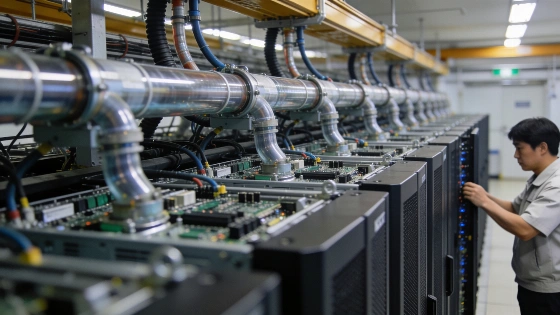
Hangang is a direct-liquid-cooled HPE Cray EX400 built around Nvidia GH200 superchips. Each combines an Arm-based Grace CPU with a Hopper GPU on a coherent package, linked by a 900 GB/s bidirectional interconnect. The operating system sees a unified 576 GB address space, which is intended to keep large molecular simulations and materials calculations within chip memory rather than moving data across a PCIe connection.
That design targets a familiar HPC bottleneck: transferring data between processor and accelerator memory. The 41.8× figure offers an early performance result for memory-bound work.
Quantum connection
The planned hybrid platform follows a trilateral agreement KISTI, Nvidia and IonQ executed in March 2026. Under the roadmap, Hangang is to connect on-site with an IonQ Tempo trapped-ion processor by May 2027, using Nvidia's NVQLink and the CUDA-Q programming environment. KISTI describes the quantum-computer connection as a future integration plan, with the machine's introduction expected around May 2027.
Tempo uses trapped barium ions and provides all-to-all qubit connectivity. That layout can avoid routing SWAP-gate overhead when a calculation maps interactions between non-local Hamiltonian terms. Hangang's GH200 nodes are intended to handle classical data preparation and parameter updates; they will also run post-processing. Structured quantum subroutines, including molecular electronic-structure ground-state calculations, are planned for execution on Tempo.
The national infrastructure focus differs from the UK's space-oriented quantum planning, which links domestic investment with flight qualification in a separate roadmap.
Funding and access
Hangang is part of the government's K-Moonshot initiative, backed by ₩10.1 trillion (about $7.5 billion) in 2026 AI research and development funding. The programme targets 12 national challenges, including battery-materials discovery and clean energy; quantum computing is another stated priority.
After pilot trials serving approximately 190 projects, full production access is scheduled to begin on December 14, 2026. KISTI's ScienceON summary also gives December 2026 as the planned start of operational service. The plan allocates 15% of the system's compute footprint to small and medium enterprises and commercial startups. Hangang's overall allocation plan divides resources among research-and-development innovation (55%), national-strategy projects (30%) and industrial innovation (15%).
KISTI's ScienceON summary identifies AI, pharmaceuticals and advanced battery materials among Hangang's intended application areas. It also notes GPU procurement and development of South Korea's domestic supercomputing ecosystem as continuing challenges.







