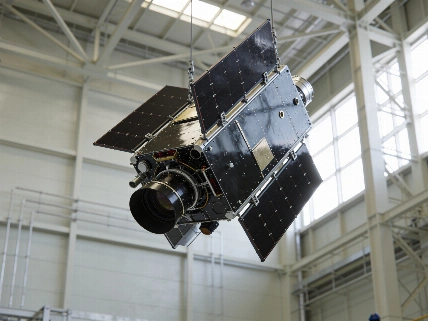
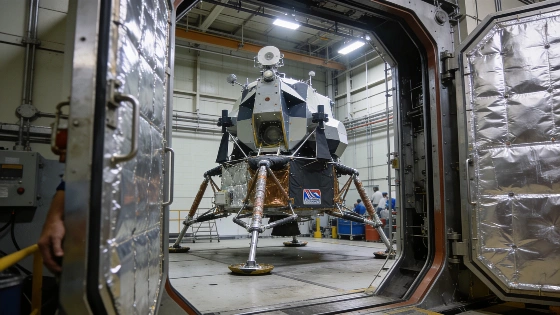
Voyager Technologies' Griffin-1 has completed thermal-vacuum, vibration, acoustic and electromagnetic checks at NASA's Jet Propulsion Laboratory. The lander is moving toward final assembly and a planned December 2026 launch on a SpaceX Falcon Heavy, carrying 10 science and technology payloads toward the lunar South Pole.
Griffin-1 has completed a demanding round of environmental tests at NASA's Jet Propulsion Laboratory, a milestone in preparations for a planned lunar cargo mission. Voyager Technologies announced the completion of acceptance testing on October 13, 2026. The results document the lander's performance under specified ground-test conditions; the spacecraft has not yet launched or landed on the Moon.
The lander spent about two weeks in JPL's 25-Foot Space Simulator, a thermal-vacuum chamber that exposes spacecraft to low-pressure conditions and sharply changing temperatures. Griffin-1 was heated to about 75 degrees Celsius and cooled to minus 100 degrees Celsius to simulate temperature extremes encountered in space and during lunar operations.
The chamber is part of a facility with a long history of testing planetary spacecraft. Its earlier work included support for Ranger, Surveyor, Mariner and Voyager missions; later projects included the Perseverance Mars rover and Europa Clipper. Griffin-1's own test campaign included thermal-vacuum, vibration, acoustic and electromagnetic checks.
Thermal-vacuum testing checks whether a spacecraft can tolerate temperature changes in an environment without air. Passing the test records how the vehicle performed under those conditions; it does not establish how it will perform in every phase of flight or on the lunar surface.
Engineers also subjected Griffin-1 to mechanical and acoustic tests. A shaker table applied vibration in three directions while hundreds of sensors monitored the spacecraft. In a separate sealed chamber, compressed-nitrogen-powered horns produced sound levels of up to 153 decibels to reproduce the intense noise of launch.
Inside an anechoic chamber, the team assessed electromagnetic interference and compatibility, checking whether electrical systems could operate without disrupting one another. Engineers also spun the lander on a specialized table to measure its mass properties and check for imbalance, data used to characterize spacecraft motion and support navigation and landing planning.
Griffin-1 weighs 1,265 kilograms. During the reported test campaign, it experienced temperatures ranging from 75 degrees Celsius to minus 100 degrees Celsius, and acoustic testing reached 153 decibels. These figures describe test conditions, not measurements of conditions the lander will encounter at every point in its mission.
Griffin-1 is being prepared through NASA's Commercial Lunar Payload Services (CLPS) program, which contracts with U.S. companies to deliver scientific and technological payloads to the Moon. NASA's Moon Base plans describe an initial phase of robotic exploration and technology demonstrations running from 2026 through 2029. Griffin-1 is intended to deliver cargo to the lunar South Pole as part of that effort.
The mission is planned to carry 10 science and technology payloads from six countries, including Astrolab's FLIP, or FLEX Lunar Innovation Platform, described as the largest commercial payload planned for delivery to the lunar surface. Other planned cargo includes Astrobotic's CubeRover and additional commercial and government experiments. The mission is expected to deliver more than 1,100 pounds of payload.
Griffin was originally developed for a NASA mission to deliver the VIPER rover. After NASA canceled VIPER, the lander continued in preparation for a separate demonstration mission with a new payload manifest. The mission is expected to target Mons Mouton near the western edge of Nobile Crater, close to the lunar South Pole.
The lander is scheduled to return after JPL testing to Voyager Lunar Systems' facility in Pittsburgh for final assembly, before shipment to Cape Canaveral, Florida. A December 2026 launch aboard a SpaceX Falcon Heavy is planned, although the exact date remains unsettled. The planned launch and landing are future mission events; the completed tests are ground qualification activities.
The lander's intended role is to transport equipment and demonstrations, rather than to establish that a lunar outpost is already operating. Work on materials for future lunar habitats has also explored using simulated lunar dust in composite materials, as described in lunar materials research. Griffin-1's mission is distinct: delivering payloads to the lunar surface.
After final assembly, launch-readiness operations and shipment to Cape Canaveral are planned ahead of the targeted launch. Environmental tests expose hardware to controlled stresses, while flight, lunar descent and surface operations remain subsequent mission stages.